
A surety bond is a three-party promise that a specific obligation will be met. In simple terms, a surety company guarantees that one party will fulfill their duty to another. If they fail, the surety covers the financial loss. This is the core concept behind many legal and business agreements, including securing a person's release from jail with a bail bond in Forsyth County, GA.
For families needing help in Cumming, Alpharetta, or Johns Creek, understanding this concept is the first step. A bail bond agent, acting for a surety, provides the court with a financial guarantee, allowing your loved one to be released quickly and discreetly.
Understanding a Surety Bond in Simple Terms
At its heart, a surety bond is a financial safety net built on a straightforward three-party agreement. Every surety bond involves the same three roles, whether it's for a construction project or a bail bond.
Let's break down who is involved.
The Three Parties in a Surety Bond Agreement
This table shows the key players and their roles, both in a general sense and how it applies directly to a bail bond.
| Party | Role in a General Surety Bond | Role in a Bail Bond |
|---|---|---|
| The Principal | The person or company required to get the bond and fulfill an obligation. | The defendant who has been arrested. |
| The Obligee | The entity protected by the bond, ensuring the Principal's obligation is met. | The court system, which requires a guarantee the defendant will appear for court dates. |
| The Surety | The company that issues the bond and financially backs the Principal's promise. | The bail bond company that guarantees the full bail amount to the court. |
Understanding these three roles clarifies how the process works. The surety provides the financial backing that gives the obligee (the court) the confidence it needs to trust the principal (the defendant).
How This Applies to Bail Bonds
When someone is arrested in Cumming, Alpharetta, or Johns Creek, the court sets a bail amount as a condition of release. A bail bond agent, working for a surety company, gives the court a surety bond.
This bond is a legally binding promise that the full bail amount will be paid if the defendant fails to appear for their court dates. In exchange for this guarantee, you pay a non-refundable fee to the bail bond agent. This process allows the court to release an individual with confidence and gives families a manageable way to bring someone home.
For a deeper dive into this specific process, you can learn more about what bail bonds are and how they function.
How a Surety Bond Works for Bail in Georgia
When a judge in Forsyth County or Hall County sets bail, you have two choices: pay the full bail amount in cash to the court, or use a bail bond—a specific type of surety bond. For most families, the second option is the most practical path.
Instead of needing thousands of dollars immediately, you work with a bail bond agent. You pay a non-refundable fee, which is a small percentage of the total bail. In exchange, the agent's surety company provides the court with a financial guarantee for the full bail amount.
This arrangement satisfies the court's requirements and allows the defendant to get out of jail and return home while awaiting trial. It is a critical service that makes the release process accessible for families in Cumming, Alpharetta, and Johns Creek.
The diagram below breaks down the relationship between the defendant (Principal), the court (Obligee), and the bail bond company (Surety).
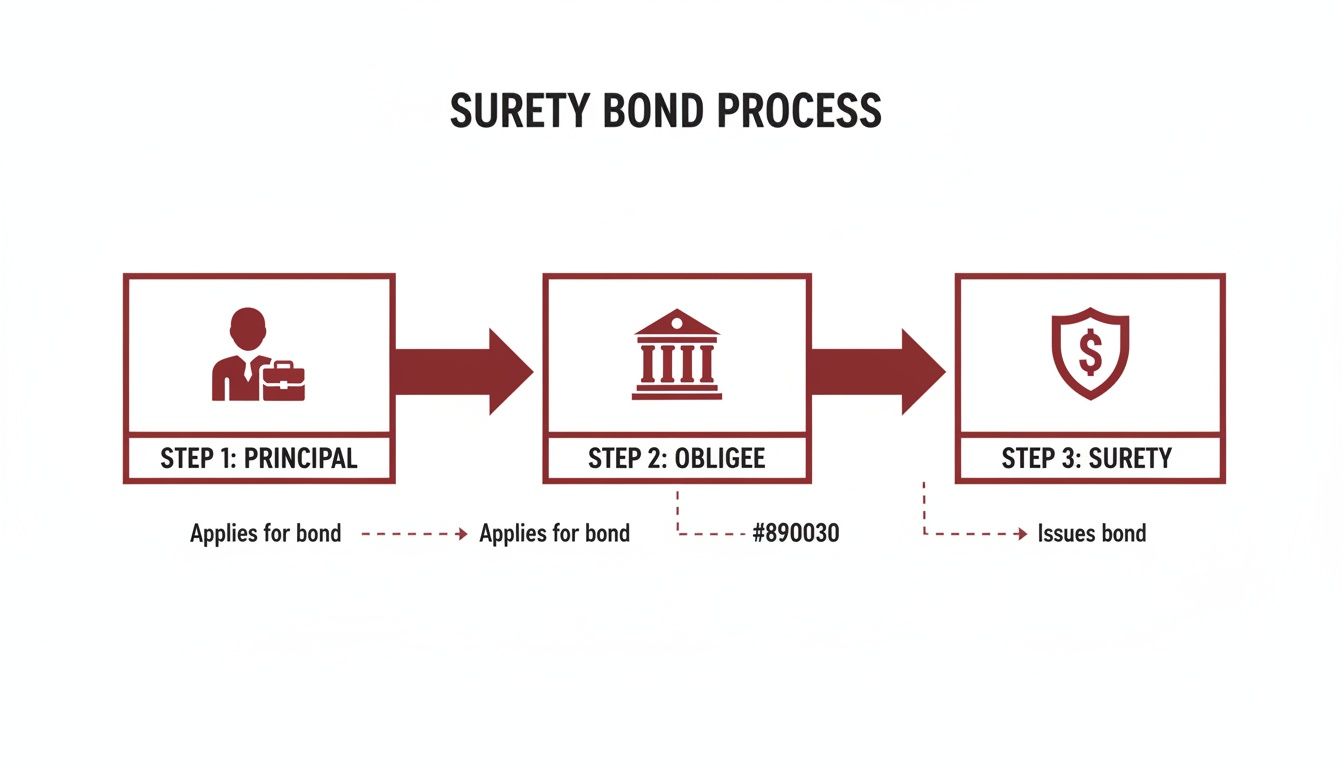
The surety company acts as a professional guarantor, giving the court the confidence it needs to release the person from custody.
The Bail Bond Process Step-by-Step
A bail bond is focused on one thing: ensuring the defendant appears for all required court dates. The process is designed to be fast and straightforward, especially when you are under pressure.
Here is what to expect:
- Make the Call: Contact a 24/7 bail bond agent and provide basic information about the person in jail—their name, date of birth, and where they are being held.
- Handle the Paperwork: The agent will explain the fee and walk you through the necessary forms. This can often be handled over the phone to speed up the process.
- Post the Bond: Once the agreement is in place, the agent goes to the jail in Forsyth County, Hall County, or another North Metro Atlanta location and posts the bond with the authorities.
- Get Them Home: The jail staff processes the bond and begins their internal release procedures. A short time later, the defendant is released.
The most important responsibility for the defendant and any co-signers is to ensure every court appearance is met. The surety bond remains in effect until the case is fully resolved.
The Role of a Co-Signer
Most bail bond agreements require a co-signer, also called an indemnitor. This is a responsible individual who agrees to financially back the bond.
A co-signer has two main responsibilities:
- Ensuring Court Appearances: They take on the duty of making sure the defendant gets to all court dates.
- Financial Liability: If the defendant fails to appear in court, the co-signer is legally responsible for repaying the bail bond company the full bail amount.
This is a serious commitment. Our agents take the time to explain these duties clearly. Understanding the co-signer's role is a crucial part of the process.
For a complete overview, you can learn more by reading about how bail bonds work in Forsyth County. Our goal is to provide the information you need to move forward with confidence.
Exploring Other Common Types of Surety Bonds
While a bail bond is what we handle in the justice system, the core concept—a financial guarantee—is used in many other areas. Seeing how these other bonds work helps clarify why the surety model is so trusted. A bail bond is part of a widely accepted system for ensuring people uphold their promises.
The surety system is a significant part of the global economy, appearing in business deals, legal judgments, and even simple business licensing. Contract bonds for large construction projects make up the largest segment (over 58%), but commercial bonds are also common as more businesses need them to meet government rules. For more details, you can review the full global surety trends report.

Contract Bonds for Construction
Contract bonds are the financial backbone of the construction industry, guaranteeing that projects are completed as specified.
- Performance Bonds: This type ensures the contractor finishes the job according to the plans. If they fail, the surety company steps in to find a new contractor or pay the project owner for the loss.
- Payment Bonds: This bond ensures the main contractor pays subcontractors and suppliers. It protects the project from legal issues arising from unpaid workers.
These bonds provide the security needed for large projects to proceed, protecting both public and private investments.
Commercial Bonds for Businesses
Commercial bonds are a broad category, often required by government agencies for a business to operate. They ensure a company operates honestly and follows the law.
For example, an auto dealer in Georgia must obtain a commercial surety bond to be licensed. This protects customers from fraud. Other examples include bonds for notaries public, mortgage brokers, and licensed contractors. A commercial surety bond serves as a business's promise to the public to follow the rules.
Court Bonds in Civil Cases
Courtrooms use more than just criminal bail bonds. In civil cases—disputes between individuals or companies—other surety bonds called judicial bonds are used. They ensure people follow a judge's orders.
- Appeal Bonds: If a party loses a lawsuit and is ordered to pay a large sum, they may need to post an appeal bond to appeal the decision. It guarantees the judgment will be paid if they lose the appeal.
- Fiduciary Bonds: These are for people in positions of trust, such as an estate administrator or a guardian. The bond protects assets from mismanagement.
Each of these examples reinforces the same point: a surety bond is a tool for building trust and ensuring accountability.
The Key Difference Between a Surety Bond and Insurance
It is a common misconception that a surety bond is a form of insurance. While they may seem similar, they operate on different principles. The most important distinction is who the product is designed to protect.
An insurance policy is a two-party deal. You pay a premium to an insurance company, and they agree to cover your losses if something goes wrong, like with car insurance.
A surety bond is a three-party agreement. It does not protect you, the person paying for it. It is a guarantee you provide to someone else (the “obligee”) that you will fulfill a promise. The bond protects them if you fail.
Purpose and Protection
Insurance and surety bonds have opposite goals. Insurance is about managing risk. Insurance companies expect a certain percentage of customers to file claims and build those expected losses into their premiums.
Surety bonds are designed to prevent loss. A surety company does not expect to pay out a claim. Before issuing a bond, they carefully screen the person or business (the “principal”) to ensure they can meet their obligation. For bail bonds in Forsyth County or Hall County, the surety is vouching for the defendant's promise to appear in court.
A simple way to think about it: Insurance protects you from your own losses. A surety bond protects someone else from your failures.
Financial Responsibility After a Claim
If you have a car accident and file a claim, your insurance company pays the bill (minus your deductible), and the matter is settled. The insurer absorbs that financial loss.
With a surety bond, the process is different. If the principal fails to fulfill their obligation and the surety company has to pay a claim, the story is not over. The surety then requires the principal to reimburse them for the full amount paid out, plus any legal fees. This is why a bail bond functions more like a line of credit than an insurance policy. The fee you pay is for the service of the financial guarantee—it does not transfer the ultimate financial responsibility from you.
Surety Bond vs. Insurance Policy at a Glance
This chart compares the key features of both financial products side-by-side.
| Feature | Surety Bond | Insurance Policy |
|---|---|---|
| Parties Involved | Three (Principal, Obligee, Surety) | Two (Insured, Insurer) |
| Purpose | Guarantees performance of an obligation. | Protects against personal financial loss. |
| Who is Protected | The Obligee (e.g., the court). | The Insured (the person paying). |
| Loss Expectation | Losses are not expected. | Losses are expected and priced in. |
| Claim Repayment | Principal repays the Surety for any losses. | Insurer absorbs the loss. |
Understanding this distinction is key in a bail situation. You are not buying a policy to cover a loss; you are securing a guarantee to ensure a promise is kept.
What You Need to Secure a Bail Bond Now
When you need help, there is no time to waste. Having the right information ready makes the bail bond process faster. A straightforward approach allows us to start working on the release immediately.
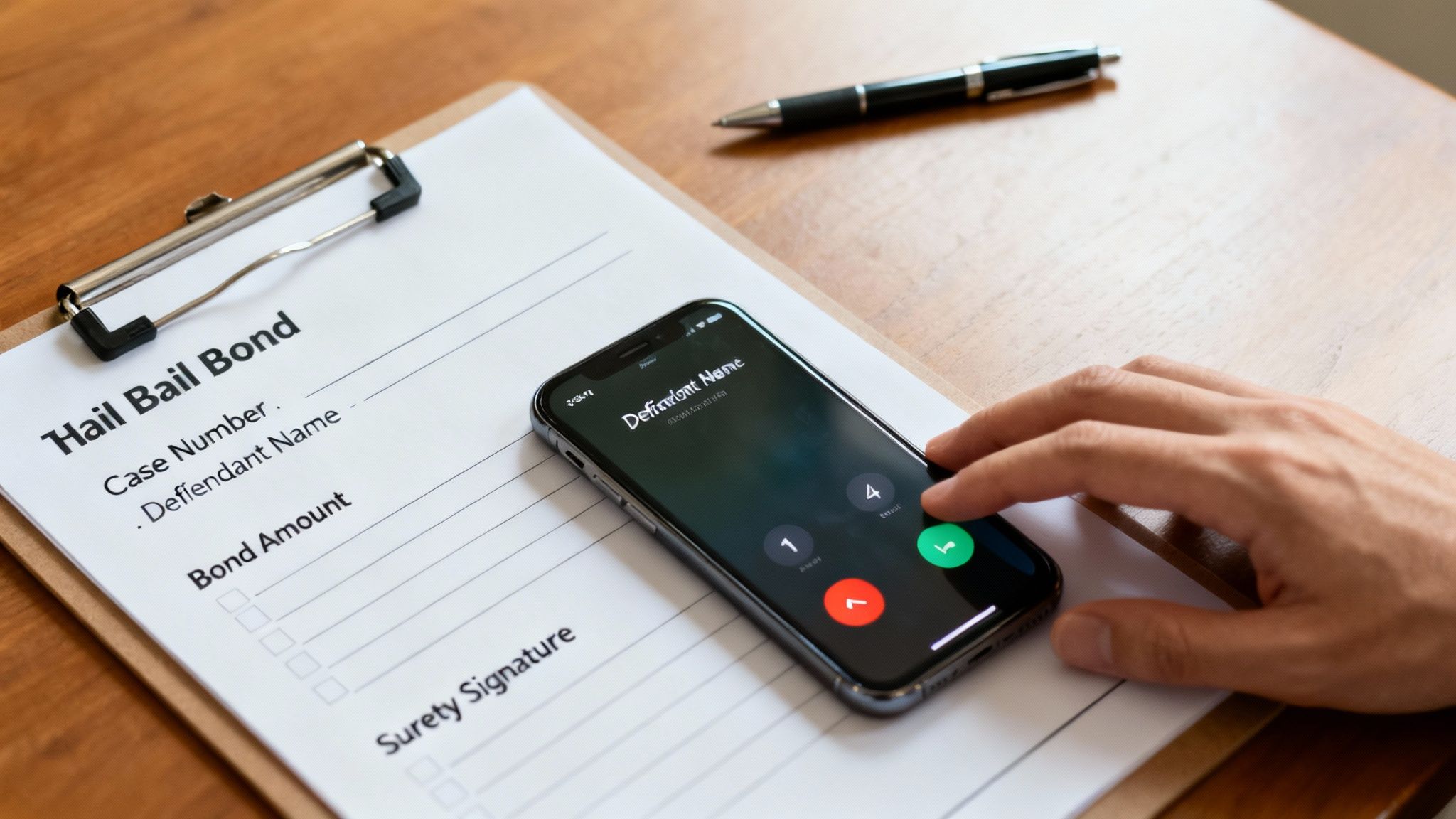
The process can begin with a single phone call. Our goal is to gather the essential details efficiently so we can file the bond with the court in Forsyth County or Hall County without delay. We are available 24/7 to answer your call and guide you through these simple steps.
Information We Need to Start
To begin the process, we need a few key pieces of information. Please have these details ready when you call:
- Defendant's Full Name: The complete and correct legal name.
- Defendant's Date of Birth: This helps confirm their identity with the jail.
- Location of Incarceration: The name of the jail where the person is being held (e.g., Forsyth County Jail or Hall County Jail).
- Total Bail Amount: If you know the exact amount set by the court, it helps us calculate the premium immediately.
Having this information ready allows our agents in the Cumming, GA area to work fast. Our local knowledge of the jail systems helps us navigate the process quickly, but starting with accurate information is the most critical first step.
Understanding the Co-Signer's Role
Nearly every bail bond requires a financially responsible co-signer, also known as an indemnitor. This person is a crucial part of the agreement, as they provide a financial guarantee. It is important for any co-signer to fully understand their commitment.
By co-signing, you accept financial liability for the full bail amount. Your primary duty is to ensure the defendant appears at all required court dates until the case is resolved. This is a serious responsibility. We will walk you through these obligations clearly over the phone to ensure you can make an informed decision before signing any paperwork.
Our focus is to make this process as clear and manageable as possible for families in Alpharetta, Johns Creek, and across North Metro Atlanta. Call us now to get started.
Answering Your Urgent Questions About Bail Bonds
When you are under pressure, you need direct answers. This section addresses the most common questions we hear from families across Forsyth County and Hall County. Our goal is to provide clear, practical information about your options.
This is for general information, not legal advice. For legal strategy, you should always consult with an attorney.
How Much Does a Bail Bond Cost in Georgia?
The cost of a bail bond is a non-refundable fee, known as the premium. This is our service fee for guaranteeing the full bail amount to the court. The premium is calculated as a percentage of the total bail amount set by the judge. The final cost depends on the specifics of the case and the bond amount. We provide a clear, upfront cost with no hidden fees, so you know exactly what to expect.
How Long Does Release from Jail Usually Take?
Getting someone released from jail is a two-part process. The first part is on us: completing the paperwork and posting the bond at the jail. We are available 24/7 to start that process immediately.
Once we post the bond, the jail begins its own internal release procedures. This part can vary depending on how busy the facility is. While we cannot control the jail's processing speed, our familiarity with the facilities in Cumming and Gainesville means we get everything submitted correctly, preventing unnecessary delays.
What Does It Mean to Co-Sign a Bail Bond?
A co-signer, or indemnitor, is someone who agrees to take financial responsibility for the bail bond. When you co-sign, you make a legally binding promise with two important obligations. As a co-signer, your primary responsibilities are to ensure the defendant appears for every single court date and to cover the full bail amount if they do not. This is a serious commitment. We take the time to walk you through the agreement so you can make a fully informed decision.
Is Collateral Required to Get a Bail Bond?
Not always. Many bail bonds can be secured without collateral. This often depends on the size of the bond, the financial stability of the co-signer, and the details of the case. Our goal is to find the simplest path to get someone released. For very large bonds, collateral may be necessary, such as real estate or a vehicle title. We will assess your situation and discuss all available options, including whether collateral is needed for your case in Alpharetta, Johns Creek, or nearby communities.
If you need help with bail bonds in Forsyth County, Hall County, or the surrounding North Metro Atlanta area, our agents are ready to assist. At One Call Bail Bonds, we provide a simple process and clear guidance to help you get someone released fast.
Call us now for a confidential consultation. We are available 24/7. https://onecallforsyth.com