
When someone calls in a panic after a loved one has been released and then misses court, the first question is usually simple and scared: what happens now?
The short answer is that the bail bond doesn’t just disappear. The court expects the defendant to appear. If they don’t, the bondsman is exposed to a serious financial loss under the bond agreement. That’s where people start hearing a term that sounds dramatic but is a normal part of the bail business: fugitive recovery agent.
If you’ve been searching for bail bonds near me, 24 hour bail bonds near me, or help with a missed court date in Forsyth County, it helps to understand what this role is and why it exists. A fugitive recovery agent is not a random person chasing people down. In the bail world, this is a hired professional working under the authority of the bail bond company to locate and return a defendant who violated the bond terms.
Families often feel two things at once in this situation. They want to help the person get back on track, and they’re worried about what the bondsman is going to do. Both concerns are understandable. The process is serious, but it’s also more structured and more professional than commonly understood.
When the Bail Bond Process Takes an Unexpected Turn
A common situation looks like this. Someone gets arrested in Cumming, Dawsonville, Alpharetta, or Suwanee. A family member arranges a bond because they need fast jail release and can’t wait around for the case to work itself out. The defendant gets out, goes home, and everyone thinks the worst part is over.
Then a court date gets missed.
Sometimes it’s panic. Sometimes it’s addiction, fear, or bad advice from friends. Sometimes the defendant thinks one missed appearance can be fixed later. In the bail business, that mistake changes everything quickly. The court can move toward forfeiture, and the bondsman who guaranteed the release is now at risk of losing the full amount covered by that bond.
That financial risk is the reason a fugitive recovery agent exists in the first place. This isn’t a side issue. It’s built into how bail works.
Why the bondsman gets involved fast
A bail bond company doesn’t lend moral support. It takes on legal and financial responsibility for the defendant’s appearance. Once the person fails to appear, the bondsman has to act.
That action often starts with basic outreach:
- Direct contact: Calls, texts, and messages to the defendant.
- Family contact: Reaching out to indemnitors or relatives who signed paperwork.
- Court review: Confirming the missed appearance and the bond status.
- Recovery planning: Deciding whether a fugitive recovery agent needs to be assigned.
A missed court date doesn’t just create a court problem. It creates a bond problem.
For families, this part feels personal. For a professional bondsman, it’s operational. The bond company is trying to get the person back before the loss becomes permanent.
What families should understand early
The term skipping bail gets used loosely, but in practice it usually means the defendant violated the agreement by not appearing as required. Once that happens, the bondsman may bring in a recovery agent whose job is focused and narrow: find the defendant and return them to custody.
That’s why the answer to what is a fugitive recovery agent matters to regular people, not just people in the trade. If you’re trying to post bail, need emergency bail bonds, or want to avoid making a bad situation worse, you need to know what role each person plays and what the legal realities are.
What a Fugitive Recovery Agent Actually Does
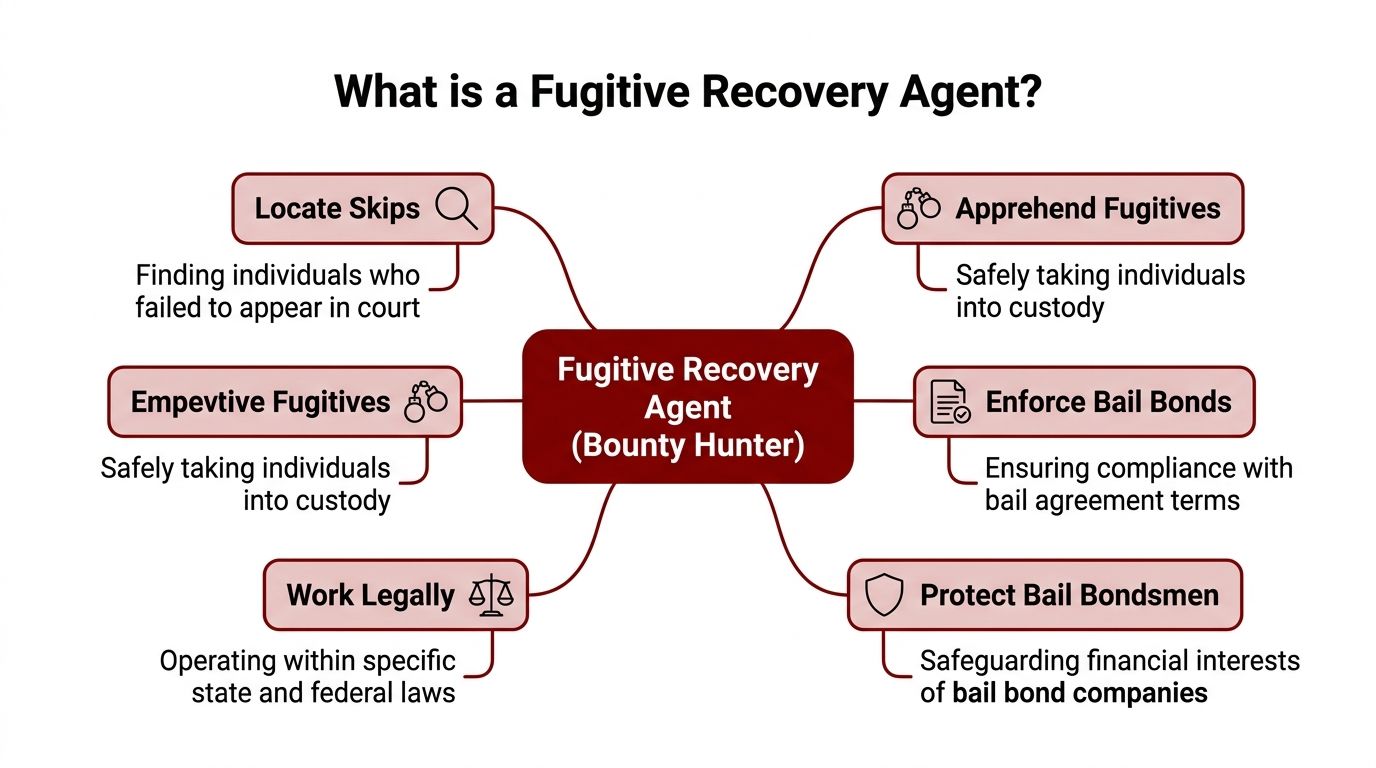
A fugitive recovery agent, also called a bail enforcement agent or bounty hunter, is a private contractor hired by a bail bond company to locate and apprehend a defendant who violated the terms of release. The job is not general crime fighting. It is not open-ended investigation. It is a targeted recovery assignment tied to a specific bond.
Think of the role like a recovery specialist for the bondsman’s risk. The court allowed release. The bondsman guaranteed appearance. The defendant broke that agreement. The recovery agent is brought in to fix that break before the bondsman takes the full hit.
The job is narrower than most people think
A professional recovery agent usually handles a defined set of tasks:
- Locate the defendant: Find where the person is staying, working, hiding, or traveling.
- Confirm identity: Make sure the right person is being tracked before any contact is made.
- Coordinate legally: Work under the authority granted through the bond relationship.
- Take the person into custody: Return the defendant so the bond issue can be addressed.
This is why families shouldn’t confuse a fugitive recovery agent with a private investigator or a police officer. The authority comes from the bail framework, and the assignment exists because the bond company has direct financial exposure.
Why the role is used in the industry
This isn’t a fringe piece of the business. It’s a core operational function. According to AboutBail’s overview of how fugitive recovery works, U.S. bounty hunters capture between 88% and 91% of fugitives they pursue, and the National Association of Fugitive Recovery Agents reports that its members apprehend more than 30,000 fugitives annually.
Those figures matter because they explain why bondsmen rely on recovery agents rather than treating a missed court date as a dead loss. The recovery system exists because it works.
Practical rule: A fugitive recovery agent is hired to solve one problem. A defendant was released on bond and didn’t show up when required.
What doesn’t work
Movies teach people the wrong lessons. Loud confrontations, reckless force, and improvised tactics create legal trouble and safety risks. Good recovery work is more disciplined than dramatic.
What tends to work is patience, documentation, verified information, and controlled contact. A seasoned bondsman wants an agent who can bring a defendant back without creating a second crisis.
How Fugitive Recovery Agents Find and Apprehend Skips
Most recoveries don’t start with a chase. They start with skip tracing.
That means building a current picture of where the defendant is likely to be, who they trust, and what routines they’ve fallen back into since missing court. A skilled agent works from paperwork, contacts, public information, and observation. The point is to narrow the field before making any approach.

Skip tracing starts with relationships
A lot of defendants don’t vanish as cleanly as they think they do. According to the California Department of Insurance page on Bail Fugitive Recovery Agent requirements, 70% to 80% of fugitives initially relocate to the homes of family or friends, often within a 100-mile radius.
That’s why experienced agents look hard at familiar people and familiar places first.
Common starting points include:
- Family homes: Parents, siblings, partners, or cousins
- Close friends: Especially anyone who has helped before
- Known routines: Work sites, hangouts, recurring errands
- Digital trails: Public social activity and contact patterns
A missed court date can also lead to a bench warrant and related legal consequences, which is one reason quick action matters.
Surveillance is about confirmation, not drama
Once an agent has a likely location, surveillance often comes next. The point isn’t spectacle. It’s verification.
An agent needs to know things like whether the defendant is really there, whether children are present, whether there’s a safe moment to make contact, and whether a peaceful surrender is realistic. That kind of preparation reduces mistakes.
Most successful recoveries look boring from the outside. That’s a good sign.
Apprehension usually goes best when tempers stay low
Professional agents are trained to use communication, pressure, and timing. The same California guidance notes that agents often use negotiation to de-escalate and secure a peaceful surrender. That matters because force creates risk for everyone involved, including family members who may be caught in the middle.
What usually helps:
- Clear contact with the defendant
- A direct explanation of the situation
- An orderly surrender plan
- Minimal surprise and minimal resistance
What usually hurts is family interference, bad information, or someone trying to “buy more time” by helping the defendant hide. That turns a manageable bond problem into a deeper legal one very quickly.
The Legal Landscape for Fugitive Recovery in Forsyth County
Georgia families are often surprised by how much of this process turns on the bond contract itself. A recovery agent’s role doesn’t appear out of nowhere. It comes from the bail relationship created when the defendant accepted release through a bondsman.
In practical terms, that means a defendant who signs bond paperwork has already agreed to conditions that can come back into play if they fail to appear. That’s one reason the legal position of a fugitive recovery agent is different from the position of an ordinary private citizen.
Georgia is not the same as every other state
People hear “bounty hunter” and assume the rules are uniform everywhere. They aren’t. As noted in Indeed’s overview of how to become a fugitive recovery agent, authority varies significantly by state, and some states, including Kentucky and Illinois, prohibit private fugitive recovery.
That matters in North Georgia because defendants don’t always stay local. If someone released in Forsyth County crosses a state line, recovery may stop being straightforward. A lawful recovery in one state can become a legal mess in another if the restrictions are ignored.
If you’re dealing with travel while a case is pending, it helps to understand whether you can leave the state on bond before a problem starts.
Why reputable bondsmen care about boundaries
A good bondsman doesn’t just want a defendant returned. The bondsman wants that done legally, safely, and in a way that won’t expose everyone to unnecessary liability.
That means paying attention to issues like:
- State restrictions: Especially if the defendant may be in a restricted jurisdiction
- Written authority: The recovery agent needs to be acting under proper authorization
- Local coordination: Some situations call for communication with local law enforcement
- Professional restraint: Not every lead should turn into an immediate contact attempt
A missed court date is stressful enough. Sloppy recovery work creates more trouble than it solves.
What families in Forsyth County should take seriously
Georgia operates under bounty hunter laws that allow agents to work with a bondsman’s contract. At the same time, families should understand that professionalism matters even more where statewide uniform certification is limited. The right question isn’t just “Can someone go pick him up?” The better question is whether the bondsman uses people who understand lawful entry, safe detention, documentation, and interstate limits.
When a defendant stays in Georgia, recovery is often more manageable. When a defendant crosses into a restrictive state, legal planning matters as much as locating the person.
A family member trying to “smooth things over” informally can make matters worse. So can posting online about where the defendant is going, warning them that the bondsman is looking, or moving them from house to house. Those choices may feel protective in the moment, but they increase risk for everybody tied to the bond.
The practical trade-off
The legal powers tied to fugitive recovery can be broad, but broad authority doesn’t mean unlimited judgment. The best operators use the least disruptive path that gets the defendant back into custody. That protects the bond, reduces safety problems, and gives the defendant the best chance to address the court issue before things snowball further.
Bounty Hunter vs Private Investigator vs Police Officer
These roles get mixed together all the time, but they are not the same. Each one answers to a different source of authority, and each one has a different mission.
A fugitive recovery agent is focused on one named defendant tied to a bond. A private investigator gathers information for a client but doesn’t carry special recovery powers from a bond contract. A police officer acts under government authority and enforces criminal law generally, not just bond violations.
Role comparison
| Role | Authority Source | Primary Goal | Arrest Power |
|---|---|---|---|
| Fugitive Recovery Agent | Bail bond contract and bondsman authorization | Locate and return a defendant who violated bond conditions | Related to the recovery of the bonded defendant |
| Private Investigator | Client engagement and general civil investigative authority | Gather information, verify facts, conduct surveillance | No special arrest authority beyond what an ordinary citizen may have |
| Police Officer | State or local government authority | Enforce laws, investigate crimes, maintain public safety | Full law enforcement arrest authority within legal limits |
Why the differences matter in real life
Families sometimes call the wrong professional because they misunderstand the problem.
If your issue is finding a witness, documenting infidelity, checking a business partner, or locating assets, that sounds like private investigation work. If your issue is that a defendant got out on bond and then disappeared, that points back to the bondsman and, if needed, the bondsman’s recovery process.
If there’s active danger, a new crime, or an emergency, that belongs with law enforcement.
A private investigator may help you find information. A fugitive recovery agent is part of the bond enforcement process.
The practical mistake people make
The biggest mistake is treating these jobs as interchangeable. They’re not. Hiring the wrong person wastes time and can create legal trouble.
Here’s the clean way to understand it:
- Bond problem: Call the bondsman.
- General investigation problem: Call a private investigator.
- Immediate public safety problem: Call police.
That distinction saves time, avoids confusion, and gets the matter to the right hands from the start.
Your First Step Should Always Be a 24 Hour Bail Bondsman
Families don’t hire fugitive recovery agents directly in the normal course of a bail case. The process begins with the bail bondsman, because the bond company is the party that took on the financial risk in the first place.
That point matters whether you’re searching for 24 hour bail bonds Cumming, emergency bail bonds Alpharetta, fast jail release Forsyth County, or help with a missed appearance after release. The bondsman is the central point of contact before release, during the bond period, and after a failure to appear.
Why the bondsman controls the process
According to the ALEC model policy language on bail fugitive recovery persons, the bail bond agreement shifts the financial risk of the defendant’s release from the court to the surety, and that contractual relationship is what gives the bondsman the right to hire a recovery agent if the defendant fails to appear.
That means the recovery agent doesn’t operate as a free agent. The authority is explicitly granted through the bondsman.
If you want a plain-language overview of the role, this guide on what a bail bondsman does is a good starting point.
What to do when time matters
If your loved one has just been arrested, focus on the release first. If your loved one has already missed court, focus on communication and damage control. In both situations, the smart first move is the same: get a bondsman involved immediately.
What helps most in an urgent call:
- Defendant’s full name: Make sure it matches jail or court records
- Location details: Which jail, court, or county is involved
- Charge information: Especially if this is a DUI bail or another urgent criminal matter
- Co-signer readiness: Know who can speak and sign if needed
What doesn’t help is waiting for “business hours,” assuming the court date can be fixed casually, or trying to solve a bond violation through side conversations with friends. Emergency cases move better when one professional has the full picture and can direct the next step.
Why this matters for local search intent
People searching bail bonds Forsyth County, affordable bail bonds, no collateral bail bonds, or warrant assistance usually want one thing. They want someone who answers quickly, knows the local process, and can move the file forward without adding confusion.
A recovery agent may become part of the picture later. But the first call should still be to a qualified, available bondsman who can tell you exactly where the case stands and what happens next.
Forsyth County Bail Bonds FAQ
What happens after someone misses court in Forsyth County
The court issue and the bond issue both become urgent. The defendant may face a warrant, and the bondsman may need to act to protect the bond. The fastest way to reduce damage is to contact the bondsman immediately and stop guessing.
Can I hire a fugitive recovery agent myself
In a bond case, that’s generally not how the process works. The bondsman manages recovery because the bondsman carries the financial exposure and controls the bond relationship.
How do I get fast jail release in Forsyth County
Have the defendant’s full name, booking location, and basic case details ready before you call. Delays usually come from missing information, unavailable co-signers, or confusion about where the person is being held.
Do no collateral bail bonds exist
Sometimes they do, depending on the case, the defendant, the co-signer, and the risk review. This is a case-by-case decision, not something anyone should assume before speaking with a bondsman directly.
What if the person has a warrant
Treat it seriously and move quickly. Don’t rely on rumors about whether the warrant is “active enough to matter.” If you need warrant assistance, get accurate information from a bondsman or attorney and make decisions based on confirmed facts.
Why does the bondsman’s choice of recovery agent matter in Georgia
As noted by the Tennessee Association of Professional Bail Agents material on recovery agents, Georgia allows agents to work with a bondsman’s contract but does not have a statewide certification or training mandate like some states. That makes it even more important to work with a reputable bondsman who vets recovery agents for professionalism and safety compliance.
If you need help with bail bonds near me, 24 hour bail bonds near me, inmate release Forsyth County, or emergency bail bonds in Cumming, Dawsonville, Alpharetta, Suwanee, or the surrounding North Georgia area, One Call Bail Bonds is available 24/7 at 770-888-8447 to help you start the release process quickly, explain your options clearly, and guide you through the next step with discretion and professionalism.