
Breaking your bond conditions can lead to fast and serious consequences. A judge will likely issue a bench warrant for your arrest, and the court will move to revoke your original bond. This creates a significant legal and financial problem for you and your co-signer, as the full bail amount can become due.
If you are facing this situation in Forsyth County, GA, or surrounding areas, understanding what happens next and acting quickly is essential. This guide provides clear information to help you navigate the process. For immediate assistance with a bail bond in Forsyth County, call us 24/7. We provide fast, discreet service.
The Immediate Consequences of a Bond Violation
When a person is released on bail, they agree to follow specific rules called bond conditions. These are direct court orders. Breaking any rule—such as missing a court date, failing a drug test, or contacting a protected person—is a bond violation.
It is critical to understand what happens if you violate bond conditions because the consequences begin immediately. The court systems in Georgia, including those in Forsyth County and Hall County, take these violations very seriously.
The Legal Domino Effect
As soon as the court is notified of a violation, a chain reaction starts. The situation can escalate quickly. Here is what you should expect:
- Bench Warrant Issuance: The judge will almost certainly issue a bench warrant. This is a direct order for law enforcement to arrest you on sight, whether during a traffic stop, at home, or at your place of work.
- Bond Revocation: The judge will revoke your bond, canceling your pretrial release. This means you will be returned to custody to await your trial from jail.
- Bond Forfeiture: The bail bond itself is forfeited. The bail bond company that guaranteed your court appearance is now required to pay the full bail amount. That financial liability is then passed to the person who co-signed for you.
A bond violation is not a minor issue; it is a serious breach of the court's trust. It signals that the accused may be a flight risk or a danger to the community, prompting the judge to act swiftly to return them to custody.
To help you understand how quickly things can escalate, here is a summary of the effects of a violation.
Potential Outcomes of a Bond Condition Violation
| Violation Action | Immediate Consequence | Long-Term Impact |
|---|---|---|
| Missing a court date | A judge issues a bench warrant for immediate arrest. | Your credibility with the court is damaged, making future bond requests more difficult. |
| Failing a drug/alcohol test | The prosecutor files a motion to revoke your bond. | You may face new criminal charges and be viewed as a higher risk. |
| Contacting a protected person | Your bond is revoked, and you are returned to jail. | The case becomes more complex, and you lose the freedom to prepare your defense. |
| Committing a new offense | You are arrested on the new charge, and the original bond is forfeited. | You will face two separate legal battles and will likely be denied bond on both cases. |
This table shows how a single mistake can trigger a series of legal and financial problems that are hard to resolve.
This process is standard across North Metro Atlanta courts, from Cumming and Alpharetta to Gainesville and Johns Creek. The system is designed to respond quickly to non-compliance. Ignoring the problem will only make it worse.
The most important step after a potential violation is to be proactive. Contacting your attorney and your bail bond agent is the best way to start addressing the situation.
Understanding Bond Forfeiture and Its Financial Impact
A bail bond is an agreement between the defendant, the court, and a bail bond company. When someone violates their bond conditions, that contract is broken. This starts a legal process called bond forfeiture, which is the court's method of claiming the full bail amount as a penalty.
The financial impact is serious and affects more than just the defendant. When a forfeiture occurs, the bail bond company that guaranteed the court appearance must pay the entire bail amount to the court. That debt is then passed directly to the person who co-signed the bond.
The Role and Liability of the Co-Signer
The co-signer, or indemnitor, plays a crucial role. By co-signing, they entered a legal contract, promising to cover the financial risk if the accused did not follow the rules. If the defendant violates the conditions, the co-signer becomes 100% liable for the full bond amount.
For example, if bail was set at $10,000, the co-signer now owes the bail bond company the full $10,000. This is in addition to the non-refundable premium they already paid to secure the release. The financial stakes are high for everyone involved.
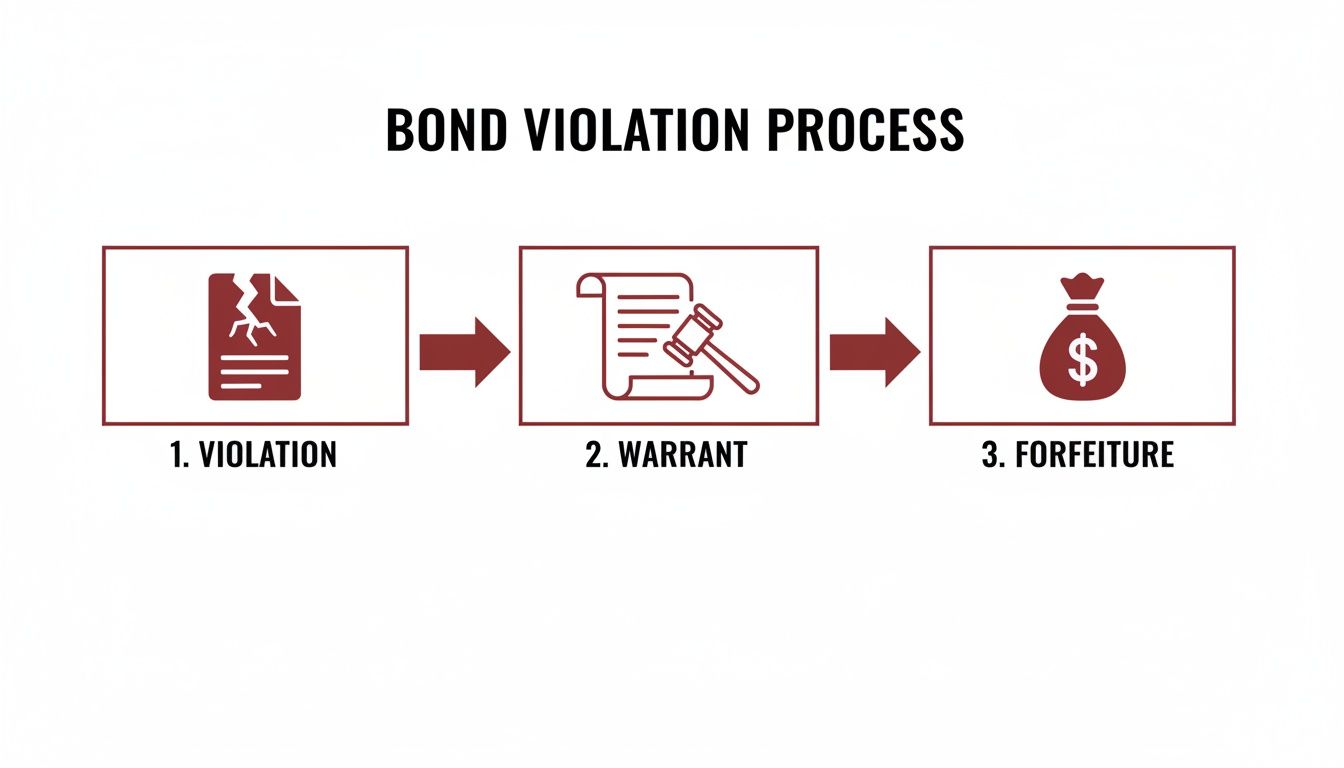
This visual shows how a single violation leads to a warrant and then to the financial penalty of forfeiture, impacting both the defendant and their family.
The Financial Recovery Process
When a bond is forfeited, a bail bond company must pay the court. To operate, we must then recover that money. We turn to the co-signer to cover the debt they agreed to back.
Our recovery actions can include:
- Contacting the co-signer to arrange a payment plan.
- Taking possession of any collateral used to secure the bond.
- Filing a civil lawsuit to obtain a legal judgment against the co-signer.
The consequences are significant, and the financial burden often falls on family and friends who were trying to help. For a deeper look at this process, you can learn more about what bail forfeiture means in our detailed guide. It is a serious matter that requires immediate attention.
What Happens When a Bench Warrant Is Issued
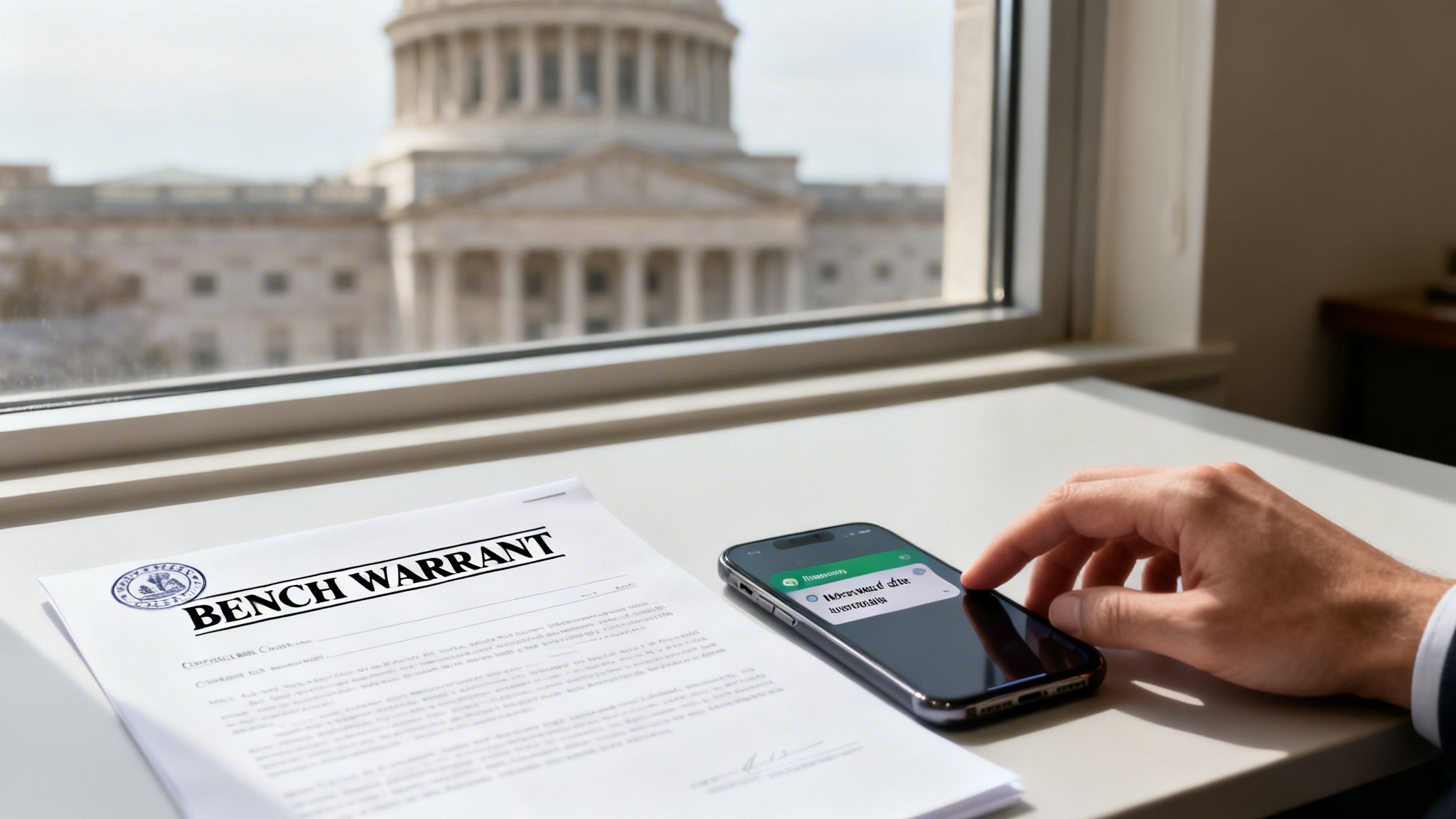
When bond conditions are broken, one of the first consequences is often a bench warrant. This is not a warning; it is a direct order for your arrest, signed by a judge. It gets its name because the order comes directly from "the bench," or the judge's seat.
Once a warrant is active, any law enforcement officer can arrest you on sight, at any time or place.
- During a routine traffic stop.
- At your front door if an officer comes to your home.
- At your job, which can be a public and disruptive event.
The warrant is entered into state and national law enforcement databases. It does not expire or get forgotten. It remains active until you are in custody or the warrant is formally addressed in court.
The Problem with Ignoring a Warrant
Ignoring a bench warrant is the worst possible action. It tells the court you are avoiding your responsibilities, which damages your credibility. It confirms the suspicion that you are a flight risk, making it very difficult to secure another bond in the future.
A bench warrant changes your status from a person awaiting trial at home to a fugitive in the eyes of the law. Every interaction with law enforcement becomes a high-risk situation that could lead to your immediate arrest.
Facing this is stressful, but taking proactive steps is the only way to begin resolving the issue. The right actions can make a significant difference in how the court proceeds. Our team frequently guides clients in Cumming, Alpharetta, and Johns Creek on how to best handle this difficult situation.
The Correct Steps to Take Immediately
The moment you believe a bench warrant has been issued, it is time to act. Hiding only makes the problem worse. Taking control starts with a few key steps.
- Contact Your Attorney: Your lawyer should be your first call. They can confirm if the warrant is active, provide legal advice, and start developing a strategy to resolve the situation. Do not try to handle this alone.
- Call Your Bail Bond Agent: Your bondsman is your partner in this process. Calling them shows you are taking responsibility and allows them to work with you. A proactive call is always better than having them learn of the violation from the court.
- Plan a Voluntary Surrender: The most effective way to handle a warrant is to turn yourself in. This is far better than being arrested unexpectedly. Your attorney and a local bail bond agent in Forsyth or Hall County can help coordinate a discreet and orderly surrender, which shows the court you are taking the matter seriously.
A voluntary surrender demonstrates respect for the court’s authority and is the first step toward getting back on track. For a more detailed look at this legal tool, you can check out our guide on what a bench warrant is and how to resolve it.
The Risk of New Charges and Harsher Penalties
Violating your bond conditions is a mistake that can create new legal problems. In Georgia, defying a court order can lead to new criminal charges. This is a separate offense from your original case.
The most common charge is Failure to Appear. If you miss a court date in Forsyth County, Hall County, or anywhere in Georgia, you have committed a new crime. Depending on the original charge, this could be a misdemeanor or even a felony, adding another serious legal issue.
The Erosion of Credibility
Beyond new charges, a violation destroys your credibility with the court. When a judge grants pretrial release, they are extending trust that you will follow the rules and appear for your court dates. Violating those conditions breaks that trust.
A prosecutor will use that broken trust against you. They will argue you are a flight risk or a danger to the community, making it more difficult to achieve a favorable outcome in your original case.
A bond violation is often viewed by the court as an act of defiance. This misstep can overshadow the facts of the original case, making judges and prosecutors less willing to consider leniency.
This loss of credibility has lasting effects. It can impact every future interaction with the court, from plea negotiations to sentencing.
The Likelihood of Harsher Penalties
When you are brought before a judge after a violation, their patience has likely run out. The court has several options, and none are favorable for the defendant.
- Bail Denial: The judge will almost certainly revoke the original bond and may refuse to set a new one. This means you would remain in jail until your case is resolved, which could take months.
- Higher Bail and Stricter Conditions: If the judge does grant a new bond, it will likely be for a much higher amount. The conditions will also be more restrictive, often including electronic monitoring (an ankle bracelet), a strict curfew, and more frequent check-ins.
- Complicated Plea Negotiations: A bond violation gives the prosecutor a significant advantage. They will be less inclined to offer a favorable plea deal, knowing your position is weakened.
While holding someone in jail before trial is a major decision, a bond violation gives the court a clear reason to do so. This detention brings its own set of problems.
Being re-arrested and returned to jail is a common and severe consequence. Across the country, about 70% of the 750,000 people in local jails are pretrial detainees. Research shows that even a short stay in jail before trial can have a negative impact. For example, defendants held for just two to three days are 40% more likely to commit new crimes than those held for less than 24 hours. For our clients, a violation often means returning to the Forsyth County jail with little chance of getting a new bond. You can explore more data on the impacts of pretrial detention and how the system works.
This highlights how important it is to follow your bond conditions precisely. The consequences are real and severe. Adhering to every rule set by the court in Cumming, Alpharetta, or Johns Creek is the only way to protect your freedom and prevent a difficult situation from becoming worse.
Your Immediate Action Plan After a Bond Violation
Realizing you have violated a bond condition can be overwhelming. However, panicking or hiding will only make the situation worse. The most important thing to do is act calmly, quickly, and proactively.
This is not a "wait and see" situation. The courts in Forsyth County and Hall County act fast on violations. Taking control begins with a clear, immediate plan.
Step 1: Contact Your Bail Bond Agent Immediately
Your first call should be to your bail bondsman. We are your partners in this process. Hearing directly from you shows that you are not trying to flee and are taking the situation seriously.
We are here 24/7 to take your call. We can check the status of your bond, explain what is happening, and provide straightforward guidance based on our experience with the local courts in Cumming, GA, and the surrounding North Metro Atlanta area. A proactive call from you is crucial.
Step 2: Call Your Attorney for Legal Advice
Your second call must be to your lawyer. While we manage the bond, only an attorney can provide legal advice and represent you in court. They will develop the legal strategy to address the violation, such as filing a motion to explain the circumstances to the judge.
This step is critical. Your attorney is your legal advocate. We work closely with legal teams, but our roles are distinct.
Step 3: Document Everything
Gather any proof that explains why the violation occurred. If it was a legitimate emergency, a simple mistake, or a family crisis, collect documentation.
- Medical Emergency: Get copies of hospital records, a doctor’s note, or ER discharge papers.
- Car Trouble: Keep receipts from the tow truck or auto mechanic.
- Simple Mistake: Write down a clear, honest account of what happened, such as misreading the date on your court notice.
This information is valuable for your attorney. It gives them the facts needed to argue for a second chance on your behalf.
A proactive approach demonstrates responsibility. Instead of waiting for law enforcement to arrive, taking these steps can help mitigate the severe consequences of a bond violation.
Step 4: Discuss a Voluntary Surrender
Finally, speak with both your bondsman and your attorney about a voluntary surrender. This means turning yourself in on your own terms, rather than being arrested unexpectedly. Arranging a surrender shows respect for the court and is the most responsible way to handle an active bench warrant.
We can help coordinate this to make the process as smooth and discreet as possible.
If you are concerned you may have violated your bond, do not wait. The table below outlines the steps to take as soon as you realize something is wrong.
Immediate Action Plan for a Bond Violation
| Step | Action to Take | Why It's Important |
|---|---|---|
| 1 | Call Your Bail Bondsman | Shows you're not a flight risk and allows them to advise you on the bond's status. |
| 2 | Contact Your Attorney | You need immediate legal advice and a strategy to present your case to the judge. |
| 3 | Gather All Documentation | Provides your attorney with evidence to explain the violation (e.g., medical records, repair bills). |
| 4 | Plan a Voluntary Surrender | Demonstrates responsibility to the court and avoids a surprise arrest. |
Following this plan gives you, your attorney, and your bondsman the best opportunity to manage the situation and minimize the damage. If you are in this position, call us now for clear, immediate next steps.
How a Bail Bond Agent Can Help Navigate This Process

Facing a bond violation can feel overwhelming. While we cannot provide legal advice—that is your attorney's role—an experienced bail bond agent is a critical partner who can offer clear, practical support. We act as your guide through the procedural side of the issue.
Our role is to provide fast, discreet guidance based on years of local experience. We understand the processes of the court and jail systems in Forsyth County, Hall County, and other North Metro Atlanta communities like Cumming and Gainesville. This local knowledge is essential when navigating a bond violation.
Providing Clarity on the Forfeiture Process
First, we help clarify the bond forfeiture process. We will explain exactly what is happening with the bond, the financial liability for the co-signer, and what notices we have received from the court. This direct information helps you and your family understand the immediate stakes.
Our agents will walk you through the steps, ensuring there is no confusion about the consequences or potential financial impact. We believe clear communication reduces stress and helps you make better-informed decisions.
Assisting with Court Communication and Bond Reinstatement
In some cases, particularly if a violation was unintentional, it may be possible to have the bond reinstated. This process, known as setting aside a forfeiture, requires swift action and is ultimately decided by a judge. We can communicate with the court clerk’s office about the bond's status and keep your attorney informed. You can read our article explaining what a bail bondsman does for more on our role.
Our team can help explain the steps your attorney might take, such as filing a motion to explain the violation to the judge. We work to support your legal strategy by managing the bond-related logistics.
A professional bail bond agent acts as a key liaison. We help you understand the system, facilitate communication, and provide a clear path forward when you need it most.
Guiding a Voluntary Surrender
If a bench warrant has been issued, turning yourself in voluntarily is almost always the best course of action. It is much better than being arrested unexpectedly at home or during a traffic stop in Alpharetta or Johns Creek. We can help coordinate this process to make it as discreet and efficient as possible.
We can arrange a time to meet you at the jail, confirm the warrant is active, and walk you through what to expect during booking and potential re-bonding. Taking this proactive approach shows the court you are taking responsibility, which can make a significant difference.
If you or a loved one has violated bond conditions, call us 24/7 for immediate, straightforward guidance.
Frequently Asked Questions About Georgia Bond Violations
When you are concerned about a bond violation, you need answers quickly. Here are answers to the most common questions we hear from clients across Forsyth County, Hall County, and North Metro Atlanta. This is general information; always consult an attorney for legal advice on your specific situation.
I Missed My Court Date in Forsyth County. Is There a Warrant for My Arrest?
Almost certainly, yes. Missing a court date is one of the most serious bond violations. In nearly every case, a judge will issue a bench warrant for your arrest and move to revoke the bond.
The best thing you can do is act proactively. Do not wait to be arrested. Call your attorney and your bail bond agent immediately. They can confirm if a warrant has been issued and help you determine the next steps, which usually involve arranging a voluntary surrender.
If My Bond Is Forfeited, Do I Lose the Fee I Paid the Bail Bondsman?
Yes. The premium paid to the bail bond company is a non-refundable fee. It is payment for the service of securing a release from jail and covers the agent's work and the risk they assumed.
More importantly, a forfeited bond creates a larger financial problem. Your co-signer (the indemnitor) becomes responsible for paying the entire bail amount to the bond company. This is why it is critical to follow all court-ordered conditions.
Key Takeaway: The premium is the non-refundable fee for the bail service. Forfeiture triggers the main financial consequence, making the co-signer liable for the full bond amount.
Can I Get Another Bail Bond After Violating the First One?
It is much more difficult. Once you have violated bond, a judge views you as a significantly higher flight risk. They will be less likely to grant pretrial release a second time.
A few outcomes are possible:
- Bail Denial: The judge might deny bail, meaning you remain in jail until your trial.
- Higher Bail Amount: If the judge grants bail, the amount will likely be much higher to reflect the increased risk.
- Stricter Conditions: Any new bond will come with tougher rules, such as mandatory electronic monitoring or daily check-ins.
Additionally, many bail bond companies may not take on the risk of bonding someone who has already violated their conditions. While every case is different, securing a second bond is not guaranteed.
What Happens to My Co-signer If I Violate the Bond Conditions?
When someone co-signs a bail bond agreement, they accept a significant financial responsibility. By signing the paperwork, they legally guarantee to the bail bond company that you will appear in court and follow all conditions.
If you violate those conditions and the court forfeits the bond, your co-signer is legally obligated to repay the full bail amount to the bondsman. This debt can also include any costs the bondsman incurred to locate you if you absconded. This liability is why co-signing is a serious commitment and why you must protect them by following your bond conditions precisely.
If you are worried about a potential bond violation in Forsyth County, Cumming, Hall County, or a nearby area, do not wait. The team at One Call Bail Bonds is here 24/7 to offer discreet, straightforward guidance and help you determine your immediate next steps. Call us now to get the help you need.