
If you're reading this because someone missed court this morning, you're probably dealing with two kinds of panic at once. First, you're worried about where your loved one stands with the court. Second, you're wondering what happens to the bond, the money, and the person who signed for it.
A missed court date doesn't always start with someone trying to run. Sometimes it's fear, confusion, bad communication, or a person who made a terrible decision in a bad moment. But once that court date passes, the system treats it seriously. The court starts moving. The bond company has to respond. Family members get pulled into a problem that can get bigger by the hour.
People searching for bail bonds Forsyth County, 24 hour bail bonds near me, or warrant assistance usually need straight answers, not legal jargon. If you're in Cumming, Dawsonville, Alpharetta, Suwanee, or nearby North Georgia communities, the key is to understand both paths at the same time. There is the legal side, and there is the bond side. They overlap, but they are not the same thing.
Your Guide to Navigating a Missed Court Date
The phone usually rings after the damage is already done.
A parent finds out their son didn't go to court. A spouse learns there is now a warrant. A friend who helped with an affordable bail bond or a no collateral bail bond suddenly realizes they may be on the hook for far more than they expected. In Forsyth County and Hall County, that moment creates a rush of bad instincts. People want to hide, wait, or hope the court will give them a pass.
That almost never helps.
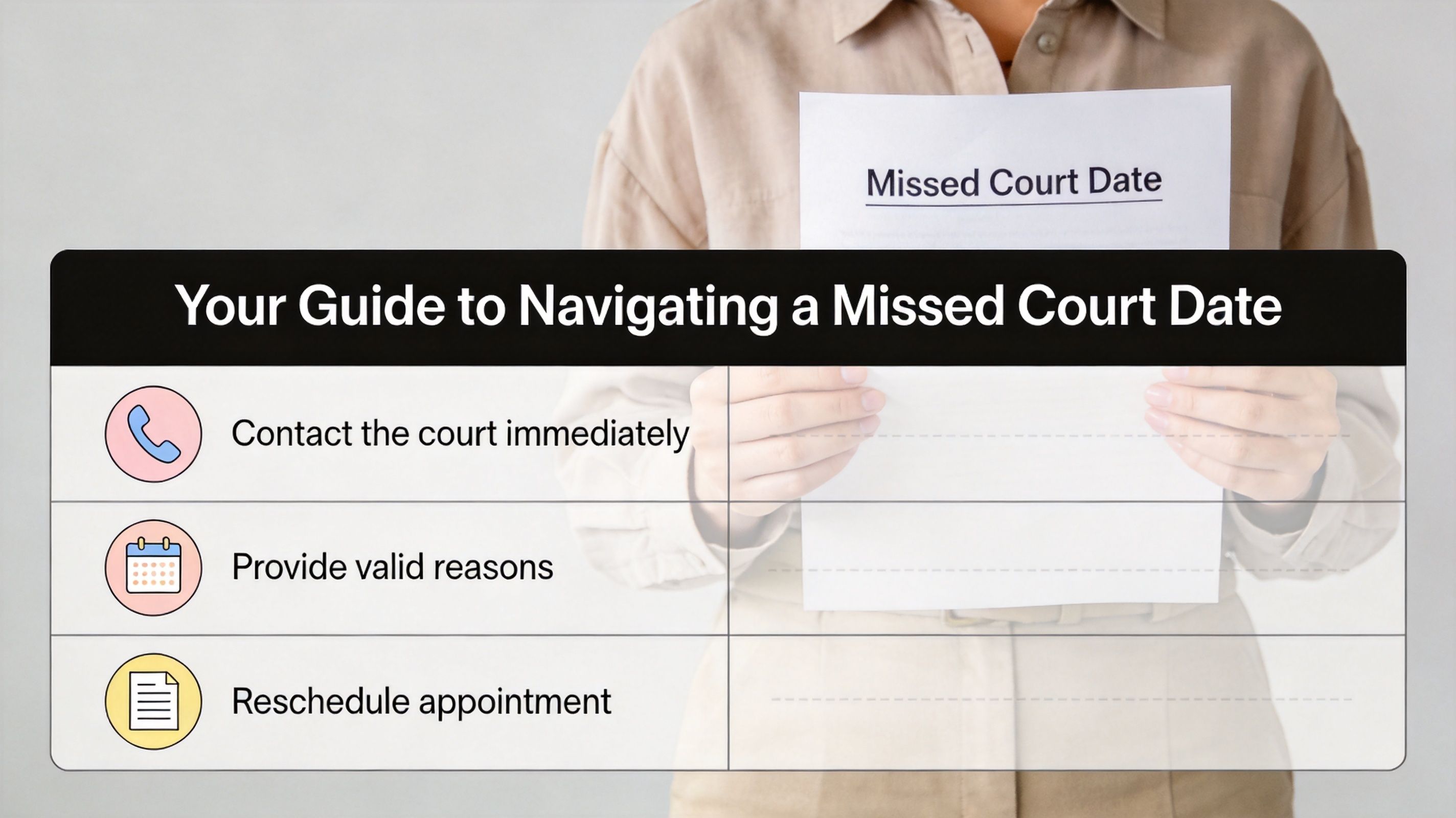
The better move is to slow down and look at the situation clearly. When people ask what happens if someone skips bail, they usually think only about arrest. Arrest is part of it, but it isn't the whole story. The court can create a new criminal problem. The bond can be forfeited. The cosigner can face financial exposure. Local judges may become much harder to work with on any future release.
What families need to understand first
A skipped bond creates pressure on everyone involved:
- The defendant now has to deal with the original case plus the fallout from missing court.
- The cosigner may be responsible under the bond paperwork they signed.
- The bail bondsman has legal duties to the court and can't just ignore the failure to appear.
- The family often becomes the bridge between panic and a practical solution.
First principle: hiding makes the legal side worse and the bond side more expensive.
In my experience, families do best when they stop arguing about how this happened and start focusing on what can still be fixed. That means confirming whether a warrant has been issued, gathering case information, and getting the person to face the problem before law enforcement or a recovery agent forces the issue.
Why local knowledge matters
A missed court date in North Georgia isn't just a generic internet problem. The practical reality in Forsyth County jail release, Hall County inmate release, and local courtroom handling matters. Families often need help with jail procedures, warrant questions, and whether another bond is even realistic.
If your loved one was already out after a DUI bail, a criminal charge, or another emergency release, the missed appearance changes how judges and bonding companies view risk. That's why the next few steps matter so much.
The Immediate Legal Fallout Warrants and New Charges
Once a person misses court, the court doesn't wait for a family explanation. It acts.
Three things usually matter right away. The judge can issue a bench warrant, revoke the person's release status, and open the door to a new charge for failure to appear, sometimes called bail jumping. If you need a plain-language explanation of the first piece, this guide on what a bench warrant means in Georgia helps clarify how it works.
The warrant comes first
A bench warrant tells law enforcement they can arrest the person because they failed to appear in court. That matters because the person's status extends beyond someone with a pending case. They are now someone the court has ordered picked up.
In practical terms, that means a routine traffic stop, a police contact, or any encounter where the warrant appears can end with an arrest. For families, this is why "we'll deal with it later" is a risky approach.
The missed date becomes a new case problem
The original charge doesn't disappear. The court can add a separate criminal charge for the nonappearance itself. According to Air Capital Bail Bonds on failure to appear consequences, misdemeanor failure to appear typically results in a Class A misdemeanor with penalties of up to 12 months in jail and a $1,000 fine, while bail jumping tied to a felony can become a third-degree felony that adds 1 to 5 years of prison time onto the original sentence.
That second part is what families often underestimate. Missing court doesn't just upset the judge. It can increase the total exposure in a very real way.
Courts treat appearance as the price of pretrial freedom. When that promise is broken, the response is usually immediate and separate from the original case.
Bail status changes fast
A missed appearance also damages any argument that the person should stay out while the case is pending. Judges view failure to appear as a trust problem. Once that trust is broken, every future request for release gets harder.
Here's the cleanest way to think about it:
- The original charge stays active.
- A warrant can bring the person back into custody at any time.
- A new failure-to-appear charge may be filed.
- Future bond terms often become tougher.
Families looking for fast jail release after a rearrest are often shocked to learn that release is no longer routine. A person who had a path out before may not have the same path after skipping bail.
The Financial Hit Bond Forfeiture and the Cosigner's Risk
The legal problem belongs to the defendant. The financial problem often lands on the cosigner.
Many parents, spouses, and friends often find themselves blindsided. They think the worst case is losing the premium they paid to get the bond posted. In reality, bond forfeiture is much bigger than that. If the bond is forfeited, the court can seek the full bail amount, not just the fee paid to the bonding company.
What bond forfeiture means in real life
When someone signs bail paperwork, they are usually signing an indemnity agreement. That agreement says the signer is financially responsible if the defendant doesn't follow the terms of release. The biggest term is simple. Show up to court.
If the person skips, the court moves against the bond. The bond company then has to answer to the court, and the cosigner may be responsible under the contract they signed with the agency. If collateral was used, such as a vehicle, property interest, or other pledged asset, that collateral may be at risk.
If you want a clearer picture of that legal role, this page on cosigner responsibilities for a bail bond lays out what signing really means.
Who is responsible for what after skipping bail
| Party Involved | Immediate Consequence | What's at Stake |
|---|---|---|
| Defendant | Missed court date triggers court action | Freedom, future bond chances, added charges |
| Cosigner | Financial liability under bond paperwork | Money owed, collateral, legal collection pressure |
| Bail bond company | Must answer for the bond to the court | Full bond principal, recovery costs, compliance obligations |
| Family | Pulled into locating and surrendering defendant | Time, finances, strained relationships |
Georgia gives cosigners some tools
This is the part many people never hear until it's too late. Georgia law gives cosigners some ways to limit damage if they act before the situation gets worse. According to this Georgia-focused discussion of skipping bail and cosigner protections, under O.C.G.A. § 17-6-50 a cosigner can petition the court to revoke the bond and surrender the defendant before a missed court date if flight risk is suspected. The same source notes that cosigners in courts like Forsyth County Superior Court can seek discharge of their obligation after forfeiture by proving the defendant was surrendered, and that this mitigates 20-30% of forfeitures.
That doesn't mean every signer gets relief. It means waiting and doing nothing is often the costliest option.
What works: acting early when you think someone is about to run.
What doesn't: assuming family pressure alone will keep them on track.
Practical trade-offs for families
If you're the person who signed, your decisions should be businesslike, even if this is family.
- Suspected flight risk: If the person is talking about leaving, dodging calls, or refusing to discuss court, treat that as a real warning sign.
- Collateral exposure: If property or a vehicle backs the bond, delay can put those assets in play.
- Communication strategy: Keep records of texts, calls, and attempts to get the defendant to appear or surrender.
- Surrender timing: Early surrender can be painful emotionally, but it can protect you from much worse financial fallout.
A lot of people search for how to post bail and never ask the harder question. What happens if the person I helped decides not to show up? That question matters just as much as the release process.
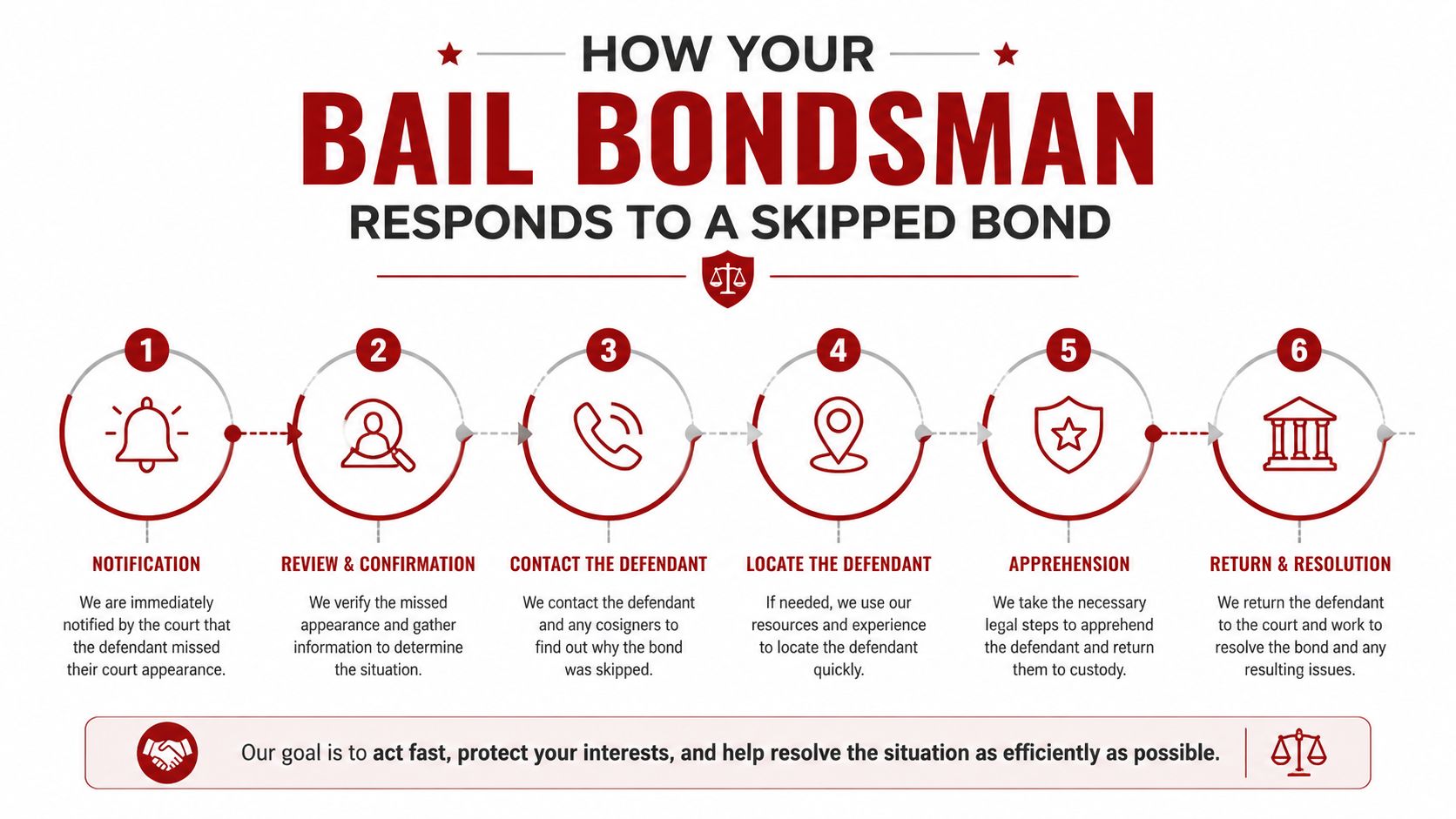
How Your Bail Bondsman Responds to a Skipped Bond
When a person skips bond, the bondsman doesn't have the option of shrugging and moving on. The company now has a live financial and legal problem.
Families sometimes take the response personally. They think the bondsman is being aggressive or unsympathetic. In reality, the bond company has obligations to the court. Once the person fails to appear, the agency has to locate, surrender, or otherwise resolve that bond exposure.
What the agency usually does first
The first response is often simple and direct. The bondsman tries to make contact with the defendant and the cosigner. Agencies want a surrender, not a chase. Voluntary return is cleaner for everyone involved.
A practical response often looks like this:
- Phone contact with the defendant: Confirm whether the missed court date was deliberate, mistaken, or caused by some emergency.
- Immediate outreach to the cosigner: Find out where the person is, whether they are in contact, and whether surrender can be arranged.
- Review of paperwork and court status: The agency checks the bond, court date, and next legal deadlines.
- Escalation if the person won't cooperate: Recovery efforts begin when contact breaks down.
Recovery efforts are part of the job
If the person disappears or refuses to surrender, agencies may use fugitive recovery agents. If you're unfamiliar with that role, this page on what a fugitive recovery agent does explains why they get involved after a skipped bond.
The legal net also gets wider very quickly. According to All City Bail Bonds on skipped bond enforcement, the warrant is entered into the National Crime Information Center (NCIC) database, which creates nationwide alerts for law enforcement. The same source explains that if the defendant crosses state lines, the situation can escalate to a federal Failure to Appear charge under 18 U.S.C. § 3146, carrying up to 10 years if the original charge was a felony, and that fugitive recovery agents are then used to locate and surrender the defendant.
That changes the family conversation. This isn't a local problem anymore once the person starts moving around.
A skipped bond is easiest to fix before the person goes silent, leaves the county, or decides to hide with relatives.
Why cooperation matters
From the bondsman's side, there is a big difference between a defendant who missed one date and calls immediately, and a defendant who vanishes. The first situation may still be manageable. The second forces everyone into enforcement mode.
Families can help by doing three things well:
- Be honest about contact. If you know where the person is, say so.
- Stop passing messages that encourage hiding. That only deepens the problem.
- Push for voluntary surrender. It is usually the least damaging option once a bond has been skipped.
People often look for warrant assistance only after recovery starts. The best time to ask for help is before that process hardens.
The Process in Forsyth and Hall County Courts
Local court culture matters more than people think.
In Forsyth County and Hall County, judges see missed court dates as a direct sign that the defendant may not follow release conditions. That local reality affects whether another bond is available, how high a future bond might be, and how much room there is to negotiate once the person is back in custody.
The timeline matters to the bond company
Georgia places real pressure on the bonding side after a failure to appear. According to this Georgia bail forfeiture overview with Forsyth and Hall County context, bail bond companies are liable for the full principal of a bond if the defendant is not surrendered within a specific timeframe, often 180 days under O.C.G.A. § 17-6-31.
That deadline is one reason agencies move fast. It isn't about impatience. It is about legal exposure that grows if the defendant stays gone.
What local judges often do after an FTA
That same Georgia-focused source states that judges in Forsyth and Hall County courts are known to deny rebonding opportunities or set new bond amounts 2-5 times higher for defendants with a prior Failure to Appear. That's a major shift for any family that thought getting a second bond would be simple.
For someone trying to secure emergency bail bonds, DUI bail, or a new release after rearrest, the prior missed appearance can become the central issue. The old case may not be the biggest problem anymore. The trust issue is.
What this means on the ground
If your loved one is picked up and booked back into custody, don't assume the same release process will repeat. Local courts may take a harder line, especially if they think the person intentionally ducked court.
A realistic North Georgia approach looks like this:
- Confirm the court and county first: Forsyth and Hall may handle timing and courtroom expectations differently.
- Find out if the person can even be rebonded: Some families waste valuable time shopping for bail bonds near me before confirming eligibility.
- Prepare for tougher conditions: A new bond, if allowed, may be much more difficult to secure.
- Move quickly on surrender: Voluntary return gives the court a different story than forced capture.
In local practice, the person who comes back on their own usually stands in a better position than the person brought back after everyone had to chase them.
For families in Cumming, Dawsonville, Alpharetta, and Suwanee, that practical difference can shape the next stage of the case.
How to Mitigate the Damage A Guide for Families
The worst response to skipped bail is silence.
If your family is trying to decide what to do, the goal isn't to invent excuses. The goal is to stop the problem from spreading. A missed date can become a warrant problem, a financial problem, and a future release problem all at once. The only useful approach is quick, controlled action.

What helps right away
Start with facts. Confirm the missed court date, gather the case number if you have it, and determine whether the defendant is willing to surrender. If the person is still talking to family, use that window. It may close fast.
Then make decisions in this order:
- Contact the bondsman immediately. If a bond company is involved, it needs accurate information now, not later.
- Tell the truth about contact with the defendant. Half-answers usually make agencies assume the person is running.
- Encourage voluntary surrender. It is generally better than being arrested unexpectedly or picked up by a recovery agent.
- Get legal advice if there is a valid explanation. Medical emergencies, notice problems, or other documented issues may matter, but they need to be raised properly.
What usually makes things worse
Families often do these things out of fear:
- Hiding the person at a relative's house
- Ignoring calls from the bond company
- Sending messages through friends instead of dealing directly
- Assuming the warrant won't be served quickly
- Waiting to see if the court "forgets"
Those choices usually increase the pressure on everyone.
Practical rule: if the defendant is still reachable, treat that as your best chance to reduce damage.
Voluntary surrender is usually the turning point
Voluntary surrender doesn't erase the missed court date. It does change how the situation unfolds. It can stop the uncertainty, bring the person back under the court's control, and give the bondsman and lawyer something useful to work with.
The trade-off is emotional, not legal. Families don't like turning in someone they care about. But in many cases, a controlled surrender is the most responsible move for the defendant and the signer alike.
If you're facing this in the middle of the night, after a 24 hour bail bonds search, or during a frantic attempt to figure out inmate release Forsyth County, remember this. Fast action matters more than perfect wording. Get the right people involved, stop the hiding, and move toward surrender before the situation hardens further.
Frequently Asked Questions About Skipping Bail
Can someone get another bond after missing court
Sometimes, yes. Sometimes, no.
A prior failure to appear makes every future bond request harder. In local practice, some judges deny a new bond outright, and others set terms that are much tougher than before. Whether another bond is possible depends on the court, the charge, the person's history, and how the missed appearance was handled after the fact.
Is a bench warrant the same as a regular arrest warrant
Not exactly.
A bench warrant comes from the court because the person failed to do something the court ordered, such as appearing for a hearing. An arrest warrant is generally tied to an allegation that a person committed a crime. For families dealing with skipped bail, the practical result is similar. Law enforcement can arrest the person.
Will the cosigner go to jail if the defendant runs
Usually, the bigger risk to the cosigner is financial, not criminal.
The signer may face collection pressure, loss of collateral, and lawsuits tied to the bond contract. The core issue is money owed and contractual liability. A cosigner should still take the situation seriously and act quickly to protect themselves.
What if the person missed court by mistake
A mistake is better than intentional flight, but it still needs immediate attention.
If there was a genuine reason, such as confusion about the date or a documented emergency, the person should not sit on that explanation. The court and any involved professionals need that information quickly. Delay makes every explanation sound weaker.
Should the family talk to the bondsman or wait for a lawyer
If a bond company is involved, talk to the bondsman immediately. If legal issues need to be addressed in court, speak with a lawyer too.
Those are not competing steps. They handle different parts of the problem. The bondsman deals with the bond exposure and surrender logistics. The lawyer addresses the court side.
What kind of help matters most right now
The most useful help is practical help. Confirm warrant status. Figure out surrender options. Get clear on whether a new bond is possible after rearrest. If the family is in North Georgia and needs fast, around-the-clock guidance on bail, release, or warrant issues, direct local help matters more than general internet advice.
If you need immediate help with a missed court date, warrant concerns, 24 hour bail bonds, or fast release questions in Cumming, Forsyth County, Hall County, or nearby North Georgia, contact One Call Bail Bonds. Their team is available 24/7 and can help you understand the next step, what information is needed, and how to move forward quickly and calmly.