
That call usually comes at the worst time. Late at night. Early morning. In the middle of work. A loved one says they’ve been arrested in Forsyth County or nearby, and the next words come fast: bail, bond, jail, release, court.
Most families hear only pieces of the conversation. They know someone needs help, but they don’t know what happens next. They wonder whether release is immediate, whether they need cash in full, whether the person will walk out in an hour, and what they have to do after getting home. Stress fills in the blanks.
That’s where clear information matters.
What happens after bail is posted is more than a single moment at the jail window. It’s a chain of steps. Paperwork has to move. Jail staff has to process the release. The defendant has to follow the rules of release. The cosigner has to understand what they agreed to. Then the case continues until the court officially closes out the bond.
For families in Cumming, Dawsonville, Alpharetta, Suwanee, and across North Georgia, the process feels less overwhelming when you can see it in order. That’s what this guide does. It walks through the hours right after bail is posted, the responsibilities that begin once someone gets out, and the final step when the bond is discharged.
The Phone Call You Hoped You Would Never Get
A man from Cumming gets a call from his sister just after midnight. She’s scared, speaking quickly, and says she’s in jail. He writes down the charge, misses the booking number the first time, asks her to repeat the jail name, and starts searching for answers with shaking hands. That kind of call turns a normal night into a problem that feels bigger by the minute.
In that moment, the immediate question is: how fast can we get them out?
That’s understandable, but the better question is slightly different. It’s this: what happens after bail is posted? Knowing that answer helps you make better decisions from the start. It helps you understand why release isn’t always instant, what the jail is doing behind the scenes, and what your loved one must do once they’re out.
When families are worried, confusion causes almost as much stress as the arrest itself.
In Forsyth County and Hall County, the first stage is usually urgent and practical. You need the right information, the right paperwork, and realistic expectations. The second stage is quieter but just as important. Court dates, bond conditions, and cosigner responsibilities begin the moment release happens.
People often think posting bond ends the crisis. In reality, it changes the crisis into a process. That process can be managed. It just needs to be handled carefully, calmly, and in the right order.
The Waiting Game How Fast Jail Release Works in Forsyth County
Posting bail starts the release process. It does not finish it.
That distinction matters because many families expect the jail door to open right away. In most cases, it doesn’t work like that. After bail is posted, defendants are typically released from jail within 24 to 48 hours, though timing can vary based on the jail, the case, and administrative processing, as explained in this guide to what happens after bail is posted.
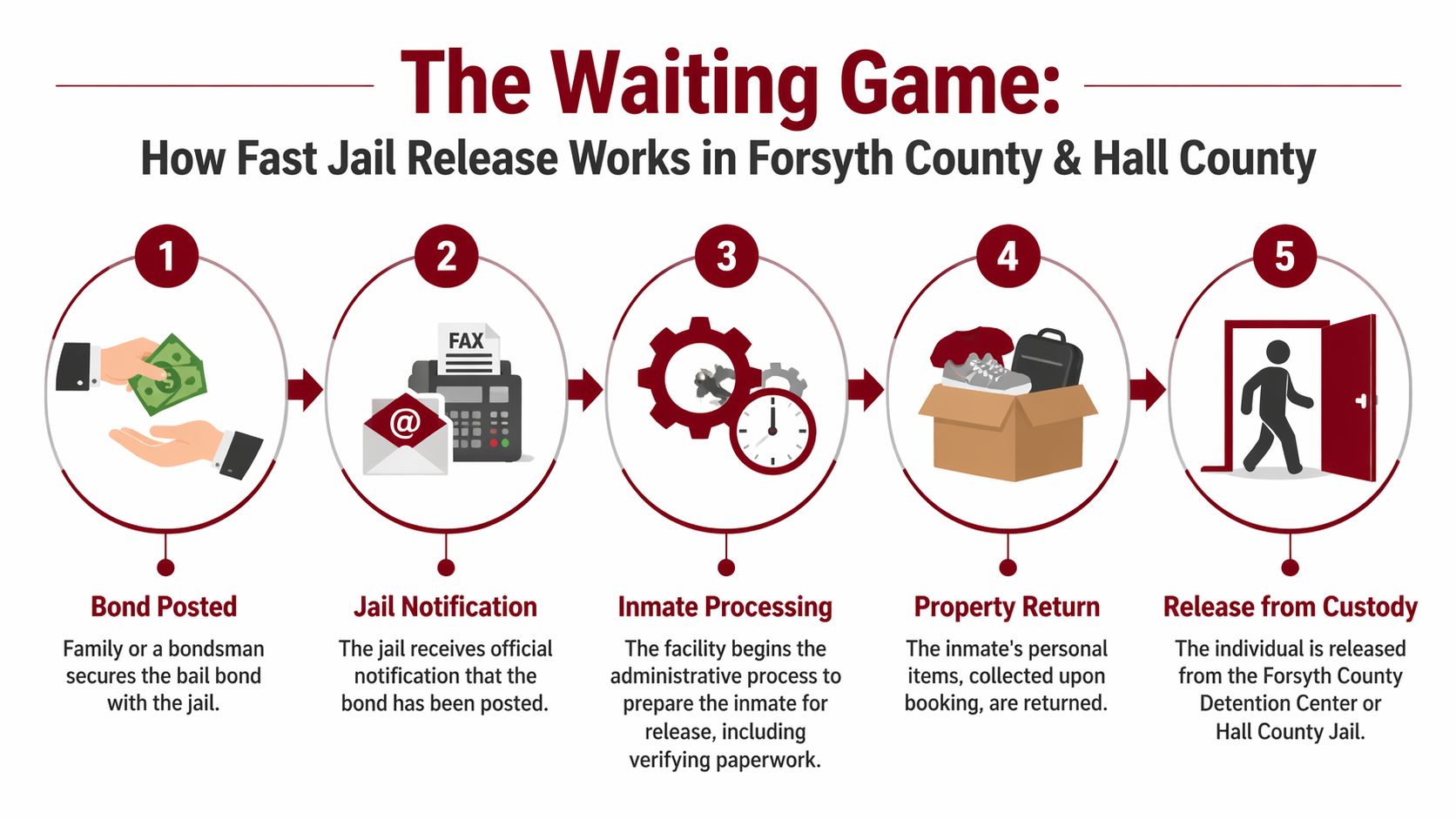
What the jail does after bond is posted
Once the bond is accepted, the jail has to receive and verify the release paperwork. Staff then check the inmate’s file, confirm there are no unresolved holds that stop release, and begin out-processing. That includes updating internal records and preparing the inmate for discharge.
Then comes the part families don’t see. The jail may need to coordinate between booking, records, property, and release staff. If the facility is busy, that queue gets longer. If shift changes happen in the middle of the process, things can slow down further.
A simple way to think about it is this:
- Bond is posted
- The jail receives notice
- Records and holds are reviewed
- The inmate is processed for release
- Property is returned and the person is discharged
If you’re trying to confirm where someone is in the process, using a Forsyth County jail inmate search tool can help you verify status while you wait.
Why release can take longer than expected
Families often assume delay means something went wrong. Sometimes it does. Often, it just means the jail is working through its normal steps.
Common causes of delay include:
- Shift changes: Staff transitions can slow review and final approval.
- Jail counts: Facilities regularly pause movement while they confirm inmate counts.
- Property return: Personal items taken at booking must be matched and returned before discharge.
- Paperwork review: A missing detail or mismatch can hold up the file until it’s corrected.
- Additional holds or warrants: If another jurisdiction has placed a hold, release may stop until that issue is addressed.
In Forsyth and Hall County cases, local familiarity helps because each jail has its own habits, workflow, and timing. The process may look straightforward from the outside, but small local details matter.
What families should do while waiting
The waiting period is hard because it feels passive. It helps to focus on the practical next steps instead of watching the clock.
Here’s what to do:
- Keep your phone close: Release calls and follow-up questions often happen at inconvenient times.
- Confirm pickup plans: Make sure someone knows where to pick up the defendant and has transportation ready.
- Prepare basic items: The person getting out may need a phone, charger, prescription information, or clean clothes.
- Avoid repeated assumptions: “Bond is posted” and “they’re walking out now” are not the same thing.
Practical rule: Once the bond is posted, think of release as an administrative process, not an instant event.
One more point helps calm expectations. Delays don’t always mean anyone made a mistake. They often mean the jail is completing a sequence it has to follow for every release. When families understand that, they’re less likely to panic during the first several hours.
Understanding Your Obligations Defendant vs Cosigner Roles
Once someone gets released, two people usually carry the bond forward: the defendant and the cosigner. They are connected, but their jobs are not the same.
That’s where many problems begin. One person thinks, “I’m out, so now I just wait for court.” The other thinks, “I signed papers, but I’m only helping with release.” Both views are incomplete.
A primary obligation after bail posting is attending all scheduled court appearances. If the defendant fails to appear, the court can issue a bench warrant, forfeit the bond, and order re-arrest, as noted in this overview of post-bail obligations.
The clearest way to see it
| Responsibility | Defendant's Duty | Cosigner's Duty |
|---|---|---|
| Court appearances | Show up for every required hearing on time | Help make sure dates are known and taken seriously |
| Bond conditions | Follow every release condition ordered by the court | Encourage compliance and respond if problems start |
| Communication | Stay reachable and report major changes | Stay in contact if the defendant becomes hard to reach |
| Financial risk | Avoid actions that put the bond in jeopardy | Understand liability tied to the bond agreement |
| Case follow-through | Work with counsel and stay engaged in the case | Support the process and avoid assuming the matter is over |
For a more detailed breakdown, families often benefit from reading what the responsibilities of a cosigner include.
What the defendant must do
The defendant’s role is personal and direct. Show up for court. Follow every condition. Stay reachable. Don’t treat release like the case disappeared.
Conditions can include no-contact rules, travel limits, check-ins, or other restrictions tied to the charge. If the person was released on a DUI bail or another charge with added supervision, the court may expect stricter compliance from day one.
The biggest mistake is casual thinking. Missing court because of work, a dead phone, or confusion about the date can turn a manageable case into a warrant problem.
What the cosigner must understand
The cosigner’s role is part support, part accountability. You are not just giving someone a ride home or helping with paperwork. You are stepping into a legal and financial relationship tied to that person’s behavior while the case is pending.
That means you should know:
- Where the defendant is staying
- How to reach them consistently
- Whether they understand their court dates
- Whether they are following release conditions
If warning signs appear, don’t ignore them. A defendant who starts avoiding calls, talking about leaving town, or treating court casually creates risk for everyone attached to the bond.
A cosigner should never sign bond paperwork based only on trust. They should sign based on trust plus a clear plan.
Where people get confused
Families often mix up moral support with legal responsibility. They’re not the same.
A mother may say, “I know he’ll do the right thing.” A friend may say, “She just needs help getting out.” Those feelings are real, but the bond agreement is still a contract. If the defendant disappears or violates key terms, the consequences reach beyond the person who was arrested.
That’s why it helps to talk openly before release happens. Where will the defendant stay? Who will keep track of court dates? Who will step in if behavior starts changing? Answering those questions early prevents ugly surprises later.
Why Your Local Bail Bondsman Is Your Partner Through the Whole Case
Many people think a bail bondsman’s job ends when the jail releases the defendant. That’s not how real cases work.
The hours after posting bond are technical. The weeks after release are practical. Someone has to stay on top of paperwork, timing, communication, and follow-through. An experienced local bondsman helps families do that without feeling like they’re guessing their way through a system they’ve never dealt with before.
After a bail bond is posted, the bondsman files paperwork and the non-refundable premium, which is typically 10 to 15%, with the court. Even when things go smoothly, the jail’s completion of the process can still take 24 to 48 hours, which is why proper filing matters, according to this explanation of what happens after bail bonds are posted.

Local knowledge helps in ways families don’t see
A local bondsman knows that release timing at one jail may not match release timing at another. They know what information usually matters first, what mistakes delay paperwork, and where families tend to get tripped up after the defendant gets home.
That matters in urgent searches like “bail bonds near me,” “24 hour bail bonds,” or “fast jail release.” People making those searches aren’t looking for legal theory. They need someone who understands the local process and can move it forward cleanly.
Local experience also helps with common questions such as:
- What information is needed to start
- How to post bail for a DUI arrest
- What to do if a warrant is involved
- Whether collateral may be required
- How release usually unfolds in Forsyth or Hall County
Support after release is where a lot of trouble is prevented
The defendant is home, but the case is still active. That’s when reminders, check-ins, and clear communication start to matter.
A good bondsman often helps families stay organized by reinforcing basic habits:
- Keep every court paper together.
- Save hearing dates in a phone calendar right away.
- Call immediately if the defendant changes address or phone number.
- Ask questions early instead of after a missed deadline.
Those steps sound simple. Under stress, they’re easy to miss.
The best post-release help is often quiet help. It keeps small mistakes from turning into expensive ones.
Why this matters in emergency situations
Families calling for emergency bail bonds or warrant assistance are often dealing with confusion, embarrassment, and exhaustion. In that state, even basic instructions can get lost. A local professional can slow the process down enough for the family to understand what needs to happen next.
That doesn’t change the court’s rules. It does make those rules easier to follow.
For many families in Cumming, Dawsonville, Alpharetta, and Suwanee, that’s the key value after bail is posted. Not just getting someone out, but helping everyone involved stay on track until the case is resolved.
Navigating Court Dates Warrants and Bond Conditions
Release from jail is not the end of the legal process. It’s the start of a supervised pretrial period. The defendant is out, but the court still expects full compliance.
That’s why the first few days after release matter so much. Court paperwork needs to be read carefully. Dates have to be saved correctly. Restrictions have to be followed exactly as ordered.
Post-release, defendants enter a supervised pretrial period where failure to appear at hearings triggers automatic forfeiture and bench warrants. National failure-to-appear rates are about 18% for misdemeanors and 28% for felonies, which is why court attendance matters so much, according to this discussion of pretrial release and hearings.

The court date is the center of everything
Some defendants focus on the charge and forget the calendar. That’s a mistake. The most immediate obligation after release is to appear when the court says to appear.
If the hearing is missed, the judge can issue a bench warrant. That can lead to arrest, bond trouble, and a much harder path forward. Even when there’s a reason for the absence, the court won’t treat silence as a solution.
Use a simple system. Put every date in your phone. Put it on a paper calendar at home. Tell one reliable family member. Then check the paperwork again.
Common bond conditions people overlook
Bond conditions depend on the case, but a few issues show up often enough that families should watch for them closely.
- No-contact orders: The defendant may not be allowed to contact an alleged victim or another person tied to the case.
- Travel limits: Leaving the county or state without permission can create serious problems.
- Substance-related rules: In DUI or drug-related cases, the court may expect testing or treatment compliance.
- Check-in requirements: Some defendants must report, monitor, or remain available under specific terms.
People get into trouble when they treat these as suggestions. They are court orders.
A simple example of how violations happen
A person is released after a DUI arrest. They go back to work, try to get life moving again, and assume the next step is just waiting for court. A week later, they travel out of town without checking their paperwork. Then they miss a message about an upcoming hearing because their phone number changed.
That kind of chain reaction happens fast. Not because the person planned to run, but because they underestimated how strict pretrial release can be.
Read every release condition the same day the defendant gets home. If any part is unclear, get clarification before the defendant acts on assumptions.
What to do if there’s already a warrant issue
Sometimes families learn about a missed date or possible warrant after the fact. The wrong move is hiding from it. The right move is acting quickly, contacting counsel, and addressing the issue directly through the proper channels.
If you’re dealing with warrant assistance concerns, speed matters. Delay usually narrows options, not expands them. Calm action is better than panic, but action still has to happen.
The Final Step How Bail is Exonerated and Collateral is Returned
Every bond has an endpoint. The legal word for that endpoint is exoneration. It means the court has released the bond obligation because the case has reached its conclusion and the bond is no longer needed.
That conclusion can happen after a dismissal, a plea, or a trial result. What matters for the bond is not whether the outcome felt good or bad. What matters is that the court has finished with the case and discharged the bond.
What happens to the money depends on how bail was posted
People often get confused at this point.
If a family posted a full cash bond directly with the court, that money may be returned after the case is finalized, though timing can take longer than families expect. If a bail bondsman posted a surety bond, the premium is non-refundable. That payment is the fee for the service of securing release and guaranteeing the bond.
For families comparing those two paths, this explanation of whether you get bail money back helps clarify the difference.
What collateral return usually looks like
If collateral was used, it is generally tied up until the bond is exonerated. Once the court releases the bond obligation, the collateral return process can begin under the terms of the bond agreement.
That means families should keep copies of all paperwork and confirm that the case is fully resolved before assuming the matter is finished. If documents are needed to release collateral, having organized records speeds things up.
A few practical reminders help here:
- Keep your final court paperwork
- Ask whether the bond has been exonerated
- Save copies of any collateral receipts or agreements
- Don’t confuse case discussion with formal discharge of the bond
The main misunderstanding to avoid
People sometimes say, “The charges are over, so everything should come right back.” Sometimes it does move quickly. Sometimes it doesn’t. Court closure and financial release are related, but they are not always simultaneous.
The safest approach is to treat exoneration as the official finish line. Until that happens, keep your records and stay in contact with the parties handling the bond paperwork.
Get 24-Hour Bail Bond Help in Forsyth County Now
When you’re dealing with an arrest, uncertainty is often the hardest part. You want to know how to post bail, how long release takes, what the defendant has to do next, and how to avoid another setback. The process is manageable, but it moves better when someone experienced helps you handle it in real time.
If you need 24 hour bail bonds, emergency bail bonds, DUI bail, warrant assistance, or help with fast jail release in Cumming, Dawsonville, Alpharetta, Suwanee, Forsyth County, or Hall County, don’t wait and hope the situation sorts itself out. Ask questions early. Get clear answers. Make sure the release process starts correctly.
For immediate, confidential help, contact One Call Bail Bonds at 770-888-8447. They serve Forsyth County and the surrounding North Georgia area around the clock, and they can help you move from panic to a clear plan.
Frequently Asked Questions About the Post-Bail Process
Is someone released immediately after bail is posted
Usually, no. Posting bail triggers the release process, but the jail still has to complete its own steps before the person walks out. That’s why families often wait even after the bond has been accepted.
What information do I need to start the bail process
The most helpful details are the defendant’s full name, the jail location, and any booking or charge information you have. If you don’t have every detail, don’t panic. Start with what you know and verify the rest quickly.
Can I help if I live outside Forsyth County
Yes. Family members or friends who live outside the area often help arrange bail. The key is making sure the information is accurate and that the person acting as cosigner understands the responsibility they are taking on.
Does posting bail mean the case is over
No. Bail only affects custody status. The criminal case continues until the court resolves it.
What if the defendant misses court
That can create a serious problem very quickly. Missing court can lead to a bench warrant, bond trouble, and possible re-arrest. If there’s any confusion about a date, it needs attention before the hearing is missed, not after.
Are bond conditions different for DUI cases
They can be. A DUI case may come with conditions tied to conduct, travel, or substance-related compliance. The exact terms depend on the court order, so the paperwork has to be read closely.
Can a cosigner back out after signing
That depends on the circumstances and the status of the bond, but a cosigner should never assume they can walk away with no further obligation. If concerns come up, they should raise them immediately and not wait until the defendant has already become difficult to locate.
What if there’s a hold or another warrant
That can delay release or stop it altogether until the issue is addressed. It’s one of the reasons families should not assume bond posting guarantees immediate discharge from custody.
What should the defendant do on the first day home
Start by reading every release paper carefully. Save all court dates. Follow every condition. Stay reachable. Contact an attorney if one is involved or needed. The first day out is when many future problems are prevented.
How do families make this process less chaotic
Use one folder for every paper. Put every date in more than one place. Keep phones charged. Make sure transportation is ready for court. Most of all, don’t rely on memory when stress is high.
If you need help right now, One Call Bail Bonds is available 24/7 to help with bail bonds in Forsyth County, Hall County, Cumming, Dawsonville, Alpharetta, Suwanee, and surrounding North Georgia communities. Call 770-888-8447 for fast, professional, discreet assistance.