
Bond forfeiture is the legal consequence of a defendant failing to appear for their court date, resulting in the court seizing the full bail amount from the bail bonds company. If a $10,000 bail bond is posted and the defendant skips court, the bondsman becomes liable for the full $10,000.
If you're reading this because someone in your family missed court in Forsyth County, Hall County, Cumming, Dawsonville, Alpharetta, or Suwanee, the situation is serious but it isn't something you should freeze on. Families usually get in the most trouble when they wait, assume the court will sort it out, or avoid the bondsman out of embarrassment.
What helps is fast, direct action. A missed date can often be addressed better when the family gathers the right information, contacts the right people, and treats the problem like a clock is running, because in many cases it is.
What Does Bond Forfeiture Mean in Georgia
The plain answer to what does bond forfeiture mean is this: the court says the bond has been broken because the defendant didn't comply with release terms, most often by missing court. In a surety bond case, that puts the bail bond company on the hook for the full amount, not just the premium that was paid up front.
For families, confusion often arises because many people think forfeiture just means a late fee, a warning, or a chance to explain things whenever they get around to it. That's not how courts treat it. A forfeiture puts the court and the surety into a formal legal process that can end with permanent loss of the full bond amount and collateral.

What it means for a family in North Georgia
In Georgia, a family usually feels the impact first, not in legal language, but in panic. Someone misses court. A co-signer gets a call or a notice. Suddenly the question isn't "what is bail?" anymore. It's "are we about to lose money, property, or both?"
That fear is understandable. Bond forfeiture can affect the defendant, the indemnitor, and the bondsman at the same time. If you want a clear explanation of how the surety relationship works before you deal with a forfeiture issue, this guide on what a surety bond is helps explain the structure behind the bond.
What usually works and what doesn't
Some responses help. Others usually make things worse.
- Helpful move: Call the bondsman as soon as you learn the date was missed.
- Helpful move: Find out whether there was a medical emergency, a jail hold elsewhere, or a paperwork mistake.
- Bad move: Telling the defendant to "lay low" for a few days.
- Bad move: Ignoring mail from the court or surety because you're hoping it's only a warning.
Practical rule: Treat a missed court date like an active legal emergency, not an inconvenience.
Georgia courts don't view bond compliance as optional. Once the court starts the forfeiture process, every hour spent avoiding the issue usually makes the options narrower, not better.
How Bond Forfeiture Happens in Forsyth County
In Forsyth County, forfeiture usually starts with one event: the defendant doesn't show up when the court calls the case. That failure to appear, or FTA, is the most common trigger. If a $10,000 bond was posted and the defendant misses court, the bondsman becomes liable for the full $10,000, and notice is sent to the defendant and co-signer as part of the forfeiture process, with local courts in Forsyth and Hall Counties enforcing 30-90 day grace periods before final collection becomes irreversible, according to Eight Ball Bail Bonds on what bond forfeiture means.
That doesn't mean every case unfolds in exactly the same way. But the chain of events is usually fast enough that families shouldn't assume they have plenty of time.
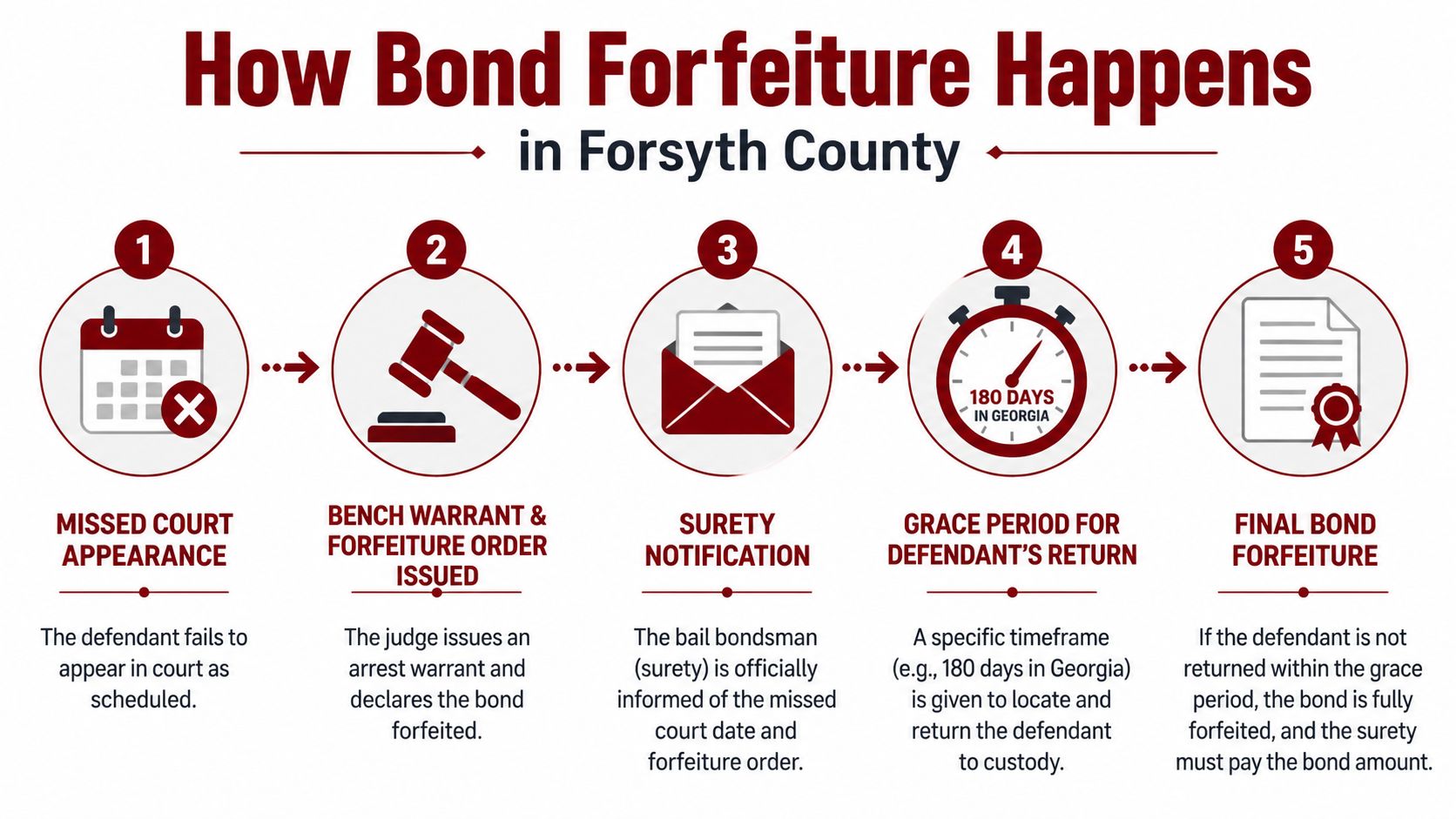
The usual chain of events
A forfeiture case often moves through these practical stages:
The defendant misses court
The judge calls the case. The defendant isn't present.The court reacts immediately
The court can declare the bond forfeited and move forward with the next legal step tied to that nonappearance.Notice goes out
The defendant and indemnitor are notified, and the surety has to respond to the court process.A grace period applies
In local practice, families may be dealing with a short window before the matter hardens into a collection problem.The problem turns financial
If the defendant isn't returned and the court doesn't set the forfeiture aside, the surety can be required to pay the full amount.
It's not always just a missed court date
Families often focus only on FTAs, but forfeiture can also grow out of release violations. A new arrest, breaking a no-contact rule, failing to report an address change, or violating another condition can put the bond in danger. In real life, that's where people get caught off guard. They assume "he didn't miss court, so we're fine," when the court may be looking at broader noncompliance.
What works here is clarity. Pull the bond paperwork. Check the release conditions. Ask whether the person had any special terms tied to the case, especially in DUI or family-violence related matters.
The faster you identify whether this was a pure nonappearance or a condition violation, the easier it is to choose the right response.
What local families should understand
Forsyth County families usually want to know one thing first: is this already final? Often, the answer is no, but that doesn't mean the risk is small. There may still be a window to return the defendant, explain the absence, or prepare for a hearing. There may also be very little room for delay.
A practical way to think about it is this:
| Situation | Likely effect |
|---|---|
| Missed court with no explanation | Court moves toward forfeiture quickly |
| Missed court with documented emergency | There may be grounds to seek relief |
| Violation plus avoidance afterward | Risk increases sharply for everyone involved |
The mistake I see families make most often is treating the first notice like the end of the story or, just as bad, like nothing important has happened yet. It's neither. It's the point where action matters most.
Legal and Financial Risks of a Forfeited Bond
Once a bond is forfeited, the problem splits in two directions. The defendant faces arrest risk. The co-signer faces money risk.
Those two problems feed each other. If the defendant stays out of contact, the bondsman has to act to reduce the loss. If the family delays, the cost and pressure usually increase.
What happens to the defendant
A forfeited bond often leads to a bench warrant that remains valid indefinitely and is entered into the NCIC database, which means even a minor police contact can lead to arrest, as explained by this discussion of what happens if your bond is forfeited.
That matters more than people realize. A traffic stop, being a passenger in a car, or a routine records check can turn into an arrest. The person doesn't need to be actively hiding for this to become a custody problem.
What happens to the co-signer
The indemnitor is usually the family member who signed because they wanted to help someone get out fast. After forfeiture, that signature becomes very real. The same source notes that collateral can be forfeited and that pursuit costs can average $5,000-$15,000, with the indemnitor liable for those costs in many cases through the bond agreement.
If you co-signed, it helps to understand your position clearly. This breakdown of co-signer responsibilities on a bail bond is useful because many families don't realize how much legal responsibility they accepted until something goes wrong.
Real-world trade-offs families face
Families often ask whether they should wait for the defendant to contact them, try to fix the court issue informally, or push for an immediate surrender. The hard truth is that the least comfortable option is often the one that protects everyone best.
Here's how that usually looks:
- Waiting: Feels easier in the moment, but usually increases legal exposure.
- Calling the defendant and getting the truth: Uncomfortable, but necessary.
- Coordinating a controlled surrender: Stressful, but often far better than an unexpected arrest during daily life.
- Ignoring collateral risk: A costly mistake if vehicles, property, or other assets were pledged.
A forfeiture notice is not a paperwork issue. It's a warning that the court, the surety, and the family are now on a collision course unless someone acts.
What doesn't work
A few responses almost never help:
- Blaming the court clerk without proof
- Assuming the lawyer and bondsman are handling it without confirmation
- Letting the defendant move around freely while promising to go in later
- Hiding facts from the bondsman
The last one is common and destructive. If the defendant was arrested somewhere else, relapsed, left the county, or intentionally skipped, that information is better dealt with early than discovered late. Problems are manageable more often when the bondsman and lawyer know what they're working with.
How to Set Aside a Forfeiture and Reinstate a Bond
A forfeiture isn't always final. Georgia law gives a path to challenge it, but only if the response is fast and supported by real facts. Under O.C.G.A. §17-6-71, Georgia provides a window, typically 60 days, to have a forfeiture set aside, and continued non-compliance can lead to bench warrants that remain valid indefinitely and are entered into national databases, according to Study.com's overview of bond bail forfeiture.
That is the part families need to focus on. Not every excuse works. Documentation matters. Timing matters more.

Grounds that may help
Courts are more likely to listen when the absence can be tied to something concrete and provable. Examples that may support a set-aside effort include documented hospitalization, incarceration in another jurisdiction, or a clerical problem that prevented appearance.
What usually doesn't help is a loose explanation with no records. "He got confused." "She was dealing with family issues." "We thought the lawyer continued it." Those statements may be emotionally true, but they don't carry much weight if nobody can prove them.
What a family should gather right away
If you're trying to fix a forfeiture, collect evidence before stories start changing.
- Court paperwork: The date, time, case number, and county matter.
- Medical records or discharge papers: If illness is the reason, get written proof.
- Jail verification: If the defendant was locked up elsewhere, confirm where and when.
- Communication records: Texts, emails, voicemail, and attorney messages can help show what happened.
- Bond documents: You need to know exactly who signed and what collateral was pledged.
The practical sequence
Most successful set-aside efforts follow a disciplined pattern instead of panic.
| Step | Why it matters |
|---|---|
| Confirm the exact court event that was missed | You can't fix the wrong hearing |
| Identify the reason for the absence | The court will ask for more than apology |
| Collect documents | Unsupported explanations rarely go far |
| Coordinate with the bondsman and attorney | They need the same facts, early |
| Prepare for surrender if needed | Return to custody may improve options |
Courts tend to respond better to documented facts than emotional explanations.
Reinstatement is a legal and practical problem
Families sometimes think reinstatement is just filing a paper. It isn't. It usually involves legal timing, court discretion, the bond company's position, and the defendant's willingness to do the smart thing now instead of the easy thing later.
That creates trade-offs. A quick voluntary surrender may be painful, but it can be far better than getting picked up unexpectedly on a warrant. Producing records fast can preserve options. Waiting to "see what happens" usually burns through the little influence a family still has.
A calm, organized response gives the court something to work with. A vague, delayed response usually leaves the court with only one clear fact: the defendant didn't comply.
What to Do Immediately When a Bond Is Forfeited
When families ask me what to do first, the answer is simple. Move now, and don't guess.
Many families miss the chance for an attorney-assisted set-aside because they don't know the first steps, and in many major markets 60-70% of forfeitures are successfully reinstated if addressed within 90 days. That same guidance says the most important first move is contacting the bondsman to coordinate surrender or get legal guidance, as explained by Smiley Bonding's article on what bond forfeiture means.

Your first moves in the first hour
Start with a short checklist. Don't wait until everyone "calms down."
Call the bondsman Give the case name, court date, county, and what you know. If there is a misunderstanding, such issues are identified here.
Confirm whether a bench warrant exists
If you're not sure what that means, this explanation of what a bench warrant is gives the basics.Find the defendant immediately
Not later that evening. Not tomorrow morning. Right now.Gather documents
Court notice, bond receipt, jail records, hospital records, and any communication with counsel.
What to say and what not to say
The best call is direct and factual. "He missed court this morning in Forsyth County. We just learned about it. He says he was in the ER. We're getting paperwork now." That gives people something they can act on.
What doesn't help is a defensive or incomplete version. If the defendant left town or is refusing to surrender, pretending otherwise wastes time that may be critical.
A short decision guide
- If the absence was unavoidable and documented, focus on collecting proof and coordinating next steps.
- If the defendant is in another jail, verify custody quickly.
- If the defendant intentionally skipped, the smartest path is often arranging surrender before the situation gets worse.
- If the family doesn't know where the defendant is, say that plainly and start working the problem immediately.
Don't spend the first day debating whose fault it was. Spend it building the best possible response.
The core idea
A forfeiture gets harder to fix when everyone talks in circles. It gets more manageable when one person takes control, gets the facts, and coordinates with the bondsman and lawyer. That's the difference between a family that still has options and one that ends up reacting after the court has already moved on.
Get 24-Hour Help from a Local Forsyth Bondsman
When a forfeiture starts, local knowledge matters. Not in a vague marketing sense. In a practical sense. You need someone who understands how Forsyth County and nearby North Georgia courts move, what information needs to be gathered fast, and how to coordinate a response without making the situation worse.
When a defendant fails to appear, the court issues a judgment nisi, which is a provisional judgment that becomes final unless it's set aside. A bondsman can help by documenting compliance efforts and presenting them at a hearing, and courts reinstate approximately 25% of bonds when there is evidence of diligent pursuit by the surety, according to the Texas District and County Attorneys Association guide to bond forfeitures.
What local help actually looks like
A good local bondsman doesn't replace the lawyer or the court. The value is operational.
- Fast communication: Someone answers when the family is panicking at night or early morning.
- Court familiarity: Local procedure, jail handling, and timing issues are easier to handle with county-specific experience.
- Surrender coordination: Families need to know where to go, what to bring, and how to avoid making things more chaotic.
- Documentation support: Compliance efforts need to be organized, not guessed at.
Why speed matters in emergency bail situations
People searching for bail bonds near me, 24 hour bail bonds near me, emergency bail bonds, fast jail release, inmate release Forsyth County, DUI bail, or warrant assistance usually aren't comparison shopping in a calm moment. They're trying to solve a problem before it expands.
That is especially true in Cumming, Dawsonville, Alpharetta, Suwanee, and the surrounding Forsyth County area, where families often need both immediate release help and straight answers about what happens after a missed court date. The right local bondsman can help with bail paperwork, release logistics, surrender planning, and communication that keeps everyone aligned.
What families should look for before they hire anyone
Use simple standards.
| What to look for | Why it matters |
|---|---|
| Answers calls around the clock | Bond problems don't wait for office hours |
| Explains the process plainly | Confusion causes delay |
| Knows local jail and court practice | Local mistakes waste time |
| Stays calm under pressure | Families need direction, not drama |
The right help should make the next step clearer. If the conversation leaves you more confused, you're talking to the wrong person.
Frequently Asked Questions About Bond Forfeiture
Can you get a new bond after forfeiture
Sometimes, yes. It depends on the court, the bond company, the reason for the forfeiture, and whether the defendant surrenders. A forfeiture can make a new bond harder and more expensive to secure, especially if the person is seen as a skip risk. Families should never assume a new bond will be available automatically.
How long does a bench warrant last
A bench warrant tied to bond forfeiture can remain active indefinitely. That means the issue doesn't just fade with time. If the defendant has contact with law enforcement later, even on something minor, the warrant can lead to arrest.
What happens to collateral after a bond is forfeited
Collateral can be at risk if the surety suffers a loss and the bond agreement allows recovery against the indemnitor. That may include property, vehicles, or other pledged assets. The exact outcome depends on the contract and whether the forfeiture is resolved in time.
If you're dealing with bond forfeiture, a missed court date, warrant concerns, or need help with bail bonds in Cumming, Dawsonville, Alpharetta, Suwanee, or anywhere in Forsyth County, don't wait and hope it settles itself. One Call Bail Bonds is available 24/7 to help families with fast jail release, emergency bail bonds, warrant assistance, and clear guidance on what to do next. Call 770-888-8447 to speak directly with a local bondsman now.