
That call usually comes at the worst time. A spouse, parent, or friend tells you someone has been arrested in Cumming, Gainesville, Alpharetta, or nearby, and then the next sentence hits harder than the charge itself: the bail amount is far higher than your family can manage right now.
When that happens, people start searching for answers fast. They look up bail bonds near me, 24 hour bail bonds, how to post bail, fast jail release, and they land on a pile of generic articles that talk about California, federal court, or broad constitutional ideas without telling them what to do in North Georgia. That gap matters. The bail reduction process can change a lot by state and by county, and Georgia-specific guidance is often missing from what families find online. Georgia bail decisions are governed by O.C.G.A. § 17-6-1, but many search results still don't explain the local standards or practices families need to understand in Forsyth and Hall County courts, as noted by this Georgia-focused discussion of bond reduction gaps.
A high bail amount doesn't always mean you're out of options. In the right case, a defense lawyer can ask the court to lower it. If a judge agrees, the amount needed to secure release may become much more manageable. If the judge doesn't agree, the family still needs a practical release plan and a clear understanding of the next move.
This guide is written for that moment. It speaks to trade-offs families face in Forsyth County and Hall County when they need inmate release help, emergency bail bonds, DUI bail information, or warrant assistance and they need it without confusion.
Your Guide to Lowering Bail in North Georgia

When bail is set high, the first question families ask is simple: can this be lowered? Sometimes yes. Sometimes no. The answer depends on the charge, the person's history, the judge, the prosecutor's position, and how well the request is prepared.
In North Georgia, the biggest mistake is treating bail reduction like a generic online form issue. It isn't. A bond reduction request is a local court matter. The facts that help in one place may carry less weight somewhere else, and the timing of the request can matter almost as much as the request itself.
Why local practice matters
A family in Cumming may hear advice from a cousin in another state and assume the same strategy applies here. It often doesn't. Georgia courts use Georgia law, and the practical side of a bond hearing often turns on how the lawyer presents the defendant's ties to the area, financial limits, court history, and a workable release plan.
That means Forsyth County and Hall County families need to think in local terms:
- Court-specific expectations. Judges want organized information, not panic.
- Charge-specific strategy. A non-violent first arrest is different from a repeat case with a probation issue.
- Release planning. Sometimes the best path is a reduction motion. Sometimes the fastest path is posting the current bond.
Practical rule: Don't assume "high" automatically means "unlawful." A judge needs a reason, backed by facts, to lower bail.
What families need to know right away
A bail reduction request is not the same thing as posting bond. One is a legal challenge to the amount. The other is the release process based on the amount currently set. Families often need to evaluate both at the same time.
That creates a real-world decision:
- Try to post the current bond now if speed is the top priority and the family can manage the cost.
- Ask for a reduction if the amount is out of reach and the defendant has facts that support a lower bond.
- Prepare for both so no time is lost if the judge grants a lower amount.
In practice, the calmest families are the ones who move quickly but don't move blindly. They get the booking details, confirm the charge, speak with defense counsel, and start gathering proof that the person is not a flight risk and not a danger to the community.
First Steps When Bail is Set Too High
The first hour matters. Not because everything must be solved immediately, but because families can lose time by calling the wrong people in the wrong order.
Start by confirming the basics. You need the defendant's full name, where they're being held, the charge or charges, and the amount of bail that has been set. If the arrest happened in or around Forsyth County, Hall County, Cumming, Dawsonville, Suwanee, or Alpharetta, make sure you're looking at the correct jail and the correct case. People often rely on secondhand information from a frantic phone call, and small details get mixed up.
Make two calls early
If the amount looks unrealistic, make these two calls as soon as possible:
- Call a criminal defense attorney. A bond reduction requires legal action. A defense attorney is the person who can file the motion and argue it.
- Call a bail bondsman. Even if you're hoping for a lower amount, you need to understand the current release option, what paperwork may be needed, and what a lower amount could mean if the judge grants relief.
Families sometimes delay one call because they think the other professional will handle everything. That's a mistake. The attorney and the bondsman do different jobs.
Why the attorney matters
A judge doesn't lower bail just because a family says the amount is too much. To seek a reduction, a defense attorney typically files a Motion to Reduce Bond and argues that the amount is excessive under the Eighth Amendment. In many states, hearings are typically held within 10 days of arrest, and judges evaluate criminal history, community ties, flight risk, and public safety when deciding whether the amount should come down, according to this explanation of how bond reduction works.
That legal point matters for worried families because it means the system does have a process for challenging an unaffordable bond. Bail is supposed to help ensure the person returns to court. It isn't supposed to operate as punishment before trial.
Why the bondsman matters
A good bondsman gives you practical information while the legal side is developing. That includes:
- Whether the current bond is eligible to be posted
- What information is needed to start the release process
- Whether collateral may be required
- How a lower bond would change the payment and paperwork
- How to move quickly if the court reduces the amount
For families searching late at night for emergency bail bonds or 24 hour bail bonds near me, the stress often begins to ease. You stop guessing and start dealing with the actual facts of the case.
Waiting to "see what happens" usually costs time. If you're considering how to get bail reduced, start the legal request and the release planning in parallel.
Decide whether speed or reduction is the main goal
There isn't one right answer for every family. Some need the fastest jail release possible and are prepared to post the current bond. Others cannot do that and need the attorney to fight for a lower amount first.
Ask these questions right away:
- Is the person charged with a non-violent offense or something more serious?
- Do they have a clean or limited record?
- Do they have stable work, family ties, and a local address?
- Can the family assemble documents quickly?
- Is there a realistic way to post the current bond if reduction is denied?
If the facts support a reduction, move on it quickly. If they don't, focus on the release option that's available. Families do best when they face that trade-off early instead of after losing a day or two.
Filing a Bail Reduction Motion in North Georgia Courts
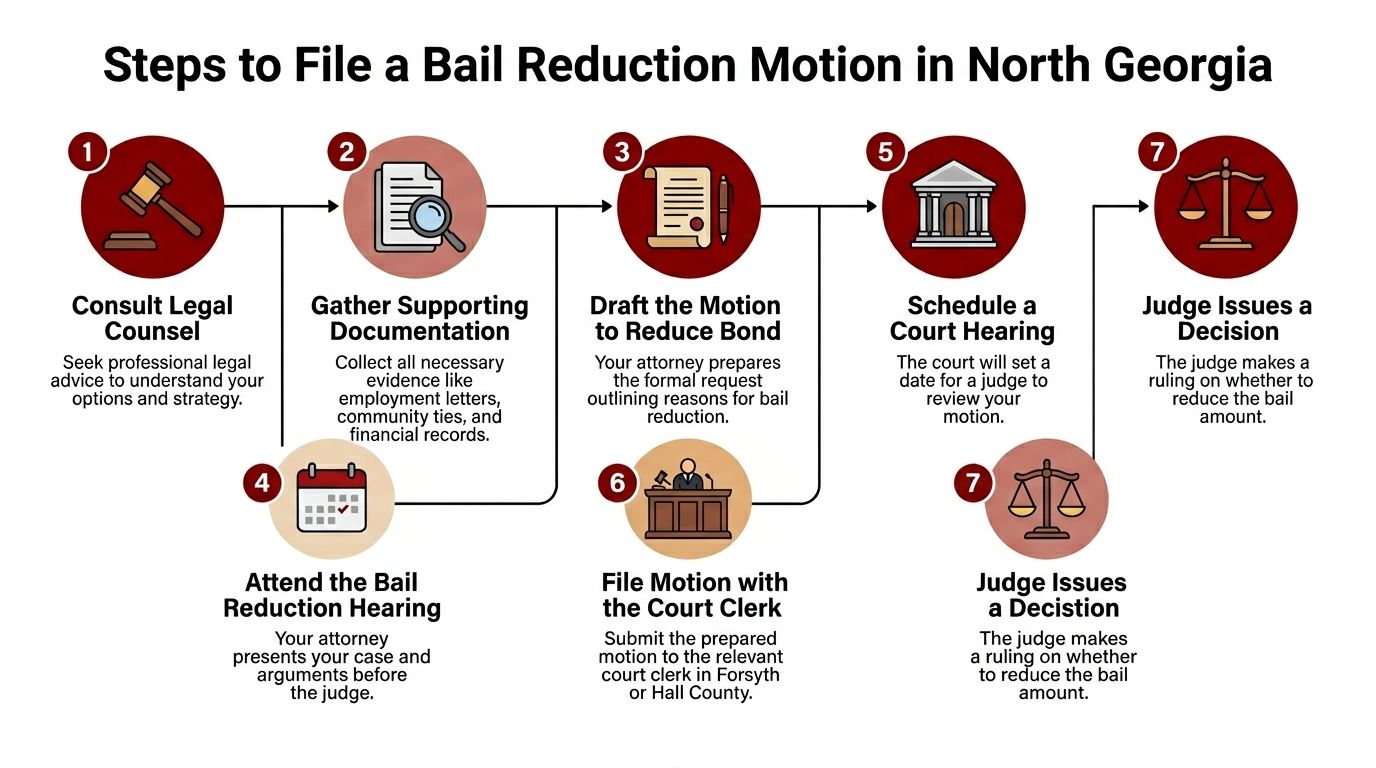
A bond reduction hearing doesn't begin with a speech in court. It begins with paperwork, timing, and preparation. In Forsyth County or Hall County, the attorney typically handles the filing, but families should understand the process well enough to help and to avoid accidental delay.
What the motion is asking the court to do
A Motion to Reduce Bond tells the court that the current amount is too high under the facts of the case and asks the judge to lower it. In Georgia cases, the motion is commonly grounded in the excessive bail principle and the considerations under O.C.G.A. § 17-6-1.
That filing isn't just a request for mercy. It should be a focused argument supported by documents. Judges want to know why the amount is more than necessary to secure appearance and protect the public. They also want to know what facts support release on a lower amount or under stricter conditions.
What usually goes into the filing
A strong motion often includes several moving parts:
The legal basis
The attorney cites the constitutional protection against excessive bail and the relevant Georgia statute.The factual background
The motion explains the charge, the amount of bond set, and the defendant's circumstances.Supporting exhibits
These may include employment records, proof of residence, financial information, and letters showing community support.A hearing request
The motion asks the court to place the matter on calendar for a judge to review.A release proposal
If appropriate, the attorney may suggest conditions that address the court's concerns.
Timing is not a small detail
Late filing hurts. According to this bond reduction overview, an experienced attorney typically files the motion citing the Eighth Amendment and Georgia's O.C.G.A. § 17-6-1, judges weigh financial resources, prior court appearance history, and community ties, and success rates can be 30-50% in non-violent felonies with attorney representation, compared with less than 10% for people representing themselves. The same source notes that a common pitfall is late filing because jurisdictions often have deadlines of 5-10 days post-arraignment.
That doesn't mean every case in Forsyth or Hall County will follow the same exact rhythm. Local calendars and courtroom schedules can move differently. But it does mean families shouldn't treat a bond reduction request like something to think about next week.
A rushed motion with no records behind it can be worse than waiting a short time to file it correctly. Judges notice the difference between urgency and disorder.
What families can do while the attorney files
The legal filing belongs to the lawyer. The factual packet often depends on the family. If you're helping someone in custody, use that time well.
Gather:
- Employment verification
- Pay stubs or income records
- Lease, mortgage, or utility records
- Names of close relatives in the area
- Any history of showing up for court
- Evidence of treatment, school, or caregiving responsibilities
- Anything that corrects bad assumptions in the initial bond setting
If the person lives in Cumming but works in Alpharetta, or lives in Suwanee and cares for family in Forsyth County, that context can matter. The court needs to see a real person with real anchors to the community, not just a case number.
What the timeline often feels like
Families often expect one of two extremes. They either think the hearing will happen immediately, or they assume nothing can happen for weeks. In reality, it is usually a defined process with waiting periods that feel longer because a loved one is still in jail.
The typical sequence looks like this:
| Stage | What happens |
|---|---|
| Arrest and bond set | Bail is assigned at the early stage of the case |
| Attorney retained | Defense counsel reviews the charge, record, and bond amount |
| Motion prepared | The lawyer drafts the request and gathers exhibits |
| Motion filed | The clerk receives the filing in the appropriate court |
| Hearing scheduled | The case is placed before a judge |
| Hearing held | The judge hears both sides and rules |
Most families feel better once they know there is a path, even if it isn't instant. Uncertainty is often harder than the work itself.
Building a Persuasive Case for a Lower Bail Amount
A lot of families think the hearing will turn on how emotional the courtroom becomes. It usually doesn't. Bail reduction hearings are won with records, verification, consistency, and a release plan the judge can trust.
Judges often reconsider initial bail amounts when new documentation shows that the person has confirmed employment, family support, financial limits, and stable community ties. Those points can significantly influence the outcome, especially for first-time, non-violent defendants, and proposing alternatives like electronic monitoring can also improve the request, as explained in Nolo's discussion of convincing a judge to lower bail.

What judges actually want to see
The word "community ties" gets thrown around a lot. Families hear it and assume it means showing that the person is liked. That's part of it, but not the important part. The court is looking for reasons to believe the defendant will stay put, follow conditions, and return to court.
Useful proof often includes:
- Job records. An employer letter is stronger than a family statement that "he has a job."
- Housing proof. A lease, mortgage statement, or utility bill helps establish a stable address.
- Family responsibilities. Documents showing caregiving obligations, dependent children, or shared residence can matter.
- Financial records. Pay stubs, tax documents, and bank records show whether the current bail amount is realistically affordable.
- School or treatment enrollment. If the person is in school, counseling, or a treatment program, that can support stability.
The strongest packets are specific
General statements don't travel far in court. Compare these two approaches.
| Weak presentation | Strong presentation |
|---|---|
| "He's a good guy and won't run." | Employer letter, lease, local family attendance, proof of income, and no missed court history |
| "She can't afford that amount." | Financial affidavit supported by pay records, tax documents, and account records |
| "This was out of character." | Clean record, treatment steps, community support letters, and a concrete supervision plan |
The judge doesn't know your family. Paperwork bridges that gap.
Bring documents that can be verified. If a fact matters, support it with something the court can read, date, and trust.
How families can help the lawyer build the record
Worried relatives become useful witnesses and organizers instead of just observers. Help the attorney by collecting a clean packet, not a loose pile of screenshots and half-remembered details.
Start with these priorities:
Employment file
Ask the employer for a short letter confirming position, schedule, and whether the job remains available.Residence proof
Pull a lease, deed, utility bill, or other record showing where the person lives.Financial hardship records
Gather recent pay stubs, tax records, and account records if the argument includes inability to pay.Support letters
Keep them short, factual, and focused on reliability, family role, and local ties.Court history
If the person has a good appearance history, make sure the attorney knows it.
Case-specific evidence matters
Not every charge calls for the same supporting material. A DUI case may benefit from proof that the person has already started taking steps to address the issue, such as evaluation, treatment, or structured support. A non-violent property case may focus more on work history, local residence, and family responsibilities. A probation-related matter may require a more careful strategy because the court may already be concerned about compliance.
In some cases, the better outcome may not be a lower cash amount at all. It may be release under conditions. Families trying to understand all options should also read about how a personal recognizance bond works in Georgia, because in the right case, the issue isn't only the number attached to the bond. It's the structure of release.
What weakens a good case
Some avoidable mistakes show up over and over:
- Unverified claims
- Missing documents
- Last-minute scrambling
- A family spokesperson who gets angry in court
- Conflicting stories about work, residence, or finances
- Ignoring obvious concerns like alcohol use, prior nonappearance, or protective-order issues
A persuasive case doesn't hide problems. It addresses them with a plan.
What to Expect at Your Bail Reduction Hearing
Families are often more nervous about the hearing than the person in custody. That's normal. Court feels formal, and many haven't seen a bond hearing up close. Once you know the rhythm, it becomes easier to focus on what matters.
The room itself is usually less dramatic than people expect. The judge has a calendar to move. The prosecutor is listening for risk factors. Defense counsel is trying to show that the current bail amount is higher than necessary and that there is a safer, more reasonable alternative.
How the hearing usually unfolds
The defense attorney goes first in most cases. The lawyer explains why the amount should come down and points the judge to the documents already filed or brought to court. That may include job verification, family support, proof of residence, financial information, and any release conditions the defense is willing to accept.
The prosecutor then responds. If the state opposes reduction, the argument usually centers on one or more concerns:
- Flight risk
- Public safety
- Prior failures to appear
- Criminal history
- The seriousness of the charge
- Victim concerns or no-contact issues
After both sides speak, the judge may ask questions. Sometimes the ruling comes immediately. Sometimes the court takes a brief pause before ruling.
What helps in the room
At a Georgia bond hearing, the court weighs the criteria under O.C.G.A. § 17-6-1, but presentation matters too. A common problem is poor preparation. Having family present can strengthen the showing of community ties, supported financial affidavits are stronger when backed by bank statements or tax returns, and proposing conditions like GPS monitoring can help because that strategy has been described as reducing flight risk by over 70% in this discussion of hearing tactics and pitfalls.
That doesn't mean more people in the gallery always equals a better result. It means thoughtful presence helps when it reinforces the story the defense is already telling.
Quiet, respectful family support often says more than an emotional outburst ever could.
What not to do
A hearing can go sideways for reasons that have nothing to do with the underlying charge. Families should avoid a few common mistakes:
- Don't interrupt the judge or prosecutor
- Don't argue from the gallery
- Don't exaggerate finances if records don't support it
- Don't surprise the lawyer with new facts at the last minute
- Don't assume the defendant needs to speak if counsel hasn't planned for it
If you're unsure what the hearing itself looks like, this overview of what happens at a bond hearing gives a helpful basic picture of the courtroom process.
The judge's possible rulings
There are usually a few realistic outcomes:
| Possible result | What it means |
|---|---|
| Bond reduced | The amount comes down and release may become easier to secure |
| Bond unchanged | The judge leaves the amount where it is |
| Conditions added | The court may lower the amount but impose supervision, no-contact terms, or monitoring |
| Further review later | In some cases, the issue may be revisited if circumstances change |
The hearing is important, but it isn't magic. Good cases can lose. Hard cases can improve with better documentation later. What matters is leaving court with a clear next step.
After the Hearing Your Next Steps for Fast Jail Release
Once the judge rules, the family's job changes fast. If bond is reduced, the focus becomes speed and accuracy. If the judge denies the request, the focus shifts to reassessing the release plan without wasting energy on panic.
If the judge lowers bail
Act immediately, but don't rush sloppily. The family member calling the bondsman should have the updated information in hand, not "I think the judge dropped it" or "my sister texted me a different number."
Use this checklist before you make that call.
| Information Needed | Why It's Important |
|---|---|
| Defendant's full legal name | Prevents confusion with similar names in the jail system |
| Booking number | Helps identify the correct inmate quickly |
| Jail location | Confirms where release paperwork must be handled |
| New bail amount | Determines the next release step and bond cost |
| Charge information | Affects eligibility and paperwork requirements |
| Court-imposed conditions | Lets the bondsman know whether special terms apply |
| Your contact information | Makes it easier to confirm documents and updates |
| Available documents | Speeds up approval and execution of the bond |
If you want a fuller overview of the release side, this guide on how bail bonds work in Forsyth County and when you need one walks through the basics clearly.
When families are organized, the release process moves more smoothly. That matters late at night, on weekends, and in the stretch after a hearing when everyone is tired and trying not to make mistakes.
What to say when you call
Keep the call simple and direct. A clean script helps.
You can say:
"I'm calling about a reduced bond for [full name]. They're being held at [jail]. The new bond amount is [amount]. The booking number is [number], and I need to know what you need from me right now to start the release process."
That kind of call gets better results than a ten-minute retelling of the arrest. The bondsman needs the key facts first.
If the judge denies the reduction
A denial hurts, especially when the family expected relief. But it doesn't always end the conversation. The next move depends on why the judge said no.
Sometimes the problem is the charge itself. Sometimes it is weak proof. Sometimes the court wants more assurance on supervision, residence, finances, or safety conditions. In those cases, defense counsel may later revisit the issue if circumstances change or if stronger evidence becomes available.
For the family, the practical options usually become:
- Post the existing bond if possible
- Ask the attorney whether new evidence could support another request later
- Focus on the criminal case itself while arranging release through the current bond structure
- Make sure there are no misunderstandings about conditions, holds, or related warrants
If the case involves a DUI, a warrant issue, or a probation concern, make sure the family understands whether any extra hurdles remain even after bond is addressed. Fast jail release can slow down if another hold appears in the file.
Keep expectations realistic
Even after bond is posted, release isn't always instant. Jails still have their own booking, processing, and release procedures. Families should stay reachable, keep phones on, and respond quickly if documents or signatures are needed.
The people who get through this best usually do three things well:
- They stay organized
- They listen closely to the attorney and bondsman
- They stop relying on rumors from other inmates' families
If you're searching for affordable bail bonds, no collateral bail bonds, or a bail bondsman in Cumming, Dawsonville, Alpharetta, or Suwanee, the right first move is always the same. Get the exact case information, confirm the current bond status, and choose the path that matches the case you have, not the one you hoped for.
A bond reduction can make release possible. When it doesn't, a clear release plan still matters. Either way, confusion is what slows families down most.
When you need calm, local help any time of day or night, One Call Bail Bonds is available 24/7 for Forsyth County, Hall County, and surrounding North Georgia. If your loved one has been arrested and you need help with fast jail release, bail bond questions, or understanding what information to gather next, their team can walk you through the process clearly and get started right away.