
The people who look up how to become a bail bondsman in Georgia usually fall into two groups. One group wants a career change. The other has seen what this work looks like up close, often after a late-night arrest in Cumming, Dawsonville, Alpharetta, Suwanee, or somewhere nearby, and realizes there's real value in being the steady person who can help when everyone else is panicking.
That part is real. This isn't a desk job where the phone can wait until morning. In North Georgia, calls come when families are scared, defendants are sitting in jail, and nobody in the room understands how bail works, what information is needed, or how fast release can happen. If you want to be the kind of bail bondsman people trust for 24 hour bail bonds, emergency bail bonds, DUI bail, or warrant assistance, you need more than a license. You need judgment, patience, and a reputation that holds up locally.
A Career in Community Justice
A lot of people enter this business thinking the work is mostly paperwork and money. It isn't. The paperwork matters, but the true job is helping people move through a bad night without making it worse.
A typical call might come after midnight. A husband has been arrested. His wife is trying to figure out whether he can be released before work the next day, what the jail needs, whether collateral is required, and whether anyone can answer the phone right now. If you're going to work as a bondsman in Forsyth County or Hall County, that's the environment you're stepping into.
What the job feels like day to day
Some days are fast. A family has the basic information ready, the bond can be written cleanly, and the release process moves the way it should. Other days are slower because names are misspelled, charges aren't clear yet, indemnitors don't understand their obligations, or the local process takes longer than the caller expected.
You're not just selling a service. You're reading risk, explaining obligations, and keeping people calm enough to make good decisions.
Practical rule: If you can't explain bail in plain English to a stressed family member at night, you're not ready to do this work professionally.
Why people stay in this business
The rewarding part is simple. You help people at one of the most stressful points in their lives. You also become part of a local justice network that includes courts, jail staff, attorneys, families, and sheriff's offices.
In a place like Cumming or Dawsonville, your name travels fast. If you're dependable, respectful, and available when others aren't, people remember. If you cut corners, they remember that too.
A good bondsman becomes known for a few things:
- Being reachable: people searching for bail bonds near me usually need help now, not during business hours.
- Staying composed: angry families, embarrassed defendants, and confused out-of-county callers need clear guidance.
- Knowing the local rhythm: fast jail release depends on understanding the county process, not just the law on paper.
- Protecting trust: every bond you write affects how local officers, courts, and clients view you.
That's why Georgia licensing matters. It's also why local approval matters just as much.
Foundational Eligibility and Background Requirements
Before you spend money on classes or applications, check whether you meet Georgia's base requirements. The state doesn't treat this as casual work, and neither should you.
According to Georgia bail bond requirements explained in detail, the baseline standard includes age, residency, citizenship, and criminal background requirements. These aren't suggestions. They're the gate.
The non-negotiables
Georgia requires an aspiring bondsman to be at least 18 years old, a Georgia resident for a minimum of one year, a U.S. citizen, and free of felony convictions or crimes of moral turpitude, as described in the state licensing overview for Georgia bondsmen.
That last part is where many people need to be brutally honest with themselves.
A bail bondsman handles release conditions, financial guarantees, and relationships with the court system. The state and the sheriff's office both want to see that you can be trusted in a role built on judgment.
What trips people up
A lot of applicants focus on whether they can pass a test and ignore whether their history will survive scrutiny. That's backwards. In this line of work, your background is part of your professional asset.
Use this checklist before you move forward:
- Age and residency: you need to satisfy the minimum age and the Georgia residency period before you apply.
- Citizenship proof: paperwork matters, and incomplete identity documents create avoidable delays.
- Criminal history: if your record raises character concerns, don't assume the state or county will overlook it.
- Local reputation: in North Georgia, people pay attention to how you carry yourself long before you ask for approval.
You can study your way past a weak exam result. You usually can't charm your way past a credibility problem.
Why the background standard is so strict
People hear “bail bondsman” and think the hard part is finding clients. The hard part starts earlier. The state is trying to keep unqualified people out of a sensitive role inside the justice process.
That's why the clean-record requirement matters so much. Clients trust you with family crises. Courts trust you to back a defendant's release. Sheriff's offices trust you to operate inside their county. If any of those players think your judgment is shaky, your path gets harder fast.
A practical self-test helps here.
| Question | Why it matters |
|---|---|
| Have you lived in Georgia long enough? | Residency is part of the baseline eligibility. |
| Can you document citizenship cleanly? | Missing documents slow the process before it starts. |
| Is your record clean enough to support trust? | Licensing and county approval both turn on credibility. |
| Would a local sheriff view you as reliable? | State eligibility alone doesn't make you operational. |
If you're uncertain on any one of those points, deal with that uncertainty first. Don't throw money at the next step and hope the issue solves itself later.
The Official Georgia Licensing Roadmap
A lot of applicants hit this stage thinking the hard part is just passing a test. In Georgia, the licensing path is more disciplined than that. The state wants proof that you can learn the insurance rules, follow procedure, and submit a clean file before any county takes you seriously.
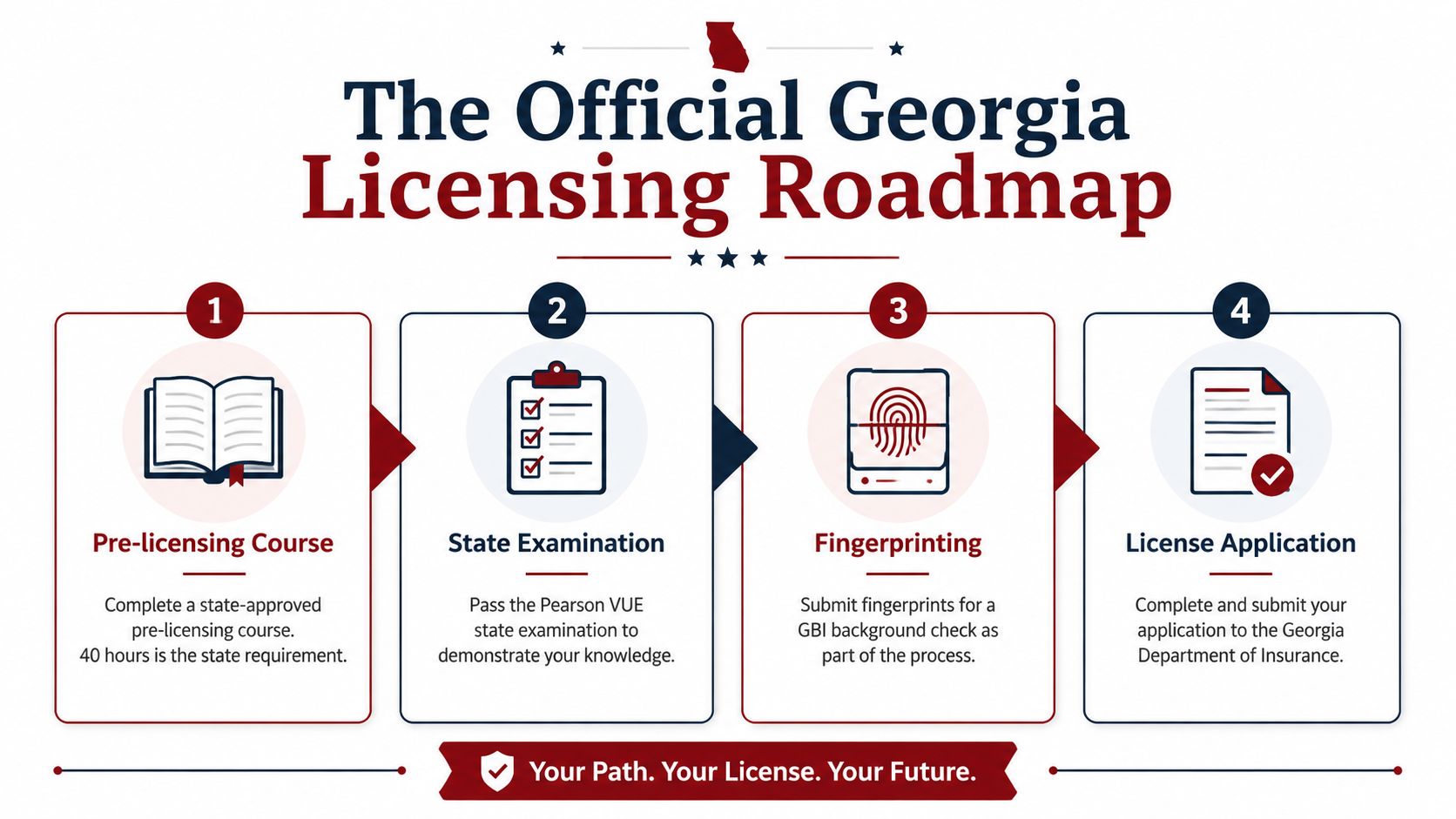
As noted earlier from the FemFounder guide, Georgia handles bail bonding through the Office of Insurance and Safety Fire Commissioner. The path runs in a clear order: pre-licensing education, the state exam, then the license application and fee. If you skip around or send in incomplete paperwork, you slow yourself down for no good reason.
Step one is education
Georgia requires a 40-hour pre-licensing course. New applicants sometimes treat that class like a hurdle to clear. That is a mistake.
The course is where you get the insurance foundation behind bail work. You need to understand liability, underwriting logic, state regulation, bond forms, and the language used by insurers and regulators. A bondsman who cannot speak that language usually creates trouble later, either in the application process or when real money is on the line.
Practical advice helps here.
- Show up ready to learn the insurance side, not just the jail side.
- Keep organized notes you can review before the exam.
- Mark the topics that feel foreign, especially indemnity, forfeiture, and compliance.
- Ask questions like someone who plans to write bonds for a living.
If you are still fuzzy on how the financial backing works behind a bond, this plain-English explanation of what a surety bond means in bail work will help you connect the classroom material to the actual business.
Step two is the state exam
After the course, you sit for the Georgia Property and Casualty Insurance Exam. It is administered through Pearson VUE. You need a passing score before the state will move your application forward.
Careless confidence costs people money in this profession.
Applicants who have worked around jails sometimes assume experience will carry them. It will not. The exam measures whether you understand the regulated insurance framework Georgia uses for this profession. If your study habits are sloppy, the score usually reflects it.
A stronger approach looks like this:
- Review your course notes by topic, not by page count.
- Spend extra time on the material you missed or guessed on during practice.
- Wait to schedule the exam until you can explain the concepts clearly.
- If you miss it the first time, fix the weak areas before paying for another attempt.
Passing the exam gets you through the state gate. It does not make you ready to work a frantic family call at 11:30 p.m. in Cumming or Gainesville.
Step three is your application package
Once you pass, you submit the casualty insurance agent license application online with the required supporting documents and the filing fee. This part is administrative, but it still weeds people out.
The state expects a complete package. That generally includes your course certificate, exam results, identification, and the required affidavit and payment. Missing documents, inconsistent names, and rushed uploads create delays that are completely avoidable.
I tell new people the same thing every time. Build the file before you open the portal. Save every document in a clean folder, confirm the names match, and review the affidavit and ID copies before you submit anything. Organized applicants look more credible because they are more credible.
Where applicants lose time
The licensing process is straightforward. The trouble usually comes from poor sequencing and weak preparation.
| Part of the process | What helps in practice |
|---|---|
| Pre-licensing course | Study it like job training, not class attendance |
| Exam prep | Focus on the subjects you do not know well |
| Application documents | Collect and review everything before you start filing |
| Submission | Check names, dates, signatures, and attachments carefully |
In North Georgia, this state license is only part of the job. It gives you the credential to pursue the work. It does not, by itself, put you in position to write bonds in Forsyth or Hall. Around here, getting established means pairing the state path with county-level trust and a workable surety relationship.
Securing Your Surety and Local Sheriff Approval
Many new applicants get surprised by this. A state license is necessary, but it doesn't automatically put you in business.
To work in practice, you need two things lined up properly. You need a surety relationship that supports the bonds you write, and you need approval from the county sheriff where you want to operate.
The surety side of the business
A new bondsman needs to understand the financial structure behind the work. You're not just filling out forms and waiting for calls. You're participating in a regulated system where a surety relationship matters.
If you need a plain-language explanation, this breakdown of what a surety bond is gives the business context in a way most new applicants can follow.
What works for beginners is usually one of these paths:
- Join an established agency: this is the easiest way to learn how surety relationships operate in practice.
- Build a reputation before asking for trust: surety partners care about professionalism, reliability, and risk judgment.
- Show consistency: if your paperwork, communication, and decision-making are erratic, people notice early.
Sheriff approval is where local reality kicks in
The county piece is often underexplained in online guides, but it's one of the most important parts of becoming operational in North Georgia. According to this Georgia bail bondsman overview focused on county approval, final approval to operate rests with the local county sheriff, and in counties such as Forsyth or Hall, that process can involve extensive vetting. The same source states that the sheriff can deny approval based on good moral character, even without a felony conviction.

That's the part many people miss. You can meet the state standard and still struggle locally if the sheriff's office doesn't view you as someone they want operating in that county.
Good moral character isn't a slogan in this business. It's a practical filter that affects whether you get in the door.
What helps in Forsyth and Hall
In local counties, approval is tied to trust. Not vague trust. Working trust.
A sheriff's office wants to know whether you are the kind of person who will conduct business responsibly, communicate professionally, and avoid creating unnecessary problems around jail release, defendants, and compliance.
Here's what usually helps:
- Clean presentation: organized records, prompt responses, and professional conduct matter.
- Local familiarity: understanding how Forsyth County or Hall County operates carries weight.
- Credible references: people who know your work ethic and character can matter.
- Patience with the process: acting entitled or impatient doesn't help your case.
What doesn't work is assuming that a state-issued credential forces local approval. It doesn't. County gatekeeping is part of the profession in Georgia, and serious applicants should treat it that way from the start.
Launching Your Career in North Georgia
Once you've cleared the formal hurdles, the career question becomes practical. Do you join an existing agency, or do you try to build your own operation?
In North Georgia, I usually tell people to think less about independence and more about competence. If you can't answer a frantic caller cleanly, if you don't know how local release flow works, and if you're not available when the phone rings, the market won't care that you hold a license.

Joining an agency or starting your own
A lot of new licensees do better inside an established office first. They learn intake, documentation, local jail procedures, communication under pressure, and how to judge a file before committing to a bond.
Starting your own shop gives you control, but it also means every mistake is yours. That includes client screening, after-hours responsiveness, paperwork discipline, reputation management, and local relationship building.
A simple comparison helps.
| Path | Best fit | Main challenge |
|---|---|---|
| Join an agency | New licensees who need reps and local guidance | Less control over branding and workflow |
| Start your own | Experienced operators with strong local credibility | You carry the operational pressure from day one |
If you're still learning the basics, agency experience is usually the smarter move. Not because you lack ambition, but because this business punishes avoidable mistakes.
What gets you hired
Agencies in places like Cumming, Dawsonville, Alpharetta, and Suwanee look for reliability before they look for polish. A good operator can teach systems. It's much harder to teach steadiness.
The strongest new hires tend to show these traits:
- Availability: people searching 24 hour bail bonds near me need someone who answers.
- Calm communication: families don't need legal jargon. They need clear next steps.
- Discretion: nobody wants their worst night handled by someone loud or careless.
- Local awareness: knowing the county process helps with fast jail release and realistic expectations.
If you build your own brand
If you decide to launch, your brand has to match the actual needs of the caller. Bail bond searches are urgent and decision-driven. People are looking for bail bonds Forsyth County, bail bondsman Cumming, affordable bail bonds, DUI bail, warrant assistance, how to post bail, and inmate release Forsyth County because they need a result, not a slogan.
A good new operator should study practical steps for starting a bail bond business and then build around three things:
- Speed: answer calls, return texts, and move paperwork without delay.
- Trust: explain obligations clearly, especially when callers ask about collateral or payment.
- Visibility: if people can't find you when they search locally, you won't get the emergency call.
In this business, the first professional who answers clearly often gets the client.
What actually builds a local reputation
Fancy branding won't save weak service. People remember whether you picked up, whether you told them the truth, and whether you treated them with respect when they were under stress.
That matters even more in a county-based business. Attorneys remember. Families remember. Jail staff remember. If your goal is to become known across Forsyth County and the surrounding North Georgia area, build your name around consistent conduct, not hype.
Advanced Skills and Continuing Obligations
Getting licensed is the entry point. Staying useful is the career.
A strong bondsman keeps learning after the paperwork is done. The best ones get sharper at reading people, documenting files cleanly, spotting weak cases early, and communicating in a way that lowers confusion instead of adding to it.
Staying compliant over time
The legal and county side of this business doesn't freeze just because you're operational. You need to keep your credentials, your relationships, and your habits in good shape.
That means paying attention to:
- Continuing education: if the state or related role requires it, treat it as part of the job, not an annoyance.
- Local expectations: county approval isn't something to disrespect once you've received it.
- Professional conduct: every interaction can either strengthen or weaken your standing.
- Record discipline: clean files and clean communication protect you later.
A bondsman who gets casual about compliance usually creates bigger problems than he realizes at the time.
Bail recovery is not the same job
A lot of newcomers assume bail recovery is just the next stage of being a bondsman. Georgia treats it as a separate path.
According to Georgia bail recovery requirements and related bail laws, a bail recovery agent in Georgia must be at least 25 years old, may need a gun license, must complete a separate 8-hour continuing education course annually, and must be re-approved by the local sheriff each year.
That has two practical implications.
First, don't market yourself as a recovery agent just because you're licensed as a bondsman. They're different roles with different obligations.
Second, if you want to grow into recovery work later, start building the right habits now. Good documentation, calm judgment, respect for procedure, and strong county relationships matter even more there.
The long game
The bondsmen who last in this field don't treat it like hustle work. They treat it like a profession with public consequences.
If you want to know how to become a bail bondsman in Georgia and stay in the business, the answer is bigger than passing the exam. Build credibility. Protect your name. Learn the county culture where you work. Stay teachable.
That's how you move from “newly licensed” to “trusted locally.”
If you need immediate help with bail in Forsyth County, Hall County, or nearby North Georgia, One Call Bail Bonds is available around the clock to help with jail release, explain the process clearly, and get the next steps moving fast. Whether you're dealing with a late-night arrest, DUI bail, warrant concerns, or urgent questions about how to post bail, their team provides direct, professional guidance when timing matters most.