
When exploring how to become a bail bondsman in ga, you're probably in one of two places. Either you need a career that moves faster than a desk job ever will, or you've already seen the bail side up close and you know this work matters when families are scared, tired, and trying to get someone home.
This business isn't built for people who want a quiet schedule. Calls come late. Paperwork still has to be right. Families ask the same question in ten different ways because they're stressed, and your job is to stay steady when nobody else in the room is. In North Georgia, especially around Cumming, Dawsonville, Alpharetta, Suwanee, Forsyth County, and Hall County, the bondsman people trust is usually the one who answers fast, explains things clearly, and knows the local process without guessing.
A lot of guides make this sound like a simple checklist. Get licensed, pass a test, open shop. That's not how it works in real life. The path consists of two parts. First, you become legally qualified. Then you prove you can operate and build trust in the counties where you want to write bonds.
Is a Career as a Bail Bondsman Right for You
The people who do well in this line of work usually don't say they were looking for an easy career. They were looking for one that keeps them engaged, puts them in direct contact with the public, and gives them a real role in urgent situations.
A bondsman doesn't just post paperwork and wait. You speak with worried parents, spouses, friends, attorneys, and sometimes employers. You explain what bail means, what the indemnitor is agreeing to, what the defendant has to do next, and what can go wrong if anybody stops communicating. That takes patience and control.
What the job actually feels like
Some days are quiet and detail-heavy. You return calls, verify information, handle documentation, and stay on top of court-related obligations. Other days are all movement. A new arrest comes in, a family is searching for 24 hour bail bonds near me, and they need someone who can cut through panic and start the release process without wasting time.
If you need a fixed routine, this work will wear on you. If you can stay calm while other people are rattled, you'll have a better shot.
Practical rule: If you hate interruptions, emotional conversations, and last-minute problems, this probably isn't your field.
Traits that matter more than people think
Licensing matters, but temperament matters just as much. Strong new bondsmen usually share a few habits:
- They answer clearly: Clients don't need jargon. They need plain language, especially when asking how to post bail or what happens next.
- They stay organized: Missed details create bigger problems later.
- They don't get flustered: Jail release work often starts with incomplete information.
- They respect people: You're dealing with people on one of the worst days of their lives.
- They can be available: This business is tied to arrests, not office hours.
There is also a hard truth that new people need to hear early. The public-facing part of the job is only one side of it. The other side is risk judgment. You have to read people well, spot weak information, and know when a bad file is going to become a bigger problem.
Why local knowledge matters from day one
In North Georgia, clients looking for fast jail release, emergency bail bonds, DUI bail, or warrant assistance aren't shopping for theory. They're looking for someone who knows the local flow and can move quickly without making mistakes.
That means the career fits best for someone who likes being useful under pressure and who understands that responsiveness is part of the product. In places like Forsyth and Hall, speed and trust aren't marketing slogans. They're the standard people expect.
Meeting Georgia's Foundational Requirements
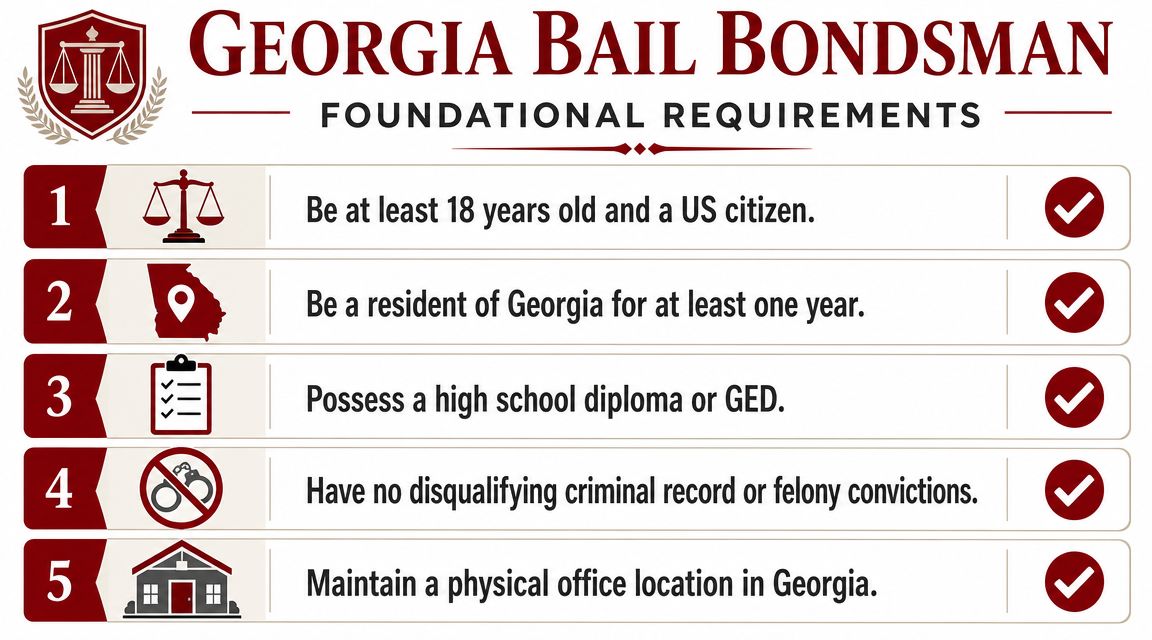
Before you spend money on courses or start studying for exams, make sure you can clear the first gate. Georgia sets baseline qualifications for anyone who wants to hold themselves out as a surety for compensation.
According to Georgia bail law, a professional bondsman must be at least 18 years old, must have been a Georgia resident for at least one year before applying, must have good moral character, must have no felony conviction or crime involving moral turpitude, and must be approved by the sheriff while remaining in good standing with applicable federal, state, and local rules in the county where the business operates, as outlined in Georgia Code requirements summarized here.
What those requirements mean in practice
A lot of people read that list and treat it like paperwork. That misses the point.
The age and residency requirements tell the state and the county that you have a real connection to Georgia. The character and criminal history standards speak for themselves. This business deals with court obligations, financial guarantees, and public trust. If your background raises serious credibility problems, the path narrows quickly.
The part many applicants underestimate is sheriff approval. This is not a side note. It is part of the foundation of being allowed to operate.
The sheriff approval issue most applicants learn too late
If you plan to work in North Georgia, you need to think county first, not just state first. The sheriff's office does more than acknowledge that you exist. The county is deciding whether it will allow you to function in that local system.
That matters in real working terms. You can satisfy broad state-level requirements and still run into county-level resistance if you haven't handled local expectations properly. That's why it's smart to review practical guidance on Georgia bail bondsman requirements in Forsyth County before you invest too far down the road.
County approval isn't optional in Georgia. It sits at the center of whether you can turn qualifications into actual work.
A clean way to assess yourself early
Before moving ahead, ask yourself these questions:
- Residency question: Have you met the Georgia residency requirement long enough to apply?
- Background question: Is there anything in your record that could trigger concern under the character standards?
- County question: Have you verified what the sheriff in your target county expects?
- Professional question: Are you prepared to stay in good standing with local rules after approval, not just at the moment of application?
People waste time when they assume the state process is the whole process. It isn't. In this business, local acceptance is part of the entry ticket.
The Licensing Gauntlet Education and Exams
A lot of applicants hit this stage thinking the hard part is memorizing terms and passing tests. The harder part is getting through the process in the right order, with the right paperwork, and without wasting weeks on avoidable mistakes.
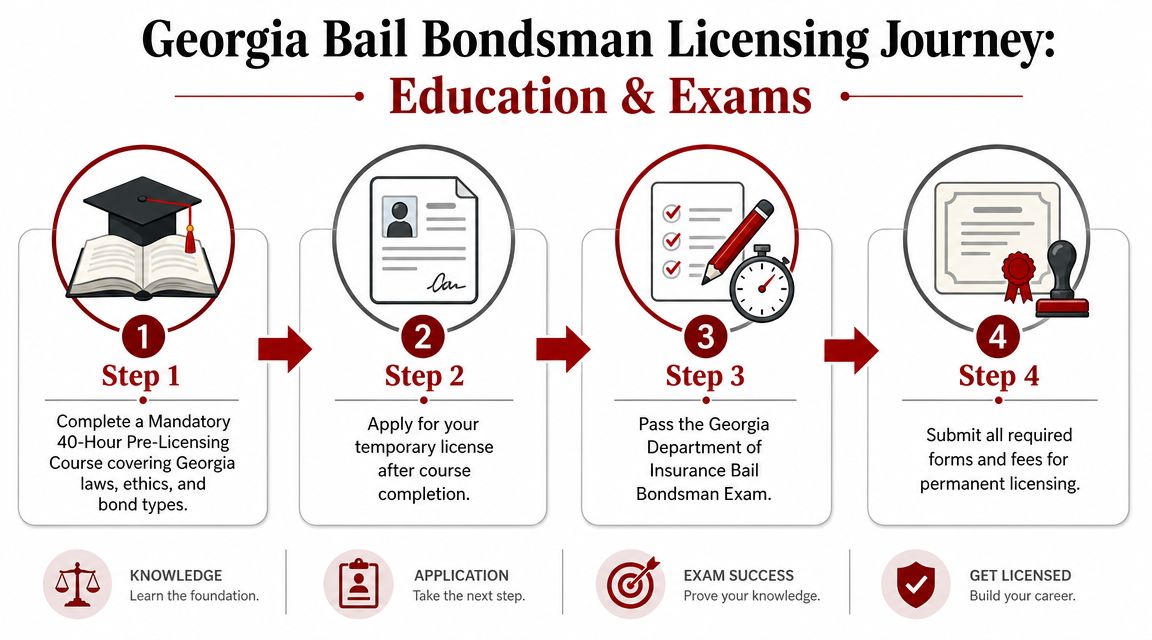
Georgia treats bail bonding as an insurance-related license path, so the education and exam side is more formal than many newcomers expect. The state requires pre-licensing education, testing, and a completed application packet through the Georgia Office of Commissioner of Insurance and Safety Fire. You can review the current licensing and exam information directly through the Georgia Office of Commissioner of Insurance and Safety Fire.
The order matters
Applicants who move through this cleanly usually follow a simple sequence:
Finish the required pre-licensing education
Do the course for understanding, not just the certificate. You need the language and the mechanics.Pass the required exam or exams tied to licensure
Treat each test as part of the same process. Weak preparation on the insurance side can stall the whole application.Assemble the full application packet
Missing affidavits, identification, course proof, or score reports create delays that were easy to avoid.Submit everything in a form the state can process without chasing you down
Clean files move faster than messy ones.
That sounds simple. It is not hard, but it is exacting.
The applicants who get tripped up are usually not careless people. They are often people with courtroom exposure, law enforcement contacts, or collections experience who assume the testing piece will be easy. Then they rush the insurance material, skim the forms, and lose time fixing preventable errors.
How to prepare like someone who plans to work the job
Study for retention. Cramming may get you through a quiz. It does not help much when a defendant's family is asking questions at 11 p.m. and you need to explain indemnity, forfeiture risk, and why a bond cannot be written the way they want.
A better approach is to break your prep into working categories:
- Bond law and procedure: Know the rules, timelines, and limits.
- Insurance concepts: Understand surety, risk, underwriting, and liability.
- Forms and filings: Learn what each document does and why mistakes matter.
- Ethics and judgment: The exam may test it, but the field will test it harder.
If you want a practical overview that connects the classroom side to real work, review this guide to bail bondsman training in North Georgia.
Where new applicants lose time
The course is usually manageable. The weak points show up in execution.
| Problem | What happens next |
|---|---|
| Treating the course like a box to check | Poor recall during testing and poor judgment later in the field |
| Underestimating the insurance exam | Failed attempts, extra fees, and delayed application timing |
| Sending an incomplete packet | Processing delays and follow-up requests from the state |
| Memorizing terms without understanding bond practice | Confusion once real clients and real risk enter the picture |
One hard truth. Passing exams proves you can meet the state's baseline. It does not prove you are ready for a desk in Forsyth or Hall County, and it definitely does not prove an agency will trust you with its name, collateral, or client relationships.
That gap is what separates licensing from an actual career.
From License to Livelihood Your First Steps in the Field
Getting licensed feels like the finish line until you realize it's the starting line. A license gives you legal standing. It doesn't automatically give you volume, judgment, or a local reputation.
That gap matters. New bondsmen often think the hard part was passing the course and exams. In reality, the next phase can be tougher because now other people are deciding whether they trust you with real files, real clients, and real risk.

Your first real career decision
Most new licensees move in one of two directions. They either join an established agency, or they try to build an operation with far more independence from the start.
Here's the practical comparison:
| Path | Upside | Risk |
|---|---|---|
| Work with an established agency | Mentorship, systems, exposure to live files, local process knowledge | Less control early on |
| Try to go more independent early | More autonomy, direct ownership over your approach | Harder learning curve, fewer guardrails, slower trust-building |
For most new people, joining a solid agency is the smarter move. Not because independence is impossible, but because this work has too many moving parts for guesswork. You need to see how experienced bondsmen handle intake, client screening, paperwork flow, family communication, and county-specific problems.
Why mentorship shortens the painful part
The early mistakes in this business usually aren't dramatic. They're procedural. A missed detail in intake. A bad assumption about local handling. Weak communication with indemnitors. Poor record discipline.
Those mistakes can pile up.
If you join an existing operation, you learn by watching how working bondsmen move from first call to release. You also see how they talk to people who are asking urgent questions like how to post bail, how quickly release might happen, or what information is needed to get started.
A new bondsman doesn't need more theory first. A new bondsman needs reps, supervision, and a clean process.
If you're thinking beyond licensing and trying to understand the business side, review guidance on how to start a bail bond business in Georgia with realistic expectations. The legal credential is one piece. Operating well is another.
What your first year should really focus on
Your goal early on shouldn't be to look seasoned. It should be to become reliable.
Focus on:
- Answering the phone well: Urgent callers decide fast who sounds competent.
- Learning local workflow: Release work depends on knowing who needs what and when.
- Handling documentation cleanly: Small errors have a way of resurfacing later.
- Protecting your reputation: In local markets, word travels faster than most beginners think.
The bondsmen who last aren't always the loudest. They're the ones people can count on when the call comes in late and the facts are messy.
Thriving in North Georgia The Unwritten Rules for Success
North Georgia is where the difference between being licensed and being effective becomes obvious. In theory, a state credential opens the door. In practice, your ability to work depends on whether the counties you care about will let you function smoothly and consistently.
A common blind spot for new bondsmen is the gap between state insurance licensure and county-level operational approval. State guides often explain the course and exam path, but they understate that a state license does not guarantee the right to work in any given county. Local sheriff's offices in places like Forsyth and Hall have their own approval processes and renewal requirements that can block or delay operations, as noted in this Georgia county-approval overview.
What clients in Forsyth and Hall actually care about
The public doesn't separate your career path into licensing categories. They care whether you can help now.
Someone searching bail bonds Forsyth County, bail bondsman Cumming, 24 hour bail bonds near me, emergency bail bonds, inmate release Forsyth County, or DUI bail is usually measuring three things very quickly:
- Can you answer right away
- Do you know the local process
- Can you explain the next step without confusion
That means local fluency becomes part of your value. You need to know how your county handles things, what information families usually have, what they usually don't have, and how to move a file forward without adding friction.
The unwritten rules that separate beginners from professionals
There are a few rules nobody should have to learn the hard way.
Be fast, but don't rush
Urgency matters in this business. Sloppiness does damage. People under pressure often give partial or incorrect details. A good bondsman moves quickly, but still verifies what matters before acting.
Learn the local personalities and procedures
County systems are run by people, not by generic flowcharts. The more familiar you are with the actual local rhythm, the fewer mistakes you'll make.
Treat discretion like part of the service
Many callers are embarrassed, angry, or scared someone at work or in the family will find out. If you handle those conversations with calm professionalism, people remember it.
In North Georgia, the bondsman who gets trusted first is usually the one who sounds steady, local, and prepared.
Stay compliant after approval
Some applicants act like county approval is a one-time hurdle. It isn't. Your ability to keep working depends on continued good standing. If you get casual about compliance, relationships, or local expectations, that catches up with you.
Why this matters for building a real career
If you want to last in Forsyth, Hall, Cumming, Dawsonville, Alpharetta, or Suwanee, don't think of yourself as someone who merely posts bonds. Think of yourself as someone who solves urgent release problems inside a specific local system.
That mindset changes everything. It improves how you communicate, how you prepare files, how you build trust, and how you handle those late-night calls from families who don't know where to start. That's where careers get built.
Your Questions on Becoming a Georgia Bail Bondsman Answered
A lot of applicants hit the same moment. They have read the state requirements, maybe even started classwork, and then important questions surface. How much cash do I need? How long will this take? Will a license truly get me in the door in Forsyth or Hall County?
What costs can you identify upfront
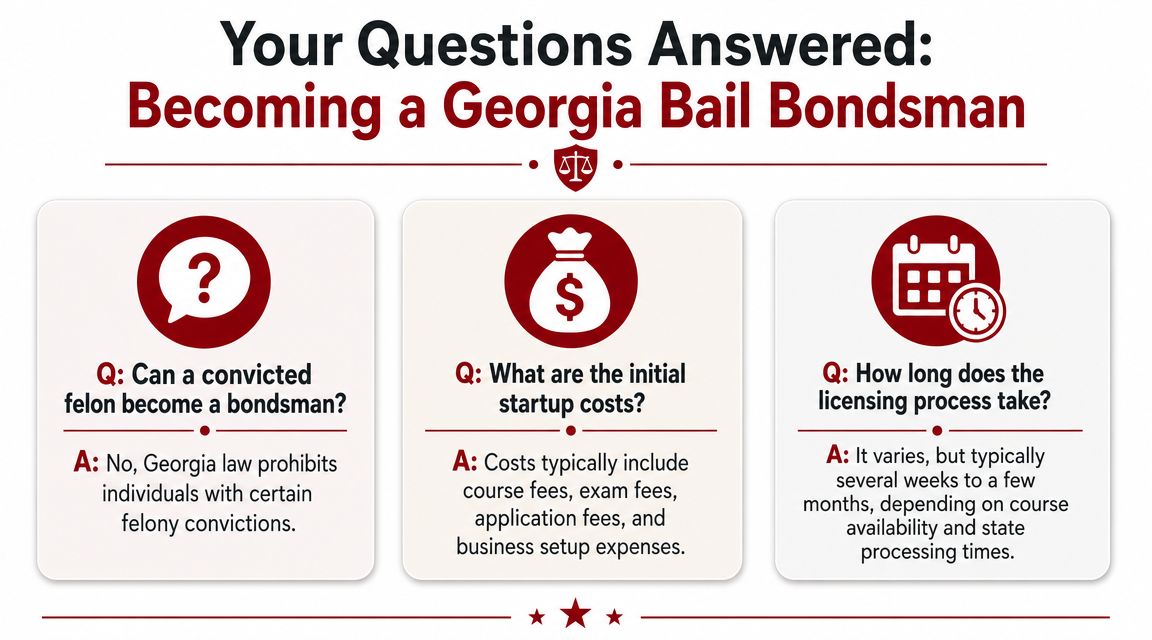
You can usually pin down a few licensing costs early. The rest depends on how you train, where you apply, and whether you join an agency or try to build from scratch. Georgia's insurance licensing information is published through the Georgia Office of Commissioner of Insurance and Safety Fire, and that is the better place to confirm current state fees before you spend money.
The bigger mistake is budgeting only for the state piece. New bondsmen also spend money on pre-licensing education, fingerprints or background-related paperwork where required, business clothing, reliable transportation, phone coverage, and county-specific filing steps. If you plan to work North Georgia jails, expect mileage and time costs to add up fast.
How long does the process take
There is no honest one-size-fits-all answer.
Some people move through the education and exam side without much trouble, then stall for weeks because paperwork is incomplete or local approval takes longer than expected. Others lose time earlier because they pick a county first, but never ask how that county wants applications handled in practice.
In Forsyth and Hall County, speed usually comes from preparation, not luck. Have your documents in order, confirm local expectations early, and do not assume the state timeline tells you anything about how quickly you will be working cases.
If you're licensed by the state, can any county in North Georgia put you to work immediately
No. A state credential helps you qualify. It does not guarantee that a sheriff, court system, or local operation will have you writing bonds right away.
That gap surprises a lot of people entering the trade. Getting licensed means you cleared one hurdle. Getting hired, trusted, and allowed to function inside a specific county system is a separate step. In North Georgia, that difference matters more than many guides admit.
What's the best next step after getting licensed if you want to work in Cumming or Dawsonville
Get inside a real office and learn the work from the ground up.
That means answering stressed family calls, checking charges, handling paperwork cleanly, learning who to contact after hours, and watching how experienced bondsmen protect themselves from bad information. A new license holder who joins an established local team usually gets better faster than someone trying to figure out county habits alone.
I have seen plenty of people pass the required steps and still struggle because no one showed them how the job runs on a Tuesday night when a caller has half the facts wrong and wants a release by morning.
What kind of person usually succeeds in this business
The people who last are steady, organized, and hard to rattle. They do not chase the image of the job. They handle interrupted sleep, messy facts, emotional families, and strict procedures without cutting corners.
Good signs include:
- Calm communication under pressure
- Comfort with irregular hours
- Good judgment with money and people
- Respect for paperwork and deadlines
- A real interest in local reputation
A license can get you considered. Your habits decide whether you stay.
What should you remember most about how to become a bail bondsman in ga
Keep the split clear in your head. There is the legal path to qualify, and there is the practical path to make a living.
The first path is exams, forms, and approval. The second is county relationships, trust, clean files, fast response times, and a reputation that holds up in places like Cumming, Gainesville, and the surrounding courts and jails. That is the difference between being licensed on paper and being useful in the field.
If you're ready to move from research to real-world direction, One Call Bail Bonds is a strong place to start. They serve Forsyth County, Hall County, and surrounding North Georgia communities from Cumming, and they understand the gap between being licensed on paper and becoming effective in the field. For someone serious about working in bail, local guidance matters. So does seeing how experienced bondsmen handle urgent calls, jail release questions, and county-specific process issues in real time.