
In Georgia, police generally can’t keep someone after a warrantless arrest without judicial review past 48 hours, and Georgia also requires a first appearance within 72 hours. Those are the outside limits, not the timeline you should wait on, because release efforts can often start much sooner.
If you’re reading this after getting a late-night call from the Forsyth County jail, you probably don’t care about legal theory first. You want to know whether your person is stuck there all weekend, whether charges have to be filed right away, and what you can do before the system slowly catches up.
That’s the right instinct. Families lose time when they assume they have to sit and wait for the court’s deadline. In real life, the fastest path is usually to start the release process as soon as booking begins, track the custody timeline carefully, and avoid the mistakes that make a bad night turn into extra jail time.
What Happens After an Arrest in Forsyth County
The first stage feels chaotic because it is. A person is taken into custody, transported for booking, searched, entered into the jail system, and held while the arrest paperwork moves through the jail and court channels. Family members usually get only fragments of information. A quick phone call. A charge that sounds incomplete. A location, maybe.
That uncertainty causes people to freeze. They tell themselves they’ll wait until morning, wait for the jail to call back, or wait until a judge sets something. Waiting is usually the slowest option.
The first few hours matter most
A warrantless arrest starts two tracks at the same time. One is the legal track, where the government has to justify continued detention within the required timeline. The other is the practical track, where booking, bond information, and release eligibility get sorted out.
Those tracks don’t move at the same speed.
Practical rule: The legal deadline tells you when the state must act. It does not tell you when your family should start acting.
In Forsyth County, families often want one clear answer to “how long can police hold you without charges.” The better question in the moment is, “What is stopping release right now?” Sometimes it’s that booking isn’t complete yet. Sometimes bail hasn’t been set. Sometimes the person has a hold, a warrant issue, or incomplete information in the system.
What families should do right away
Use the first hour to gather facts, not to argue with the jail.
- Confirm the full name used at booking: Nicknames and shortened names slow searches.
- Find the jail location: Forsyth and Hall County procedures are similar in some ways, but they aren’t identical.
- Ask what the arrest is for: Even a rough answer helps narrow down likely release options.
- Start learning the post-arrest process: This guide to what happens after you get arrested gives a clear picture of the sequence families usually face.
A common mistake is calling multiple people for opinions before confirming basics. Another is assuming “no charges yet” means “they have to let him out now.” That isn’t how it works after a full arrest. There is a process, and that process has deadlines. But those deadlines are not a reason to sit still.
What works and what doesn’t
Here’s the short version:
| What helps | What slows things down |
|---|---|
| Getting accurate booking details early | Guessing at charges or jail location |
| Tracking when custody began | Assuming the clock starts when family finds out |
| Staying calm with jail staff | Angry calls that produce no new information |
| Moving on release options immediately | Waiting for the maximum legal deadline |
Most families feel better once they know this much: jail time after arrest isn’t one long mystery. It’s a sequence. If you know where your person is in that sequence, you can make smarter decisions fast.
Understanding Your Rights During Initial Detention
Before a formal arrest, there’s often a shorter police encounter that people misunderstand. An officer may stop someone, question them, and keep them there temporarily based on suspicion. That is not the same thing as being arrested and booked into jail.
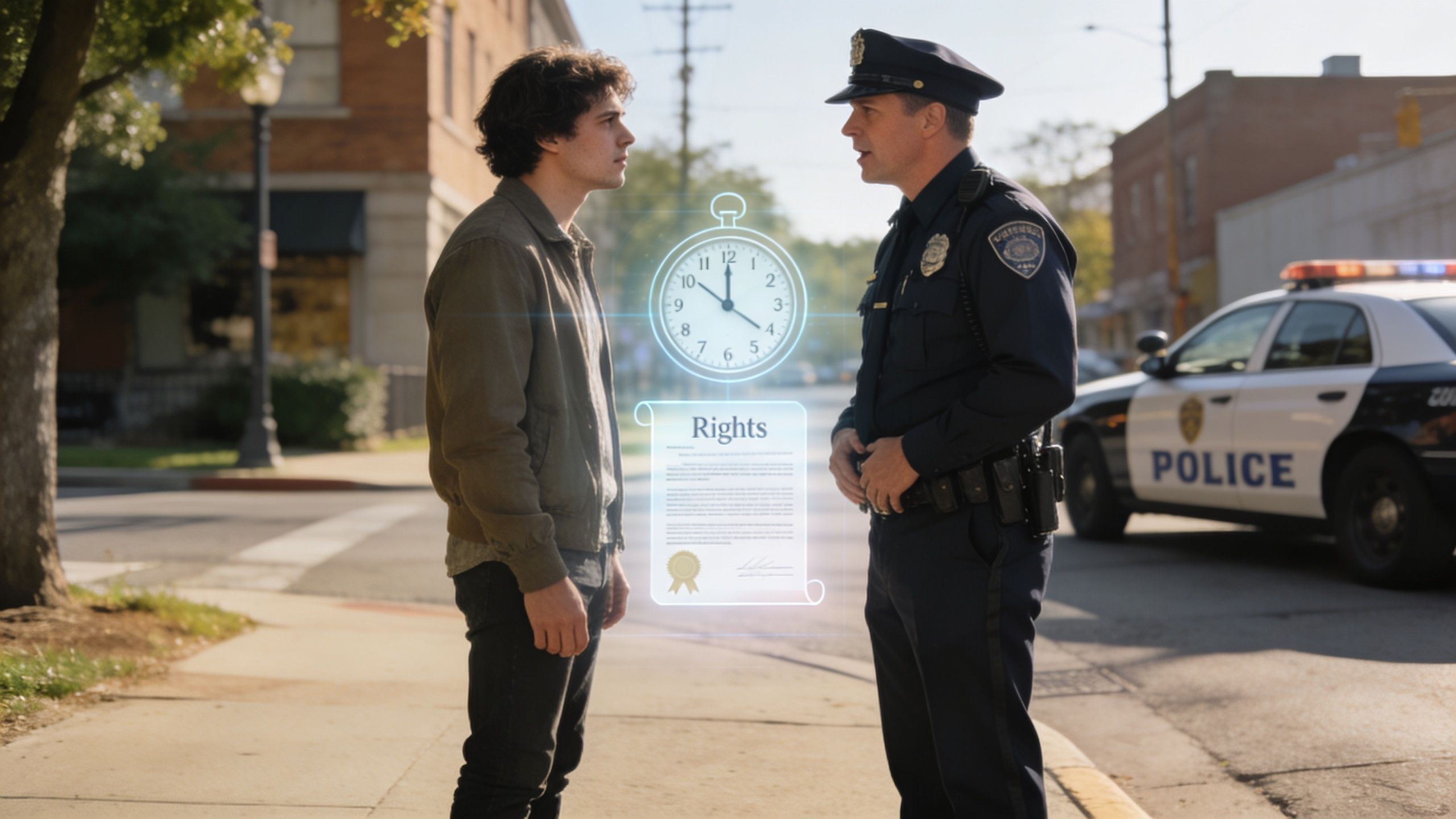
Under Terry v. Ohio as described here, police can briefly detain a person for investigative purposes without charges or an arrest, but that detention is limited to 20 minutes to verify or dispel reasonable suspicion.
Detention is not the same as arrest
People frequently talk themselves into trouble. They think, “If I just explain enough, they’ll let me go.” Sometimes that happens. Sometimes the explanation gives police the extra facts they need to justify an arrest.
During an initial detention, the safest approach is usually simple and respectful. Identify yourself if required. Don’t resist. Don’t volunteer details. Don’t try to talk your way out of a bad set of facts on the roadside.
If an officer is still deciding whether to arrest, your words can change that decision. Silence can’t be taken back later.
A short stop should stay short. If officers are checking a description, sorting out a misunderstanding, or confirming whether there’s cause to proceed, that’s one thing. If they keep someone far beyond that brief investigative window without moving to arrest or release, the detention raises a different set of legal issues.
What to do during an investigative hold
The best response is calm, not clever.
- Ask if you’re free to leave. If the answer is yes, leave.
- If the answer is no, don’t argue on the street. Street arguments rarely help.
- Use the right to remain silent carefully. You don’t have to fill every silence.
- Do not consent to extra searches casually. If police have lawful grounds, they’ll act on them. If they don’t, don’t supply consent out of panic.
Signs the encounter is changing
A brief stop can become a formal arrest quickly. Watch for these changes:
- Movement to another location: Transportation often signals a different phase.
- Search tied to arrest procedures: Pat-downs and booking searches are not the same thing.
- Handcuffs plus transport: At that point, the family’s focus shifts from “end the stop” to “start planning release.”
People often ask how long can police hold you without charges when they really mean two different things. The first is roadside or street detention. The second is jail custody after arrest. Those are different clocks, and mixing them up causes confusion.
The Federal 48-Hour Rule for Holding a Suspect
Once a person has been arrested without a warrant and taken into custody, the government has to justify keeping that person there. In such circumstances, the federal rule matters most.
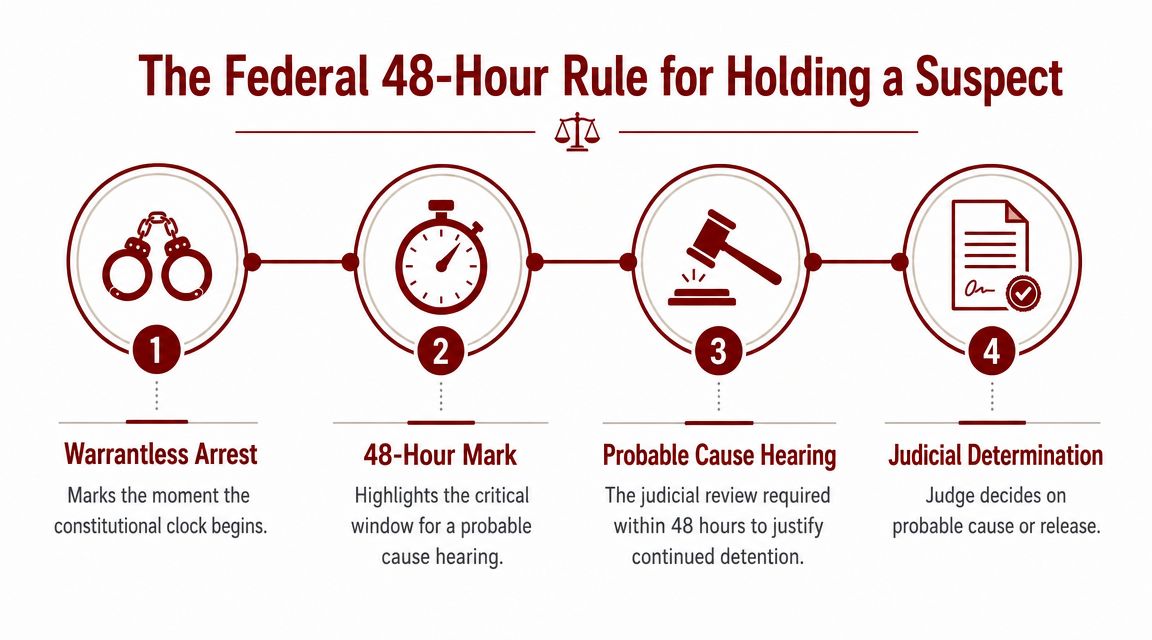
Under County of Riverside v. McLaughlin as summarized here, police must bring an arrested person before a judge for a probable cause determination within 48 hours of custody, or release them without formal charges.
What probable cause means in plain English
Probable cause is the legal basis for holding someone after arrest. It means there must be enough facts to support the arrest, not just a vague hunch. A judge reviews whether the police had a legally sufficient reason to keep the person in custody.
That hearing is not a full trial. It is a checkpoint.
The court isn’t deciding guilt at that stage. The court is deciding whether continued detention is justified under the Constitution.
Why the 48-hour mark matters to families
The 48-hour rule is important because it prevents indefinite holding after a warrantless arrest. But families often misunderstand it in one of two ways.
First, some people think release is automatic before that deadline. It isn’t. Second, some think nothing can be done until that deadline arrives. That’s also wrong.
A deadline is a ceiling, not a recommended wait time.
The practical goal is still earlier release. If bond can be arranged, information can be verified, and the jail process can move, there is no reason to treat the federal maximum like a target.
The timeline in simple form
| Stage | What it means for the family |
|---|---|
| Arrest and booking | Confirm custody details and charges if available |
| Custody clock starts | Track the actual arrest time as closely as possible |
| Judicial review window | Watch for probable cause review before 48 hours |
| Continued detention or release | Bond, court action, or release determines next move |
A lot of frustration comes from dead time between booking and court review. That window feels inactive to families, but it isn’t. Paperwork is moving. Jail staff are processing. Judges and magistrates may not yet have touched the file. That’s why organized action early matters more than repeated panic calls later.
How Georgia Law Impacts Jail Time in Forsyth & Hall County
Federal rules set the constitutional floor. Georgia procedure adds another local layer, and that’s where families in Cumming, Dawsonville, Alpharetta, Suwanee, and the surrounding North Georgia area often get confused.

In Georgia, O.C.G.A. § 17-4-26 is summarized here as requiring a first appearance within 72 hours, but that process is still subject to the federal 48-hour probable cause standard from County of Riverside v. McLaughlin.
Why the local process matters
On paper, people see 48 hours and 72 hours and assume one of them must be the “real” answer. In practice, both matter, but they affect different parts of the process.
The federal standard limits how long a person can be held after a warrantless arrest without a judicial probable cause determination. Georgia’s rule addresses first appearance timing. In a real jail setting, those events can feel blended together to families, but they are not exactly the same legal checkpoint.
That distinction matters because local procedure affects speed. Booking practices, magistrate availability, staffing, paperwork flow, and charge type all shape how quickly a person moves from intake to bondable release.
Forsyth and Hall County reality on the ground
Families usually don’t need more theory. They need to know what slows release in local custody.
Here are the pressure points:
- Incomplete booking information: If the name, date of birth, or charge information is wrong or missing, release planning stalls.
- Hold issues: Another county’s interest, a warrant question, or a separate agency hold can stop a simple bond release from being simple.
- Charge-specific handling: DUI bail, probation-related issues, or more serious criminal charges may trigger extra review before release can move.
- Timing of arrest: Night, weekend, and holiday arrests can create practical delays even when rights remain in place.
A local operator knows the difference between “nothing can happen yet” and “the right paperwork just hasn’t been pushed.” That’s not a small difference. It can be the difference between a release moving today or drifting into the next available court window.
What local knowledge actually helps with
A good local release strategy is less about slogans like “fast jail release” and more about knowing the sequence.
| Local issue | Why it matters |
|---|---|
| Which jail has custody | Procedures differ by county |
| Whether the charge is bondable now | Some people can move quickly, others need a hearing |
| Whether there’s a warrant complication | Warrant assistance changes the next step |
| Whether a first appearance is approaching | Timing affects release choices |
Families searching for bail bonds Forsyth County, 24 hour bail bonds near me, or bail bondsman Cumming GA are usually in a decision-stage moment. They don’t need broad advice from another state. They need someone who understands how Georgia rules interact with local jail practice and can explain how bail works in Georgia in plain language.
Local knowledge doesn’t change the law. It changes how quickly you can act within it.
That’s the trade-off. If you wait for the system to explain itself, you usually lose time. If you know the jail, the court rhythm, and the likely release path, you can make decisions while the clock is still working in your favor.
Your Next Steps for a Fast Jail Release
Once you know your person is in custody, the question changes from “how long can police hold you without charges” to “what can I do in the next few minutes that helps?” That answer is straightforward. Get organized, move early, and don’t mistake silence from the jail for a reason to do nothing.
The fastest sequence to follow
If you need emergency bail bonds, inmate release Forsyth County, or 24 hour bail bonds near me, use this order:
Confirm who is in custody
Get the person’s full legal name and date of birth if possible.Confirm where they are
Forsyth County and Hall County families sometimes lose time because they assume the wrong facility.Find out the charge if you can
Don’t delay action if you don’t know it yet. Even partial information helps.Ask when they were arrested
The custody timeline matters. Write it down.Start the release process immediately
In this step, speed matters most, especially for DUI bail, overnight arrests, and cases where the family wants to avoid unnecessary extra time in custody.
Information that speeds things up
You don’t need a perfect file folder to get started. You need enough to locate the person and identify the likely release path.
Bring or gather:
- Defendant’s full name
- Date of birth
- Jail location
- Known charge or arrest reason
- Any warrant information you’ve been told about
- A reliable callback number
If you only have a name and county, start there. Waiting for every detail often wastes the best window to move quickly.
Don’t assume release without charges ends the problem
A person can be released before prosecutors move forward, but that doesn’t always mean the case is over. According to this discussion of release without charging trends, there has been a 12% rise in release without charging nationwide, and 25% of those releases lead to rearrests within 30 days.
That matters for one reason. Families sometimes relax too early.
If someone is released without immediate charges, keep records, track court notices, and stay alert for warrant or follow-up issues. This is especially important when the arrest involved a developing investigation, conflicting witness accounts, or an unresolved warrant question.
Being released is good news. It is not always final news.
What not to do while waiting
Avoid these common mistakes:
- Don’t flood the jail with repeated calls asking the same question
- Don’t rely on social media updates from friends of friends
- Don’t assume a minor charge means automatic quick release
- Don’t ignore possible warrant assistance needs
If you need a clear next move after arrest, this page on how to get out of jail gives a practical starting point families can use right away.
Your Forsyth County Bail Bonds Questions Answered
Families usually ask the same few questions once the initial shock wears off. They want to know the cost, the timeline, what information is needed, and whether the case type changes anything.
How much does a bail bond cost in Forsyth County
In Georgia, the premium is set by law. The exact amount depends on the bond and the circumstances of the case. When families search for affordable bail bonds or no collateral bail bonds, what they usually want is clarity.
The useful question isn’t just “what does it cost?” It’s also “what will be required to get the bond moving now?” In some cases, paperwork is simple. In others, the bonding company may need more verification before approving the bond.
Ask for the terms in plain language. A good bondsman should explain the premium, any collateral requirement if one applies, and what the indemnitor is agreeing to sign.
How long does inmate release take after posting bond
There isn’t one fixed release time because the jail still has to complete its own release steps after bond is posted. Some releases move smoothly. Others slow down because the jail is busy, another hold appears, or internal processing takes longer than the family expects.
That’s why local knowledge matters in fast jail release Forsyth County cases. Posting the bond is a major step, but it isn’t the final step. Families should expect some waiting even after paperwork is finished.
What information do I need to start the process
This is the short list that helps most:
| Needed first | Helpful if available |
|---|---|
| Full legal name | Date of birth |
| Jail or county | Charge details |
| Callback number | Booking number |
| Basic arrest timing | Warrant details |
If you don’t have everything, don’t assume you have nothing. Start with what you know.
Do bail bondsmen handle DUI bail and warrant assistance
Yes, those are common calls. DUI bail often has its own urgency because families want to move quickly once the person becomes eligible for release. Warrant assistance matters when someone wants to address an active warrant in a more controlled way instead of waiting for an unexpected arrest at work, at home, or during a traffic stop.
A walk-through or planned surrender may be possible in some situations. Whether that’s realistic depends on the warrant, the county, and the court handling it. The key is to ask before someone turns a manageable situation into an emergency.
What actually helps the family most
The most helpful families are not the ones who know every legal term. They’re the ones who stay reachable, gather accurate information, and make decisions quickly.
If you’re comparing bail bonds near me, look for these signs:
- Local familiarity: They know Forsyth County and Hall County procedure.
- 24-hour availability: Arrests don’t wait for office hours.
- Clear communication: They answer direct questions directly.
- Discretion: Good help doesn’t create extra stress.
- Experience with criminal and DUI bail: Not every case follows the same path.
When people ask how long can police hold you without charges, they’re usually asking a deeper question. “How fast can I get my person home?” That answer depends less on the maximum legal deadline and more on how quickly the right steps begin.
If your family needs help right now in Cumming, Forsyth County, Hall County, Dawsonville, Alpharetta, or Suwanee, contact One Call Bail Bonds. They provide 24/7 bail bond help, straightforward guidance, and fast action when you need a calm local bondsman to start the release process immediately.