
When you or someone you care about is arrested, the first hours are often confusing and stressful. In Georgia, the system for getting released from jail while a case is pending follows a clear process. Bail is not a punishment. It is the court's way of getting a financial promise that the person charged will show up for their future court dates. If you need help with bail bonds in Forsyth County, GA, our team is available 24/7 to provide clear steps.
The Georgia Bail Process From Arrest to Release
After an arrest in Forsyth County, Hall County, or surrounding areas like Johns Creek, a specific sequence of events begins. Understanding what to expect can make a difficult situation more manageable. The process starts with the arrest and booking, moves to a hearing where a judge sets the bail amount, and finally allows for release.
This flowchart breaks down the basic steps, from the moment of arrest to when bail is officially determined.
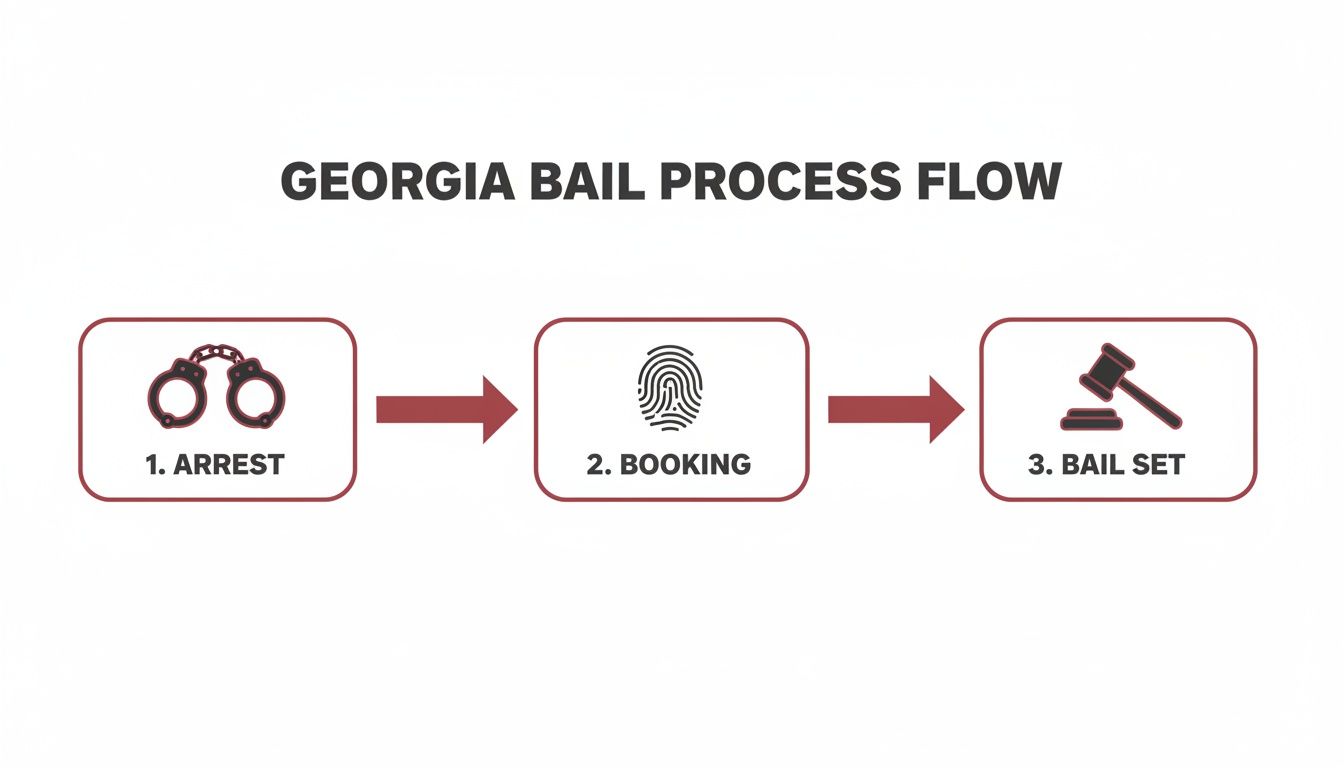
Each step is a distinct part of the process, starting with the arrest, then the administrative work of booking, and ending with a judge setting the terms for release.
The Initial Arrest and Booking
The process begins when law enforcement takes someone into custody. From there, the individual is transported to a local jail, such as the Forsyth County Jail or Hall County Jail. This is where the booking process happens. It is a series of administrative tasks that officially log the person into the system.
During booking, officials will:
- Record personal information like name and date of birth.
- Take fingerprints and a mugshot.
- Log and store personal belongings.
- Run a background check for any other outstanding warrants.
This process is not immediate; it can take several hours, especially if the jail is busy. For more details on this stage, see our guide on what happens after an arrest in Forsyth County, Georgia.
The purpose of booking is to create an official record of the arrest. Once completed, the person is held in jail until they can appear before a judge.
First Appearance and Bail Hearing
Under Georgia law, anyone arrested must see a magistrate judge within 48 to 72 hours. This is known as the first appearance hearing. It is a brief but critical meeting.
At this hearing, the judge informs the person of the charges and reads them their constitutional rights, such as the right to an attorney. This is typically when the judge decides whether to grant bail and, if so, the amount.
This amount is not arbitrary. For minor offenses, bail may be a standard amount from a pre-set schedule. For more serious crimes, the judge weighs several factors to balance the defendant's rights with community safety. The decision made in this hearing sets the stage for securing a release from jail.
Understanding Your Bail Bond Options in Georgia

Once a judge sets a bail amount, the next step is determining how to pay it. In Georgia, there are a few different paths to secure someone's release from jail. Each has its own rules and financial requirements.
The right choice depends on your financial situation and the size of the bond. For most families in Forsyth and Hall County, one option is the most realistic and accessible during a stressful time.
Comparing Bail Bond Options in Georgia
This table provides a quick comparison of common bail bond types. It helps clarify the core distinctions between each option.
| Bond Type | Who You Pay | Cost | Collateral Requirement | Best For |
|---|---|---|---|---|
| Surety Bond | A licensed bail bond agent | A small, non-refundable percentage of the total bail amount | Often not required for smaller bonds; varies by situation | Most families who need a fast, affordable release |
| Cash Bond | The court or jail directly | The full bail amount, paid upfront | The full cash amount serves as collateral | Those who have the full bail amount readily available in cash |
| Property Bond | The court (via a lien) | The full bail amount, secured by real estate equity | Property equity must be at least double the bail amount | Individuals with significant, lien-free property who are not in a hurry |
| Own Recognizance | No one | Free (a written promise to appear) | None | Low-risk individuals charged with minor, non-violent offenses |
As shown, each option serves a different purpose. For most people, a surety bond is the most practical way to proceed.
Surety Bonds: The Most Common Path
A surety bond is the most common way people are released from jail. It involves a licensed bail bond agent acting as a financial guarantor—or "surety"—for the court. The agent provides an assurance to the court that the defendant will appear at all required hearings.
Here’s how it works:
- You pay a small, non-refundable percentage of the total bail amount to the bail bond company. This fee covers their service and the financial risk they take.
- The bail bond agent then posts the entire bond amount with the court.
- This allows for a quick release without requiring you to use all your savings or sell assets.
This is the standard method for families in Cumming, Alpharetta, and Johns Creek who need to get a loved one home fast. The process can usually be started with a single phone call, 24/7. To learn more, see our guide on what a bail bond is and how it works.
Cash Bonds: Paying The Full Amount
A cash bond requires you to pay the entire bail amount directly to the jail or court in cash. If bail is set at $10,000, you must provide $10,000.
This money is held by the court as a guarantee. If the defendant makes every court appearance, the full amount is returned when the case concludes, minus any court fees. If even one court date is missed, the court keeps the entire amount.
The primary challenge with a cash bond is having that much money available immediately. Tying up thousands of dollars for months or years is not feasible for most people.
Other Types of Bonds
While surety and cash bonds are the most common, Georgia courts may allow other options in specific circumstances.
Property Bonds
In some cases, real estate can be used as collateral. The property must have clear equity worth at least double the bail amount. This is a slow process that involves appraisals, title searches, and placing a legal lien on your property. It is not designed for speed.
Own Recognizance (OR) Bonds
A judge may release a defendant on their "own recognizance." This means no money is required. The person signs a document promising to appear in court. OR bonds are generally reserved for individuals with clean records, strong local ties, and who face low-level, non-violent charges. The decision is entirely up to the judge.
How Judges Determine Bail Amounts in Georgia

When someone is arrested in Forsyth or Hall County, the bail amount set by a judge is a critical number. It is not a fine. It is collateral—a financial promise to the court that the individual will attend all hearings. Understanding how bail works in Georgia starts with how judges determine that specific dollar amount.
Judges in Georgia do not choose these numbers randomly. They weigh a specific set of factors to balance a person's right to be free before trial with the need for public safety. It is a calculated decision based on the individual and the details of their case.
Primary Factors Influencing the Bail Decision
A judge's primary goal is to answer two questions: Is this person a flight risk? Do they pose a danger to the community? To find the answers, they look at several key factors during a bond hearing.
- Severity of the Alleged Crime: This is the starting point. A serious felony will almost always have a much higher bail than a misdemeanor.
- Criminal History: The judge will review the defendant's record. A history of prior convictions, especially for failing to appear in court, indicates higher risk and can lead to a higher bond.
- Ties to the Community: This is a major factor. A steady job, homeownership, or family in Cumming or Alpharetta suggest someone is less likely to flee. Strong local connections can support a reasonable bail amount.
- Potential Danger to Others: If the charges involve violence or the judge believes the individual is a threat, they may set a very high bail or deny it completely to ensure public safety.
All these factors are considered together to arrive at a final number.
Standard Bail Schedules and Judicial Discretion
For many common or less serious offenses, courts in areas like Forsyth and Hall County use a bond schedule. This is a pre-set list of bail amounts for specific charges. It helps speed up the process for minor issues, allowing for a faster release without an immediate hearing.
However, the judge has the final say. Even with a bond schedule, a judge can raise or lower the amount based on information presented during a first appearance or bail hearing. That judicial discretion is a fundamental part of how bail works in Georgia.
A bail schedule provides a baseline, but the judge's assessment of an individual's risk factors truly shapes the final bail amount. It is a judgment call based on the facts presented.
Recent Changes to Georgia Bail Laws
The rules around bail in Georgia are changing. A new law, Senate Bill 63, is expanding the number of offenses that require a cash bail. By the time it fully takes effect in July 2025, it will add 30 new offenses to that list, including 18 misdemeanors that will now require a cash or surety bond for release.
This law means more people will need professional bail bond services for charges that previously might have allowed for a signature bond. You can learn more about the impact of these 2025 criminal justice reforms in Georgia.
For families across North Metro Atlanta, from Johns Creek to Gainesville, this change makes it even more important to understand your options. Working with a professional bail bond agent is often the quickest and most realistic path to getting someone home.
The Role of a Professional Bail Bond Agent
When a judge sets a bail amount that is too high to pay out-of-pocket, it can feel like an obstacle. This is where a professional bail bond agent is your most important call. We guide you through a confusing system when you are under pressure.
Our primary job is to act as a surety for the court. We provide a financial guarantee for the entire bail amount, promising the court that the defendant will show up for all scheduled appearances. For this service, you pay us a much smaller, non-refundable fee, which makes getting out of jail financially possible.
This means you do not have to use your savings to pay a large cash bond. It is the most common and practical way families in Forsyth County, Cumming, and across North Metro Atlanta get their loved ones home. Our process is designed to be fast and clear, starting with one simple phone call.
How to Start the Bail Bond Process
Getting started is simple. We can handle most of the process over the phone, 24/7. We know the situation is urgent, so our process is built for efficiency. The goal is to get the information we need quickly so we can start working on the release immediately.
To begin, we will need a few basic details:
- Defendant’s Full Name and Date of Birth: This helps us find the right person in the jail system.
- The Jail's Location: It is critical to know if they are in Forsyth County, Hall County, or another nearby jail.
- The Bail Amount: If you have this number, it allows us to get the paperwork started faster.
Once we have this information, we will verify everything and walk you through the next steps. This includes explaining the co-signer's responsibilities and providing a clear, upfront cost. We provide direct answers without complicated jargon.
A professional bail bond agent in Forsyth County does more than post money. We are local experts who know the specific procedures inside the jails in Cumming, Gainesville, Alpharetta, and Johns Creek. That knowledge helps us file paperwork correctly and avoid delays.
Your Guide Through the System
The value of a licensed bondsman goes beyond the financial aspect. We are navigators in a system most people never expect to encounter. Our experience helps us manage the logistics of securing a release, which saves you time and stress.
We handle all direct coordination with the jail's staff, making sure every document is filed correctly. These professional relationships and our understanding of local rules are key to a smooth process. You can learn more about our duties in our guide on what a bail bondsman is.
Our job is to provide a fast, discreet, and reassuring service. We manage the paperwork so you can focus on supporting your family member or friend. With one call, you get a clear plan and an experienced professional working to get them home.
Your Responsibilities After Posting Bail

Release from jail is the first step. Once out on bond, a new set of rules applies to both the defendant and the person who co-signed for them. A bail bond is a serious agreement. Fulfilling your side is crucial for staying out of jail and avoiding financial penalties.
The most important rule is that the defendant must attend every single court date. This is the fundamental promise made to the court. Missing a court date can trigger a warrant for re-arrest and put the entire bond amount at risk.
The court and the bondsman will have other conditions in place to ensure the defendant follows the rules while the case is ongoing.
Key Obligations for the Defendant and Co-Signer
Both the person who was arrested and the co-signer must ensure all conditions are met. Good communication is essential.
- Attend All Court Appearances: This is the non-negotiable core of the agreement. The co-signer can help by keeping track of dates and sending reminders.
- Maintain Regular Contact: The defendant must check in with the bail bond agent regularly. We need to have a current address and phone number.
- Avoid New Arrests: Getting into more trouble while out on bail can lead to the bond being revoked and a return to jail.
- Follow All Court-Ordered Conditions: A judge might add other rules, like staying away from certain people or not traveling out of state. These must be followed exactly.
A bail bond is a three-way agreement between the court, the defendant (and co-signer), and the bail bond agent. Fulfilling your part of this agreement is vital to navigating the legal process while remaining out of custody.
What Happens if a Court Date is Missed
The moment a court date is missed, a chain reaction begins. The judge will almost always issue a bench warrant for the defendant's arrest and declare the bond forfeited. "Forfeited" means the full bail amount is now due to the court.
At this point, the bail bond agency is legally required to pay the court the full amount. We then must recover that money from the co-signer, as laid out in the contract they signed. This could mean seizing any collateral that was provided.
If a court date was missed for a legitimate reason, such as a medical emergency, the most important thing to do is call your bail agent and your attorney immediately. Being proactive is the only chance to explain the situation to the court and ask to have the bond reinstated. This is why working with a local bondsman in Forsyth or Hall County is so critical—we know the system and can provide clear instructions.
Your Questions About the Georgia Bail Process, Answered
When you get that call, you have urgent questions. It is a stressful, confusing time, and you need direct answers. Here are the questions we hear most often from families in Forsyth County, Cumming, and Hall County to give you the straightforward information you need.
How Do I Start the Bail Process Right Now?
The quickest way is to call us. We are here 24 hours a day, 7 days a week. You can start the entire process over the phone.
To help us move as fast as possible, try to have this information ready:
- The person's full legal name and their date of birth.
- Which jail they are in (e.g., Forsyth County Jail or Hall County Jail).
- The charges, if you know them.
- The bail amount, if it has been set.
If you are missing some of these details, call anyway. Our team can find the information we need and walk you through everything, step by step. We help families all over North Metro Atlanta, including in Alpharetta and Johns Creek, and can get started immediately.
How Long Does It Take to Get Someone Out of Jail?
This is a two-part answer. The first part is us handling the paperwork, and the second is the jail's internal release process.
Our job is to prepare and submit the bond paperwork to the jail as quickly as possible. Once we have the needed information and the co-signer agreement is complete, we can get the documents to the jail very quickly. Our local knowledge of procedures at the Forsyth County and Hall County jails helps us avoid common delays.
The actual release is up to the jail staff. After they receive our bond paperwork, they follow their own procedures. This can take anywhere from a few hours to several, depending on how busy they are or their staffing levels. We cannot control their timeline, but we ensure our part is done right and fast to begin the process immediately.
What Is a Co-Signer and Who Can Be One?
A co-signer, also called an indemnitor, is a key person in the surety bond process. This is a responsible adult who signs the bail bond agreement, taking on financial responsibility for the defendant.
By co-signing, you are not paying the bond fee. You are making a financial guarantee to us that the defendant will show up for every single court date.
If the defendant misses court, the co-signer becomes responsible for paying the full bail amount to us. It is a serious commitment.
A co-signer is usually someone with stable ties to the community, such as:
- A family member
- A close friend
- An employer
The main requirements are being over 18, having a steady job or income, and being a legal resident. The co-signer provides the accountability that keeps the process moving forward.
What Information Will I Need to Provide?
To post a bail bond in Cumming, Gainesville, or anywhere nearby, we need to gather some basic information for the legal documents. The process is simple, and we can handle most of it over the phone and through email.
Here’s what is typically needed:
- For the Co-Signer: A valid photo ID (like a driver's license) and proof of employment or income (like a recent pay stub).
- For the Defendant: We will need their full legal name, date of birth, and the jail where they are being held.
We will walk you through exactly what is needed. Our goal is to make the paperwork simple so we can focus on securing the release. Your privacy is a top priority.
What Happens If the Defendant Misses a Court Date?
Missing a court date has immediate consequences. The moment the defendant fails to appear, the judge issues a bench warrant for their arrest and declares the bail bond forfeited.
A forfeiture means the court demands the full bond amount be paid. That responsibility falls on us, the bail bond agency. We must then recover that full amount from the co-signer, based on the signed agreement. Any collateral provided would be used at this point.
If a court date is missed, communication is critical. If it was for a legitimate reason, like a medical emergency, you or the defendant must call us and the attorney immediately. Acting fast may give us a chance to resolve the situation with the court and get the bond reinstated. Waiting only makes things worse and increases the financial risk for the co-signer.
When you need fast, clear answers, call One Call Bail Bonds. We are available 24/7 to help families in Forsyth County, Hall County, and across North Metro Atlanta. We can start the process over the phone and get your loved one released as soon as possible. Visit us at https://onecallforsyth.com or call now for immediate assistance.