
When you need help with the bail process, understanding how a bondsman makes money can provide clarity. The business model is direct and designed for speed: a bail bond agent earns a fee, called a premium, for posting the full bail amount on your behalf.
For those needing bail bonds in Forsyth County, GA, this service is crucial. It allows an accused person to be released from jail quickly, without their family needing to pay the entire bail amount set by the court.
The Core of the Business: The Bail Bond Premium
The primary way a bail bondsman makes money is through a non-refundable fee known as the premium. When a judge sets bail, the defendant's family pays a bail bond company a set percentage of that total. This payment is the bondsman's fee for service.

This premium is the gross income for posting the bond and accepting the full financial risk of ensuring the defendant appears for all court dates. For families in Forsyth County or Hall County, this means you can get someone released without having to provide the entire bail amount in cash, which can often be thousands of dollars.
Understanding the Premium Fee Structure
Let's use a clear example. If a judge in Cumming, GA, sets bail at $20,000, you would pay a bondsman a fraction of that amount. In Georgia, this fee is typically between 10% and 15%.
This fee is non-refundable. Once we post the bond with the court, our service is complete. We have secured the release and assumed the financial risk. Even if charges are dropped or the accused is found not guilty, the premium is not returned because our service has been rendered.
Think of a bail bond premium as a service fee, not a deposit. You are paying a licensed professional to guarantee the full bail amount to the court so a person can return home while their case is pending.
The table below shows how the premium works for various bail amounts.
Bail Bond Fee Examples at a 12% Premium
This table shows a client’s non-refundable fee based on a standard 12% premium.
| Total Bail Amount Set by Court | Client's Non-Refundable Fee (12%) | Amount Guaranteed by Bondsman |
|---|---|---|
| $5,000 | $600 | $5,000 |
| $10,000 | $1,200 | $10,000 |
| $25,000 | $3,000 | $25,000 |
| $50,000 | $6,000 | $50,000 |
As shown, the fee is a predictable fraction of the total, making release more accessible for most families.
How Premiums Generate Revenue
This fee-based model is standard across the U.S. Whether a judge in Hall County or Johns Creek sets bail at $10,000, a local bondsman will charge between $1,000 and $1,500 to post a surety bond for the full amount. This system allows us to operate a crucial 24/7 service.
By charging a predictable fee, we cover operational costs, manage financial risks, and offer a service that helps families with clear, upfront pricing discussion. For more details on fee determination, see our guide on how much a bail bond costs.
Managing Financial Risk with Co-Signers and Collateral
While the premium is how a bondsman earns income, the business relies on the defendant appearing for their court dates. To protect their financial guarantee to the court, a bondsman uses two key tools: co-signers and collateral.
These tools do not generate extra profit. They exist to manage the risk that comes with guaranteeing large sums of money to a court. If the defendant fails to appear, the bondsman is responsible for the full bail amount.

The Role of a Co-Signer
A co-signer, or indemnitor, is a trusted friend or family member who signs a contract with the bail bond company. This agreement is a promise to ensure the defendant attends every court appearance. It also means the co-signer is financially responsible for the full bail amount if the defendant fails to appear.
This arrangement provides a strong reason for friends and family to stay involved. The co-signer becomes a partner in accountability. Before accepting this role, it is important to understand what are the responsibilities of a co-signer.
The co-signer's agreement acts as a personal guarantee. It shows the bail agent that a committed support system is in place, which is often the most important factor in ensuring a defendant meets their obligations.
Securing the Bond with Collateral
For very large bond amounts or high-risk situations, a bondsman may also require collateral. This is a valuable asset pledged to secure the bond.
Common forms of collateral include:
- Real Estate: A deed to a property with sufficient equity.
- Vehicle Titles: The title to a paid-off car or truck.
- Valuables: Items like jewelry or other assets with a verifiable value.
Collateral is not always required. For many smaller bonds in Forsyth County and Hall County, a qualified co-signer is sufficient. The need for collateral depends on the specifics of the case, such as the bond amount and the defendant's community ties.
If all court dates are met, the collateral is returned. It is only seized if the defendant fails to appear and the bond is forfeited. Collateral is a safety net, not a revenue stream.
Profitability and Business Costs
The 10-15% premium is a bondsman’s gross income, not pure profit. To operate successfully in a busy area like Forsyth County or Hall County, a bail bond agency must balance revenue with significant operational costs and financial risks.
Maintaining 24/7 availability for communities like Cumming and Gainesville involves overhead expenses.
The Everyday Costs of Business
- Office and Staff: This includes rent for a physical office, utilities, and salaries for licensed agents and support staff who are always available.
- Licensing and Insurance: Every bondsman must pay for state licenses, continuing education, and business insurance.
- Surety "Build-Up Fund" (BUF): We partner with a large insurance company (the surety) that backs our bonds. A portion of every premium goes into a reserve account with them, called a BUF, to cover potential losses from forfeited bonds.
- Marketing and Administration: Reaching people who need our help in Alpharetta and Johns Creek has costs, along with other administrative tasks.
Balancing Revenue Against Financial Risk
The greatest financial threat is a bond forfeiture. This occurs when a defendant misses a court date, which can eliminate the profit from many other successful bonds.
We manage this risk by being selective about cases, requiring strong co-signer agreements, and maintaining communication with our clients.
A stable bail bond business is built on steady volume, efficient operations, and a disciplined approach to managing financial obligations to the courts.
The system is designed to spread risk. While U.S. bail bond services generate billions in revenue annually, the average profit margin is around 10–15% of total bond amounts written after expenses. For a local company serving Forsyth and Hall Counties, the key to profitability is consistent, predictable business.
More detailed industry financial data is available from market research firms like IBISWorld.
What Happens When Someone Misses a Court Date
The bail bond business is based on the defendant's promise to appear in court. When they do not, a bondsman's financial risk becomes real.
If a person fails to appear (FTA) for a court date in Forsyth County or Hall County, a judge issues a bench warrant for their arrest and the court declares the bond forfeited. The bondsman is now liable for the entire bail amount.
However, payment is not due immediately.
The Forfeiture and Recovery Process
Georgia law provides a grace period after a bond is forfeited. This window allows us to locate the defendant and return them to custody, a process sometimes called "skip tracing." This is a vital part of the business that protects us from major financial losses.
If we successfully return the defendant to the jail in Cumming or Gainesville, we can file a motion with the court to have the forfeiture set aside. This cancels our obligation to pay the full bail amount.
This is the basic balance of the business—revenue coming in versus costs and potential losses going out.
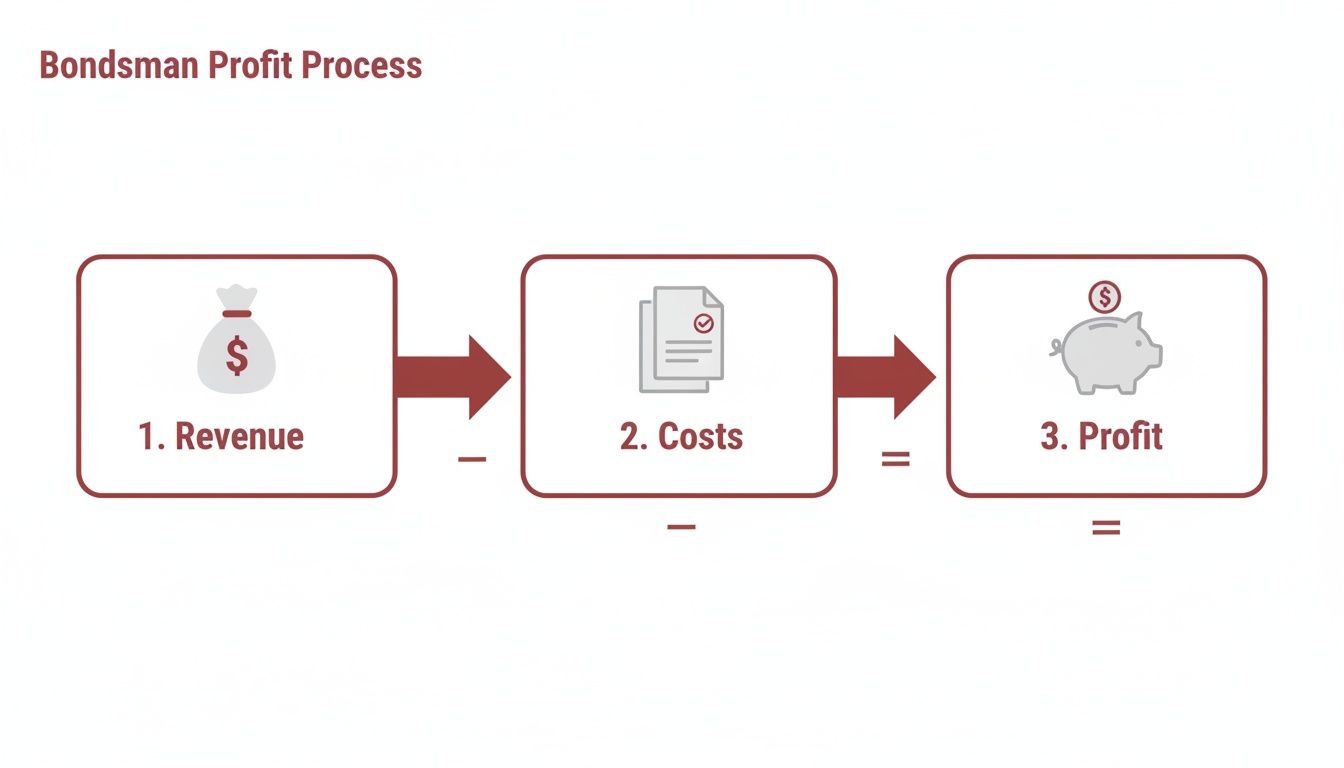
While the premium is our income, managing the risks and costs associated with a defendant failing to appear is key to staying in business.
Why Losses Are Lower Than You Might Think
The system has built-in protections that keep a bondsman's losses low. While failure-to-appear rates for defendants on surety bonds can be between 15–30%, the large insurance companies that underwrite these bonds report almost zero losses from forfeitures.
This is possible because state laws and court practices give bondsmen multiple opportunities to resolve the situation. We can negotiate for more time or have the bond reinstated once the defendant is back in custody. You can learn more about how a surety bond protects against financial loss on our blog.
Most FTAs are resolved without the bonding company paying the full bail, while we keep the original premium. A report from the Prison Policy Initiative provides more detail on this financial structure.
The system incentivizes us to do everything possible to ensure people make their court dates. It is a structured process for managing risk, which allows us to serve communities like Alpharetta and Johns Creek 24/7.
The Advantage of Local Knowledge in North Georgia
Understanding how a bondsman makes money is one part of the picture. Making the process work smoothly requires deep local knowledge. A local bail bond agent in Forsyth County understands the procedures of the Forsyth County and Hall County jail systems.

This is about more than knowing an address. It is about understanding the people, the required paperwork, and the typical release timelines for jails in Cumming, Gainesville, and Alpharetta. This knowledge results in a faster, less stressful process for our clients.
Why Local Expertise Matters
A bondsman who is physically present and respected in the community can get things done more efficiently. They know the clerks, understand the jail's procedures, and can often anticipate potential delays.
This familiarity helps in several key ways:
- Faster Processing: We know which forms are needed and how to file them correctly at local facilities, reducing errors and delays.
- Accurate Timelines: Our firsthand experience allows us to provide a realistic estimate of the release process timeline.
- Clear Communication: Our direct relationships help us get clear updates and solve minor issues quickly, keeping you informed.
When you need someone released from jail, every minute matters. Local knowledge is the key to a fast, discreet, and effective bail bond service.
This local focus means less waiting and more clarity on the next steps. For someone needing 24/7 bail bonds in North Georgia, choosing an agent who works in these communities daily is the practical choice. It provides a guide who knows the path forward and can offer a reassuring service.
Getting Started with the Bail Process
Now that you understand how a bail bondsman operates, the next steps are fast and straightforward. Our goal is to secure a release as quickly as possible by focusing on what you need to do right now.
From your first call, our job is to guide you through the system with clarity and professionalism.
Your First Step is a Simple Call
For immediate, 24/7 assistance with bail bonds in Forsyth County, Hall County, Cumming, Alpharetta, or Johns Creek, the process starts with one phone call. We will ask for basic information and then handle the rest.
Here is what to expect:
- Initial Contact: Call us anytime. We need the defendant’s full name and the jail where they are being held to start.
- Information Gathering: We will verify the charges and the exact bail amount. Then, we will clearly explain the non-refundable premium and any other requirements.
- Paperwork and Payment: Most paperwork can be completed electronically or over the phone for a fast and discreet process.
- Posting the Bond: Once everything is finalized, we post the bond directly with the jail to initiate the release process.
If you need a bail bond agent in Forsyth County or the North Metro Atlanta area, we can start everything over the phone.
Got Questions? We Have Answers.
People often have the same questions when they call, especially if this is their first time dealing with the bail process. Here are straightforward answers to common questions.
How Do I Start the Bail Process for Someone in Forsyth or Hall County?
Just call us. That is the first and most important step.
We are here 24/7. All we need to start is the person's full name and their location. With that, we can look up their situation and tell you the exact next steps over the phone.
What Information Will I Need to Provide?
To begin, we only need the defendant's name and location.
To complete the paperwork, the person co-signing the bond (the indemnitor) will need a few basic items:
- A valid, government-issued photo ID
- Proof of residence (like a recent utility bill)
- Proof of employment (like a recent pay stub)
We will walk you through the process to ensure it is as quick and discreet as possible. Our job is to make this easier for you.
How Long Does It Take to Get Someone Out After the Bond Is Posted?
Once we post the bond, the release timeline is determined by the jail. The release process can take anywhere from under an hour to several hours.
The timing depends on how busy the jail staff is. Because we work with the jails in Forsyth County and Hall County daily, we can usually provide a realistic time estimate.
What Does It Mean to Be a Co-signer?
As a co-signer (or "indemnitor"), you have two main responsibilities. First, you promise to help ensure the defendant appears for all court dates. Second, you financially guarantee the full bail amount if they do not.
Being a co-signer is critical. You provide the support and accountability that allows the defendant to navigate their case from home instead of from jail.
It is a serious commitment, but it is what makes the bail bond system work. This partnership between you, the defendant, and our agency leads to a successful outcome. We are always available to answer your questions about this role.
If you need immediate help with bail bonds in Forsyth County, Cumming, Hall County, or anywhere in the North Metro Atlanta area, One Call Bail Bonds is ready to help. We make the process fast and straightforward.