
When someone is arrested, the terminology can be confusing. The real bond and bail difference boils down to a simple question: who pays the court, and how much? Understanding this difference is the first step toward securing a fast release for someone in Forsyth County, GA.
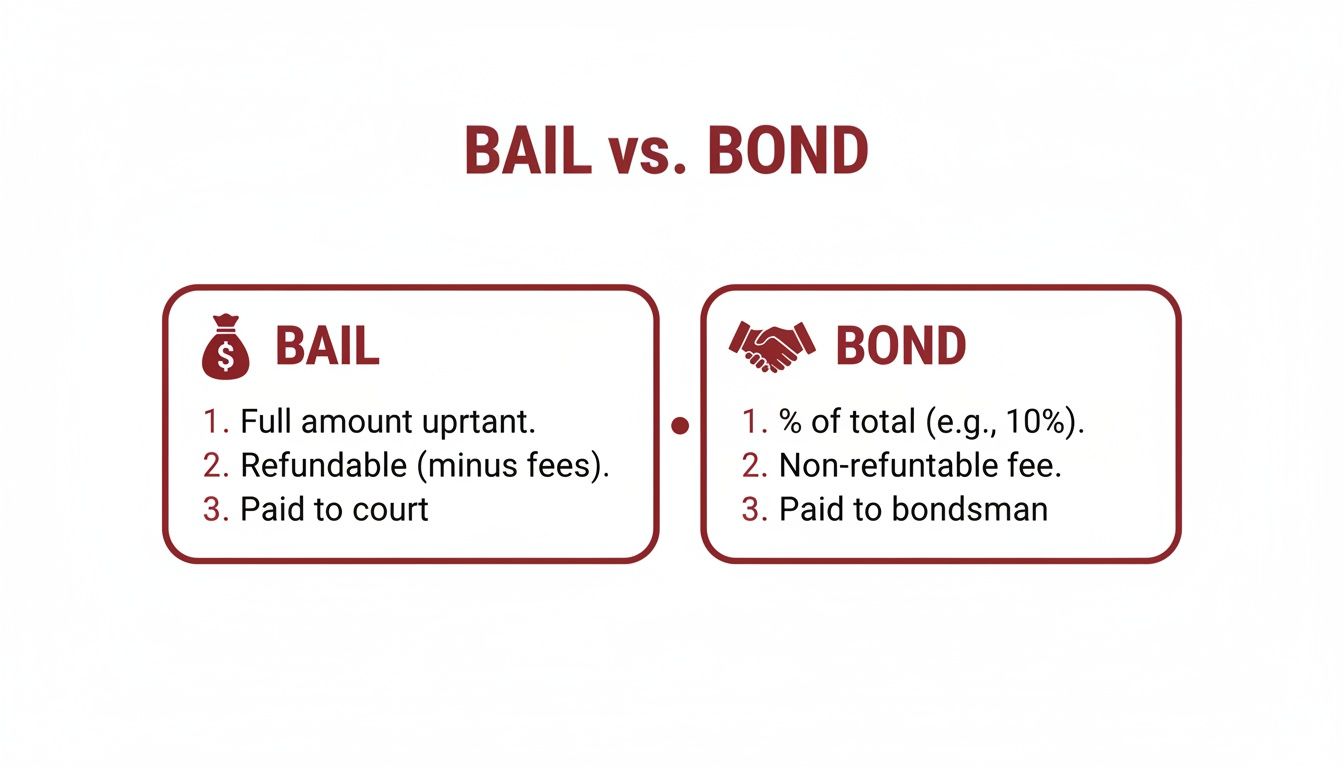
Bail is the full amount of money a court requires for release, paid directly to the court in cash. A bail bond is a service from a licensed agent. You pay the agent a smaller, non-refundable fee, and they guarantee the full bail amount to the court on your behalf. For most families, a bail bond is the fastest and most practical path forward. One Call Bail Bonds provides 24/7 bail bonds in Forsyth County to help you navigate this process with clear steps.
Understanding Bail Versus a Bail Bond
When a judge in Forsyth County sets bail, it acts as a financial guarantee that the person charged with a crime will appear for their court dates. Families have two main options to secure a release, and each one impacts your finances differently.
Cash Bail: Paying the Full Amount
Paying bail directly means providing the entire dollar amount set by the court. If bail is set at $10,000, you or your family must deliver $10,000 in cash or certified funds to the court or jail. Assuming all court appearances are made, this money is returned at the end of the case, minus any court fees or fines. The challenge is that most people do not have thousands of dollars immediately available.
Bail Bonds: The More Common Route
This is where a bail bond comes in, and it's the path most families in Forsyth County and Hall County take. Instead of paying the full $10,000, you hire a licensed bail bond agent. You pay them a non-refundable percentage of the total bail—this is their fee for the service. The agent then posts a surety bond with the court, which is their professional promise to pay the full bail amount if the defendant fails to appear. It makes getting out of jail financially possible for the vast majority of people.
Let’s break down the core differences at a glance.
Bail vs. Bond: A Direct Comparison
This table puts the two options side-by-side, making it easy to see which path makes the most sense for your situation.
| Aspect | Cash Bail | Bail Bond |
|---|---|---|
| Who Gets Paid | The court or jail, directly. | A licensed bail bond company. |
| What You Pay | The full bail amount in cash (e.g., $10,000). | A small percentage of the total bail (e.g., 10-15%). |
| Is It Refundable? | Yes, the principal is returned after the case ends. | No, the fee paid to the bondsman is non-refundable. |
| Financial Risk | You risk losing the entire bail amount if a court date is missed. | The bail bond company assumes the financial risk with the court. |
Ultimately, a bail bond transfers the financial burden from your family to the bonding company, requiring a much smaller out-of-pocket expense to secure a release.
There’s a reason bail bonds have become the standard way to get someone out of jail. Data shows a clear trend. In 1990, only 24% of felony defendants in large urban counties used a surety bond. By 2009, that figure had more than doubled to 49%.
Meanwhile, the number of people paying the full cash amount has always been low. For most working families in areas like Cumming and Gainesville, a bail bond is the only practical choice. You can find more of this data on pretrial release trends from the Prison Policy Initiative.
How The Cash Bail Process Works In Georgia
When a judge sets a bail amount, you have the option to pay the full price in cash directly to the court. This path, often called a cash bond or cash bail, does not involve a bail bondsman. However, it requires a significant amount of money upfront.
For families in Forsyth and Hall counties, this can be a serious financial hurdle. It is important to understand exactly how the process works before committing that kind of cash.

The first step is to get the exact bail figure from the court or the detention center, such as the Forsyth County jail. Once you have that number, a family member or friend must physically deliver the funds to the correct location—usually the clerk of court's office or the jail's bonding administration desk.
Where And How To Pay Cash Bail
In local systems like those in Forsyth and Hall County, you must go to specific locations. It is smart to call ahead to confirm their hours and what form of payment they will accept.
- Accepted Payment: Personal checks are almost never accepted. Most courts require certified funds, like a cashier’s check or a money order. Some may accept a credit card, but expect a processing fee on top of the bail amount.
- Proof of Payment: Once you pay, you will get an official receipt. This document is essential. You will need it to request your money back later.
The Refund Process
The biggest draw of paying cash bail is that the money is refundable. However, the refund is not quick, and it is not guaranteed.
The court only returns the bail amount after the case is completely resolved—meaning after sentencing, a plea, or a dismissal. This is contingent on the defendant appearing for every single court date.
Even then, the court will first deduct any fines, fees, or restitution owed from your bail money. What is left is what you get back, and the refund process itself can take weeks or even months after the case closes.
You can learn more about how bail works in Georgia in our guide. This long delay in getting funds back is a crucial part of the bond and bail difference and a major reason why most families in Cumming, Alpharetta, and Johns Creek find that a bail bond is a more manageable and realistic solution.
Navigating The Bail Bond Process In Forsyth and Hall County
When providing the full bail amount is not an option, a bail bond is the fastest way to get someone out of jail. This situation is stressful for families in Forsyth and Hall County. Our job is to make the process direct and clear so you can focus on your family.
It starts with a simple, confidential phone call. We are available 24/7 to act, whether you are in Cumming, Gainesville, or Alpharetta.
Your Step-By-Step Guide To Securing A Bond
We provide a clear, predictable path from your first call to the moment of release.
Initial Call and Information: Call us with the defendant's full name and their location. We will find the necessary details and confirm the bond amount.
Explaining The Agreement: We will walk you through the non-refundable fee, which is a percentage of the total bail. We will be direct about whether any collateral is needed for the specific case. You will understand every cost and obligation before you commit.
Handling the Paperwork: Most paperwork can be completed over the phone or online. This saves crucial time when dealing with the Forsyth County or Hall County detention centers.
Posting The Bond: As soon as the agreement is complete, one of our licensed agents goes directly to the jail to post the bond. Our experience with local facilities helps keep the process moving.
The Release Process: After we post the bond, the jail begins its release procedures. We cannot control their timeline, but by acting fast, we ensure there are no delays on our end.
We understand the urgency. Our entire process is built for speed and discretion, offering calm, professional guidance through a difficult time.
Local Expertise Matters
An agent who knows the court and jail systems in Forsyth County, Hall County, Johns Creek, and Alpharetta is a significant advantage. We know who to call and how to file paperwork correctly, which prevents setbacks. This local knowledge is a critical part of what we do.
Our commitment is to give you a clear path forward. To learn more about how our agents use financial guarantees, read about what a surety bond is and how it functions. Ultimately, the bond and bail difference often comes down to having an experienced partner to manage the process for you.
Comparing The Financial Impact Of Bail Vs A Bond
When it is time to get someone out of jail, the biggest question for most families is financial: should we pay the full bail ourselves, or use a bail bond service? It is a critical decision, and the path you choose will have both immediate and long-term effects on your finances.
Let's walk through a common scenario in Forsyth County. A judge sets bail at $10,000. You now have two very different financial options.

The Upfront Costs Analyzed
Paying the court directly with cash means you need the entire $10,000 now. That money is potentially refundable once the case is over, as long as every court date is attended. However, most people do not have that much cash available, and liquidating assets can cause immense financial strain.
A bail bond offers a more manageable alternative. Instead of paying the full amount, you pay a bail bond agent a non-refundable fee, which is a fraction of the total bail. This gets your loved one out of jail quickly without forcing you to drain your savings, which you will need for other expenses.
Cost Scenario For A $10,000 Bail Amount
This table breaks down the immediate financial reality of each choice.
| Financial Factor | Cash Bail Payment | Bail Bond Payment |
|---|---|---|
| Immediate Out-of-Pocket Cost | $10,000 | A smaller percentage (e.g., $1,000-$1,500) |
| Is this money returned? | Yes, minus court fees, after the case ends. | No, the premium is the fee for the service. |
| Impact on Your Savings | Ties up a large amount of cash for months or longer. | Preserves your savings for other expenses. |
The trade-off is direct. With cash bail, you tie up a large sum of money for the entire legal process. With a bail bond, you pay a smaller, non-refundable fee to keep your own money accessible.
The fundamental difference is this: Cash bail is a deposit you hope to get back, while a bail bond is a fee you pay for a service that protects your savings.
This financial reality has changed how pre-trial release works. While some bail amounts have remained stable, the average has increased, making full cash payments impossible for many families. Data shows that between 1990 and 2009, the use of commercial bonds as the primary method of release doubled from 24% to 49%. For someone in Hall County facing that $10,000 bail, paying a 10% premium to a bondsman is what makes release possible. You can read more on these trends in this issue brief.
Of course, knowing how the refund process works is also important. Our guide explains in detail if you can expect to get your bail money back from the court. Ultimately, the difference between a bond and bail comes down to what makes the most financial sense for you right now.
Understanding Your Responsibilities and Risks
Posting bail involves more than just money. Whether you pay cash bail or use a bail bond, you take on a serious responsibility. It is critical to understand the risks involved with each choice.
When you pay the full cash bail directly to the court in Forsyth County, you are 100% responsible. You become the sole guarantor, personally promising the court that the defendant will show up for every hearing. If they miss one court date, the judge can forfeit the entire amount. That is a significant financial risk.

The Role of a Co-Signer in a Bail Bond Agreement
Choosing a bail bond changes this dynamic. Instead of one person carrying all the risk, the responsibility is shared between the person signing the agreement (the co-signer or indemnitor) and the bail bond agent. The co-signer provides a financial guarantee to the bail bond company, not the court.
This setup creates a team effort focused on ensuring the defendant follows through. As a co-signer, your main duties are to:
- Provide a Financial Guarantee: You are financially responsible to the bail bond company for the full bond amount if the defendant skips court.
- Help Ensure Court Appearances: You agree to help make sure the defendant gets to all their required court dates. This is often as simple as staying in touch and providing reminders.
- Share Information: You need to inform the bail agent if the defendant’s contact information or address changes.
A bail bond creates a support system. It is not just about money; it is about having a professional partner who is also invested in making sure everything goes smoothly until the case is resolved.
Mitigating Risk with Professional Guidance
When you work with a bail bond agent in Cumming or Gainesville, you are not navigating this process alone. We become your partner, helping with court date reminders and clearly explaining the defendant's obligations. This professional oversight significantly lowers the risk for everyone involved.
For families in Alpharetta and Johns Creek, understanding this shared responsibility is key. A bail bond gives you an experienced professional to help you manage the legal requirements, which reduces the chance of a costly mistake like a missed court date. It provides a layer of support that paying cash bail cannot offer. We will walk you through every obligation so you feel confident and informed before signing anything.
So, How Do You Choose?
Deciding whether to pay full cash bail or use a bail bond comes down to two things: your immediate cash flow and your comfort with risk. The main bond and bail difference is simple—one demands a large sum of cash now, while the other requires a smaller, manageable fee.
For most families in Forsyth and Hall County, the choice becomes clear quickly. A bail bond is almost always the fastest and most practical way to get a loved one out of jail without draining your bank account.
When to Consider Each Option
Cash Bail: This option makes sense only if you have a significant amount of available cash. You also need to be certain the defendant will appear for every court date, because you will not see that money again for months or longer.
Bail Bond: This is the go-to solution for the vast majority of people. Using a bond keeps your savings available for other important expenses and shifts the financial risk from your family to our company.
Your top priority is getting someone out fast, with no surprises. For most families, a bail bond is the tool that gets it done without creating a financial emergency.
If you need help in Cumming, Alpharetta, Johns Creek, or anywhere else in the North Metro Atlanta area, we are here for you 24/7. We work quickly and discreetly, bringing calm and clear direction to a stressful time.
Call now to start the bail process and get clear next steps.
Your Questions Answered: Bail, Bonds, and Getting Help
When you are navigating the legal system, urgent questions arise. We have put together direct answers to the things we hear most often from families in Forsyth and Hall County.
How Can I Start The Bail Bond Process Right Now?
The quickest way is to call us. We are here 24/7, and we can start the process immediately over the phone. That first conversation is all it takes to begin the process of bringing someone home.
What Information Will I Need To Provide?
To get started, we typically only need the defendant's full name, their date of birth, and which jail they are in, such as the Forsyth County jail. From there, we will calmly walk you through any other required information.
How Long Does It Take To Get Someone Out Of Jail?
Once the paperwork is done and we post the bond with the court, the release time is in the hands of the jail's staff. Our job is to move as quickly as possible on our end—often within a couple of hours—so there are no delays from our side of the process.
The core difference between bond and bail often comes down to speed and access. A bail bond makes immediate release financially possible for most families, bypassing the need to liquidate assets to pay the full cash bail amount.
What Does A Co-Signer Actually Do?
A co-signer, or indemnitor, provides a financial guarantee for the bail bond. By co-signing, you take on the responsibility of ensuring the defendant appears for all their court dates. We make sure every obligation is explained clearly before you sign anything.
Can We Handle This Over The Phone?
Yes. To save you time and stress, we can handle most of the necessary steps over the phone or online. We aim to make everything as discreet and straightforward as possible for you.
Will I Need To Put Up Collateral For A Bail Bond?
Whether collateral is required depends on the details of the case, such as the bond amount and the specific charges. We will have a clear and direct conversation about pricing with you at the start, explaining every requirement. Many bonds do not require collateral.
If you need immediate help in Forsyth County, Cumming, or the surrounding North Georgia area, One Call Bail Bonds is ready to provide clear steps and fast assistance. We can start over the phone right now.
Call 770-888-8447 or find out more at our One Call Bail Bonds website.