
A bail bond in Greensboro usually requires a non-refundable 10% to 15% premium paid by the co-signer, and once that’s handled, release can happen in as little as 2 to 6 hours depending on jail processing. If you’re trying to get someone out tonight, the fastest move is to get the booking details together before you make the call.
That phone call usually comes at the worst time. Late at night, early morning, middle of work, doesn’t matter. Someone you care about is in jail, they’re scared, and now you’re expected to make smart decisions with almost no notice.
I’ve seen this enough to tell you the truth plainly. Panic slows everything down. Clean information speeds it up. If you’re looking for a bail bondsman greensboro nc families can use in a stressful moment, you need a straight answer on cost, timing, paperwork, and what happens after release.
A common starting point is asking the wrong question. They ask, “How fast can you get them out?” That matters, but the better question is, “What do you need from me right now to move this forward?” If you handle that part correctly, the rest gets easier.
Your Guide to Getting Someone Out of Jail in Greensboro
The call usually comes after dark. Your brother is in Greensboro. You live in Charlotte, Atlanta, or three states away. He is rattled, the jail staff will not explain much over the phone, and you are supposed to make fast decisions with limited facts.
Here is the straight answer. Getting someone out starts with order, not panic. You need the person’s full name, date of birth, where they are being held, the charge if known, and the bond amount once it has been set. If you are calling from outside Greensboro, that does not put you at a disadvantage as long as you can verify information, sign paperwork promptly, and pay the premium.
Best first move: Gather the facts before you start calling around. Bad details waste time. Clean details get the bond moving.
Greensboro cases go smoother when the family understands the chain of events and the local jail process. That matters even more for relatives handling everything from another city or state, because distance makes every delay feel worse. A clear step-by-step guide to getting someone out of jail helps you know what to collect, what questions to ask, and what your role will be as the co-signer.
You also need to know what this process does not do. A bondsman cannot speed up booking, set the bond, or change the court’s conditions. What a good local bondsman does is move fast once the case is eligible, catch missing information early, and keep an out-of-town family from getting stuck in confusion.
That is the playbook here. Get the facts. Confirm the jail. Find out whether bond has been set. Be ready to sign and pay. If you are handling this long-distance, work with someone who knows Guilford County and can keep the process tight without wasting your night.
First Steps After an Arrest in Greensboro
Your phone rings at 1:30 a.m. A son, daughter, spouse, or brother has been arrested in Greensboro, and you are two states away trying to fix it from a kitchen table. That situation is common. It is stressful, but it is manageable if you handle the first few hours the right way.
The first thing to understand is simple. Release does not happen the minute someone is taken into custody. Guilford County has to book the person, enter the charge, and get bond conditions set before a bondsman can post anything. Until then, you are waiting on the jail and the magistrate.

What happens before a bondsman can act
Booking comes first. That usually includes identification, fingerprints, photographs, and entering the arrest into the system. After that, bond has to be set. If the charge is more serious, or if there are holds, prior failures to appear, or questions about identity, the wait can stretch longer than families expect.
That delay scares people, especially relatives handling the case from Charlotte, Atlanta, New York, or anywhere else outside Guilford County. They assume nobody is helping. Usually, the issue is that the case is not ready for a bond yet.
A good bondsman cannot skip booking. He cannot set the bond himself. He cannot change the judge’s conditions. He can get ready early, verify the jail, spot missing information, and move fast the second the case becomes bondable. If you want the legal basics behind that process, read this North Carolina surety bond explanation.
What you should do right away
Use the waiting time well. Get the facts straight before you start making calls.
- Get the full legal name. Use the exact name used at booking.
- Get the date of birth. This helps avoid mix-ups with similar names.
- Confirm where the person is being held. Do not guess.
- Get the charge if you know it. The charge affects bond conditions.
- Ask whether bond has been set yet. If it has not, be ready to check back.
- Identify the co-signer now. This matters even more if the family is handling everything from out of town.
A calm caller with correct information gets help faster than a panicked caller working off guesses.
Where families lose time
The biggest delays usually come from avoidable mistakes. Somebody gives a nickname instead of a legal name. Nobody knows the date of birth. Three relatives call with three different versions of the story. An out-of-state family member wants to sign but is not ready to send ID, paperwork, or payment once the bond is set.
Get one person in charge. That person should collect the facts, talk to the bondsman, and stay reachable. If you are arranging bail from another city or state, speed comes from organization, not from calling five agencies with incomplete information.
Why some arrests take more work
Some bonds are straightforward. Others are not. Felony charges, domestic cases, probation issues, immigration holds, and warrant situations can all add questions before a bond is written. That does not mean the case is hopeless. It means you need accurate information and a Greensboro bondsman who knows how Guilford County operates.
Local knowledge matters most in these first hours. A bondsman who works Greensboro every day knows the usual slow points, knows what paperwork to chase first, and knows how to keep an out-of-town family from wasting half the night.
How the Bail Bond Process Works in Guilford County
It is 11:40 p.m. Your brother was arrested in Greensboro. You are sitting in Charlotte, Atlanta, or New Jersey, trying to get him out with half the facts and a dying phone battery. That is a normal call in this business. The process is not complicated, but it punishes confusion.
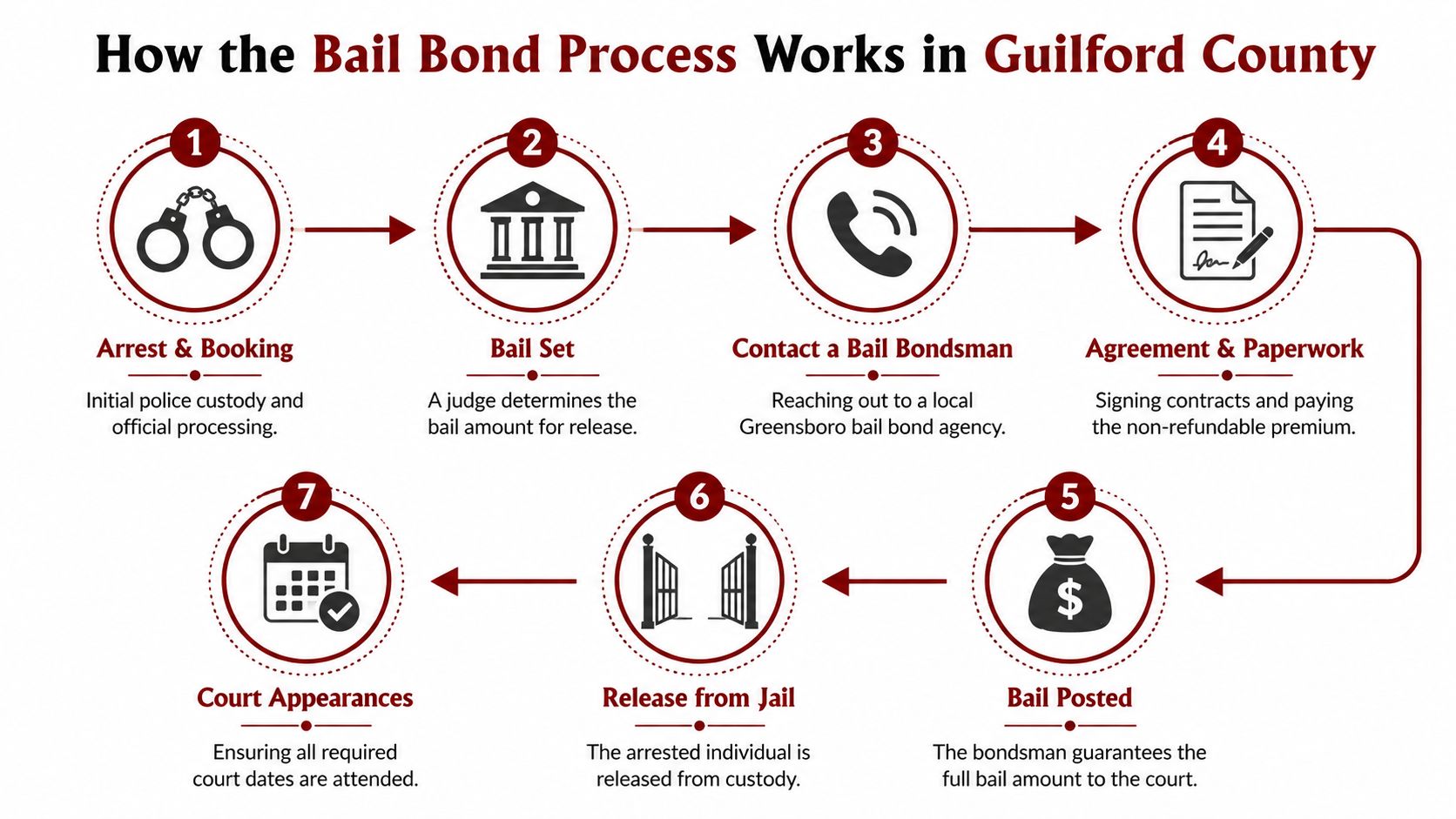
Once the magistrate sets bond, the job becomes simple. Get the right bondsman, get the right co-signer, complete the paperwork fast, pay the premium, and wait for the jail to process release. If you want the legal framework behind a surety bond, the North Carolina surety bond overview lays out the basics. In Guilford County, speed comes from accuracy and local follow-through.
What happens after bond is set
A bondsman starts by confirming the defendant, the charge, the bond amount, and the jail status. After that, the co-signer fills out an application and signs an indemnity agreement. The premium is collected. If the bond calls for collateral, that gets documented before anything is posted.
Then the bond is filed with the jail.
That last part is where out-of-town families get frustrated. They finish the paperwork and assume release happens right away. It does not. Guilford County still has to process the release on its own timeline, and that can take a while even when the bond was handled correctly.
The information that actually matters
A strong first call is short, calm, and specific. Families lose time when they start with arguments, rumors, or five different versions of the arrest.
Have this ready:
| Information Needed | Why It's Important |
|---|---|
| Defendant’s full name | Lets the bondsman identify the correct person in custody |
| Date of birth | Helps confirm identity and avoid mix-ups |
| Booking number | Speeds verification with the jail |
| Charges | Helps the bondsman evaluate risk and bond requirements |
| Jail location | Confirms where paperwork must be filed |
| Bail amount | Determines the premium and whether collateral may be needed |
| Co-signer name and contact info | The bond can’t move without a responsible signer |
| Basic employment and residence details | Used in the state-approved application |
| Reference contacts | Part of the risk review and application process |
If you are calling from another state, put one person in charge and keep that person available. A Greensboro bondsman can work with remote families every day. What slows the case down is missing ID, unsigned forms, unanswered calls, or payment delays after the bond is already approved.
Read the contract before you sign it
The premium gets all the attention. The contract deserves more.
The application gives the bondsman enough information to decide whether to write the bond. The indemnity agreement sets the co-signer’s responsibility if the defendant misses court, disappears, or breaks bond conditions. If you sign from out of town, that responsibility does not shrink because you live three states away.
Read every page. Ask direct questions. If a term is unclear, stop and get the answer before you send money or collateral.
If you do not understand whether you are paying a fee, pledging collateral, or guaranteeing the defendant’s performance in court, do not sign yet.
What the co-signer is really agreeing to
The co-signer is not a backup contact. The co-signer is the person standing behind the bond.
That usually means:
- Providing accurate information
- Paying the premium
- Offering collateral if the case requires it
- Keeping track of court dates
- Staying in contact if something changes
If the defendant skips court, the co-signer is the first person the bondsman calls. That is why the smartest choice is the responsible adult with stable contact information, steady income, and the backbone to hold the defendant accountable. Not the loudest relative in the group chat.
How long release takes after the bond is posted
Families often think posting bond and walking out happen back to back. Sometimes they do. Often they do not.
After the bond is filed, the jail still has to complete its release steps. Staffing levels, shift changes, inmate movement, and internal processing all affect timing. A good bondsman can move the paperwork quickly and avoid preventable mistakes. Nobody on the outside controls the jail’s release queue.
That is why local Guilford County experience matters. A bondsman who works Greensboro every day knows where delays usually happen, what paperwork must be correct the first time, and how to keep an out-of-town family informed without feeding them false promises.
Shop for that. Calm answers, clear instructions, and local knowledge get people home faster than sales talk ever will.
Understanding Bail Costs Collateral and Payment Plans
It is 11:30 at night. Your brother is in Guilford County Jail, and you are trying to arrange bail from Charlotte, Atlanta, or three states away. The number that matters first is not the full bond amount. It is what you must pay now, what property may be required, and what you are putting at risk if you sign.
People get burned here because nobody explains the terms in plain English.
The premium is the fee for the bond service. It is usually a percentage of the bond amount, and it is not refunded when the case ends. Collateral is different. Collateral backs the risk the bondsman takes. That can be cash, a vehicle title, real estate, or another asset with clear value.

Premium first collateral second
Keep these two buckets separate from the start.
If the bond is modest and the case is low risk, you may only need the premium and a qualified co-signer. If the bond is larger, the charge is more serious, or the defendant has a weak history of showing up, expect a collateral discussion. That is normal in this business. It is not a scare tactic.
Out-of-town families need to ask one direct question early: “What do you need from me today to post the bond, and what do you need from me to secure it?” That question saves time and cuts through vague sales talk.
When collateral becomes likely
Collateral usually comes into play when the risk is high, the bond amount is steep, or the co-signer’s finances are shaky. A bondsman has to look at the whole file. Charge level, court history, local ties, employment, and who is signing all matter.
Do not trust anyone who promises instant approval on every case.
A large felony bond gets more scrutiny. So does a case where the signer lives out of state and cannot easily appear in person if something goes wrong. If you are arranging bail from another city, have your ID, proof of address, income details, and any asset documents ready before you call. Speed comes from being organized.
What payment plans really mean
A payment plan can help you get the bond posted without coming up with the full premium at once. It can also create a second mess if you agree before you understand the terms.
Ask for the details in writing. Every time.
Before you sign, pin down these points:
- Amount due now: What has to be paid before the bond is posted
- Payment dates: The exact due dates and amounts
- Interest or fees: Whether the plan adds finance charges
- Missed payment terms: What triggers default
- Collateral terms: What property is tied to the agreement and when it is released
If you want a plain explanation of how financing is usually structured, review these bail bond payment plan options before you commit.
Cheap causes problems. Affordable means you can make the payments and protect the collateral.
What I recommend before you sign
Be blunt about your situation. If you live outside Greensboro, say that up front. If you need to handle everything remotely, say that too. A good local bondsman will tell you what can be done by phone, email, or electronic signature and what documents need to be sent over immediately.
If you do not own property, ask whether the case can be written on signature strength and supporting information alone. If the bond is high, expect tougher questions and answer them cleanly. That is how serious bonds get written fast.
Read the agreement. Check the payment terms. Ask what puts your collateral at risk. Then make sure the defendant understands one simple fact. Missing court does not just create a legal problem. It puts your money and property on the line.
Navigating DUIs Warrants and Out-of-State Arrests
Your phone rings at 11:40 p.m. Your son was arrested on a DUI in Greensboro. Or your husband got stopped on an old warrant while driving through Guilford County. Or your daughter is in jail here and you are sitting three states away trying to fix it from your kitchen table. That is not the time for vague advice. You need a local bondsman who knows the jail, knows the timing, and can tell you what happens next.
DUI bail needs a practical approach
DUI arrests often come with delays that families do not expect. The defendant may still be in booking, may be waiting for bond to be set, or may have release conditions that slow things down if nobody is prepared.
Start with the basics. Confirm where the person is being held. Confirm the charge. Confirm whether bond has been set yet. Then get the co-signer ready before the jail process catches up. That saves time.
Do not treat a DUI like a simple low-level arrest. Ask about hold times, conditions of release, and what paperwork will be needed the moment the bond can be written.
Warrant cases reward planning
If someone knows there is an active warrant, a planned surrender is usually the smartest move.
Getting arrested at work or on the side of the road turns a manageable problem into a family mess. A planned surrender gives you a better shot at having the right bondsman ready, the right co-signer lined up, and the right documents in hand when the court sets bond.
Keep it simple:
- Verify the warrant first: Make sure it is active and confirm which county is handling it.
- Choose the surrender timing carefully: Earlier in the day usually gives you more room to get through booking and bond setting.
- Line up the co-signer in advance: Do not wait until the person is already in custody.
- Bring identification and basic case details: Delays often come from missing information, not from the bond itself.
Planning does not erase the warrant. It gives you control over a bad day.
Out-of-state families need straight answers
Families calling from Charlotte, Atlanta, New York, or Florida run into a different set of problems. They do not know the jail routine here. They cannot drive across town to sign papers. They are trying to help with limited information while everyone in Greensboro is asleep or unavailable.
Distance changes the process. A good bondsman will say that up front.
Remote bonds usually require more identity checks, more back-and-forth on paperwork, and tighter payment verification. None of that means the bond cannot be done. It means you need to move in the right order and stop guessing.
Use this order:
- Get the exact booking information first: Full name, jail location, charges, and, if possible, booking number.
- Have your identification ready: A remote co-signer still has to be verified.
- Ask which forms can be signed electronically: Some documents are easy to handle remotely. Others may require extra steps.
- Confirm how payment will be made: Card, wire, or other approved method. Get clear instructions before sending anything.
- Expect extra time for verification: Remote help is common, but it is rarely instant.
One Call Bail Bonds serves Greensboro and helps both local callers and families handling cases from another city or state. What matters most is choosing a bondsman who explains remote paperwork clearly and moves fast without cutting corners.
Remote bonding works when the family stays organized, answers questions quickly, and treats verification as part of the job.
From Jail Release to Court Date Your Responsibilities
Your worst mistake is treating release like the hard part is over. It is not. The bond stays in play until the defendant appears in court and follows every condition the judge set.
That matters even more for families helping from another city or state. If you are in Charlotte, Atlanta, New York, or anywhere else, you still need to know the court dates, the rules, and what happens if the defendant stops answering the phone. Distance does not remove your responsibility as a co-signer.
What the defendant must do after release
The job is simple. Appear in court every time. Follow every bond condition exactly as written.
Those conditions may include no-contact orders, travel limits, sobriety requirements, or check-ins. Break any of them and the court can revoke release. A bondsman can also act under the bond agreement if the defendant becomes a risk or disappears.
Do not guess about the terms. Read the paperwork. If something is unclear, ask before a mistake turns into a surrender.
What the co-signer is responsible for
A co-signer is not just a ride home or a name on a form. A co-signer is taking on real financial risk and promising the defendant will stay on track.
Stay involved from day one. Keep a copy of the bond paperwork. Save the court date in your phone, write it on a calendar, and make sure the defendant has it too. If you live out of town, set reminders and check in early, not the night before court.
Silence is a warning sign. If the defendant changes phones, moves, misses a meeting with counsel, or starts talking about skipping court, deal with it right then.
How to keep the bond from falling apart
Use a basic system and stick to it.
- Track every court date: Keep it in at least two places.
- Keep contact information current: Report new numbers or addresses right away.
- Follow the bond conditions as written: Side deals and excuses do not help.
- Speak up early if there is a problem: A scheduling mistake, medical issue, or confusion about court should be addressed immediately.
- Out-of-town co-signers should check in often: Do not assume someone in Greensboro is handling it for you.
I have seen plenty of cases go bad for one reason. People relaxed too soon.
A bond ends when the court requirements are satisfied and the case reaches the point where the bond is discharged. Until then, treat every date and every condition seriously. That is how you keep the defendant out of jail and keep the co-signer from taking a preventable hit.
Greensboro Bail Bond FAQs
What happens if the defendant misses a court date
It gets serious fast. The court can move toward forfeiture, and the bondsman can take immediate steps under the agreement to locate or surrender the defendant. If there’s any excuse for the missed date, deal with it immediately instead of hoping it goes away.
Can a bail bond be revoked after release
Yes. If the defendant violates bond conditions, disappears, gives false information, or creates new risk, the bond can collapse. Release is conditional. It is not permanent freedom with no strings attached.
Can I post bond for someone in Greensboro if I live in another state
Yes, but expect extra verification and more paperwork coordination. Remote bonding is possible, and digital signing has become easier, but distance still adds friction. The smart move is to have all booking information ready before any documents are sent.
Do all bonds require collateral
No. Some lower-risk bonds may not require it. Larger bonds and higher-risk felony cases often do. If you need a straight answer, ask that question early instead of waiting until the contract is on the table.
If you need immediate help with a Greensboro case, One Call Bail Bonds gives you a direct way to start the process, understand what information to gather, and move toward release without wasting time. If you’re calling for a loved one from another city, another state, or right here in Guilford County, get the booking details together first, then make the call.