
When that late-night call comes in, your first job isn't to know the law. It's to stay calm long enough to gather the right facts and move fast.
In Forsyth County and Hall County, families often lose time because they're reading generic bail articles written for other states. That's a problem. Georgia practice is local, and what works in Cumming or Gainesville often comes down to having the right documents, the right co-signer, and a bondsman who knows how the jail handles bond paperwork after hours.
An Urgent Call How to Get Someone Out of Jail Fast
If your spouse, child, sibling, or friend has been arrested, the situation feels chaotic for about the first ten minutes. People start calling from the roadside, from the jail, or from another family member who only knows half the story. That's normal.
The fastest path is simple. Confirm where the person is being held, get their correct legal name, find out whether bond has been set, and contact a licensed local bondsman who handles Forsyth County or Hall County regularly. Don't spend an hour comparing national websites. Most of them are built around states with very different rules.
Georgia families get tripped up by that all the time. Most online bail bond information focuses on regulations in states like California, leaving North Georgia families confused. In Georgia, bondsmen must be licensed by the state, and local judges often expect co-signers with verifiable local residency and employment, which generic guides usually don't explain, as noted in this Georgia bail bond regulations overview.
What helps right away
A fast jail release usually depends on three things:
- Accurate jail information: If you name the wrong jail or misspell the defendant's name, the process slows down immediately.
- A reachable co-signer: The jail won't care that a family member is “on the way” if the paperwork still isn't signed.
- Clean, readable documents: A blurry ID photo or incomplete address can create avoidable back-and-forth.
Practical rule: The family that moves fastest is usually the family that stops guessing and starts verifying.
In Cumming, Gainesville, Dawsonville, Alpharetta, and Suwanee, the smartest move is to treat the first call like an intake. Write everything down. Don't rely on memory. Stress makes people swap names, charges, and dates of birth, and those mistakes cost time.
What doesn't work
Families usually lose time in the same ways:
| Common mistake | What it causes |
|---|---|
| Calling around before confirming the jail | Delay and conflicting answers |
| Sending incomplete arrest details | More calls, more waiting |
| Assuming “no collateral” applies automatically | Last-minute denial or reset |
| Choosing an out-of-area bondsman | Slower paperwork and release coordination |
If you need emergency bail bonds or a bail bondsman near you, speed starts with local accuracy, not panic.
The First Call What Information You Need to Start
Before anyone can post a bond, someone needs the facts. Not rough facts. Exact ones.

Your bail info checklist
Have this ready when you call:
- Defendant's full legal name: Use the name the jail will have on the booking record.
- Date of birth: This helps confirm you're dealing with the right person, especially with common names.
- Jail location: Forsyth County Detention Center and Hall County Jail are not interchangeable.
- Booking number if available: Helpful, but not always required.
- Charges: Even a simple description helps the bondsman assess what documents may be needed.
- Bond amount or bond status: Has bond been set yet, or is the person waiting to see a judge?
- Caller relationship to defendant: Parent, spouse, sibling, employer, or friend.
- Co-signer availability: If the likely indemnitor is asleep, out of town, or unreachable, say so up front.
The financial side is why this matters so much. The average bail amount set by courts is about $10,000, and in 2017, 40% of U.S. adults reported they couldn't cover a $400 emergency expense, according to this national bail and affordability summary. Most families can't just walk in and pay full cash bail on the spot, so accurate information becomes the difference between a quick start and a long night.
Documents that usually help in Forsyth and Hall
Local cases often move better when the co-signer can provide proof quickly. Common items include:
- Government-issued ID
- Proof of local address
- Employment verification or recent pay information
- Vehicle title or property documents if collateral is needed
- Basic arrest information from the jail
If you don't have every document at 2 AM, don't freeze. Start with what you do have, then fill in the gaps fast.
A good first call sounds organized, even if you're upset. “My brother was arrested in Forsyth County. His full name is this. His date of birth is this. I believe the charge is DUI. I'm the co-signer, and I have my ID and proof of address ready.” That gets things moving.
Understanding Your Financial Obligations for a Bail Bond
The first money question is always the same. “How much do we need tonight?”
What the premium is
A bail bond premium is the fee paid to the bondsman for posting the bond. In Georgia, families are usually dealing with a nonrefundable premium in the 10% to 15% range, depending on the bond and risk profile. It's nonrefundable because you're paying for the service, underwriting decision, and financial guarantee to the court, not making a deposit that sits untouched.
That structure didn't appear out of nowhere. Courts have leaned more heavily on financial release conditions over time. In the nation's largest counties, the share of felony pretrial releases involving a financial requirement rose from 37% in 1990 to 61% in 2009, a shift described in this pretrial finance report from Civil Rights Corps. That's one reason the 10% non-refundable premium is now so familiar to many families.
When collateral comes into play
Collateral is different from the premium. It isn't the fee. It's security.
A bondsman may ask for collateral when the bond is larger, the charge carries more risk, the defendant has weak local ties, or the co-signer's profile doesn't fully support the bond on its own. Typical examples include a vehicle title, real property paperwork, or another asset the company can hold against the risk of forfeiture.
Here's the plain version:
| Financial piece | What it does | Is it refundable |
|---|---|---|
| Premium | Pays for the bond service and guarantee | No |
| Collateral | Secures the risk of nonappearance | Usually returned if bond conditions are satisfied |
What families should ask before signing
Don't ask only, “What do I owe tonight?” Ask better questions.
- Is this premium fixed, and is it refundable or not?
- Is collateral required in this case, or only if risk factors change?
- What happens if the defendant misses court?
- What documents do you need from me tonight versus tomorrow?
If you're comparing payment choices, review the available bail bond payment options before you commit. The right setup is the one you can complete quickly without creating bigger problems for yourself later.
A cheap-sounding bond that falls apart on documentation is slower than a properly structured bond from the start.
About no-collateral bail bonds
Families search for “no collateral bail bonds” constantly, especially after an arrest in Cumming or Gainesville. Sometimes that's possible. Sometimes it isn't.
What usually helps is strong employment, stable residence, a dependable co-signer, and facts that show the defendant is likely to return to court. What doesn't help is assuming no-collateral approval is automatic because the charge seems minor. Bondsmen look at the full picture, not just the charge title.
The Co-Signers Role and Responsibilities
A co-signer isn't just the person answering the phone. A co-signer, also called an indemnitor, is the person promising the bond company that the defendant will follow through.
If you sign, you're telling the bondsman, “I know this person, I can help keep them on track, and I'm willing to take responsibility if they disappear.” That's why co-signer approval matters so much in bail bond requirements.
What makes a co-signer strong
In Forsyth and Hall County cases, bondsmen usually look for practical signs of stability:
- Local roots: A verifiable address in the area helps.
- Steady work: Employment shows consistency and capacity to stand behind the agreement.
- Reachability: If the company can't reliably reach you, that's a problem.
- Credibility with documents: ID, address proof, and supporting records need to line up.
Some families think the closest relative is automatically the best co-signer. Not always. A parent with weak documentation may be less helpful than a spouse or sibling with stable employment, clear residency records, and the ability to respond quickly.
What you're agreeing to
A co-signer may be responsible if the defendant fails to appear in court or breaks bond conditions badly enough to create a surrender or forfeiture issue. That is the fundamental trade-off. You're helping someone get out of jail now, but you're also taking on serious risk.
Honesty matters in this context. If the defendant has a history of missing court, unstable housing, or active substance problems, say that upfront. A bondsman would rather structure the bond correctly than unwind a bad decision later.
For a fuller breakdown, read these co-signer responsibilities on a bail bond.
Don't co-sign because you feel cornered. Co-sign when you understand the person, the risk, and what the bond company expects from you after release.
What works after release
Good co-signers stay involved. They remind the defendant about court dates, make sure phones stay on, and speak up early if something starts going off track. The bond doesn't end when the jail door opens. That's when your responsibility starts to matter most.
Navigating the Forsyth and Hall County Jail Release Process
Local knowledge matters most after the bond is written. Families often think the hard part ends once payment is made and signatures are done. It doesn't. The jail still has to process the release.
The real sequence from call to release
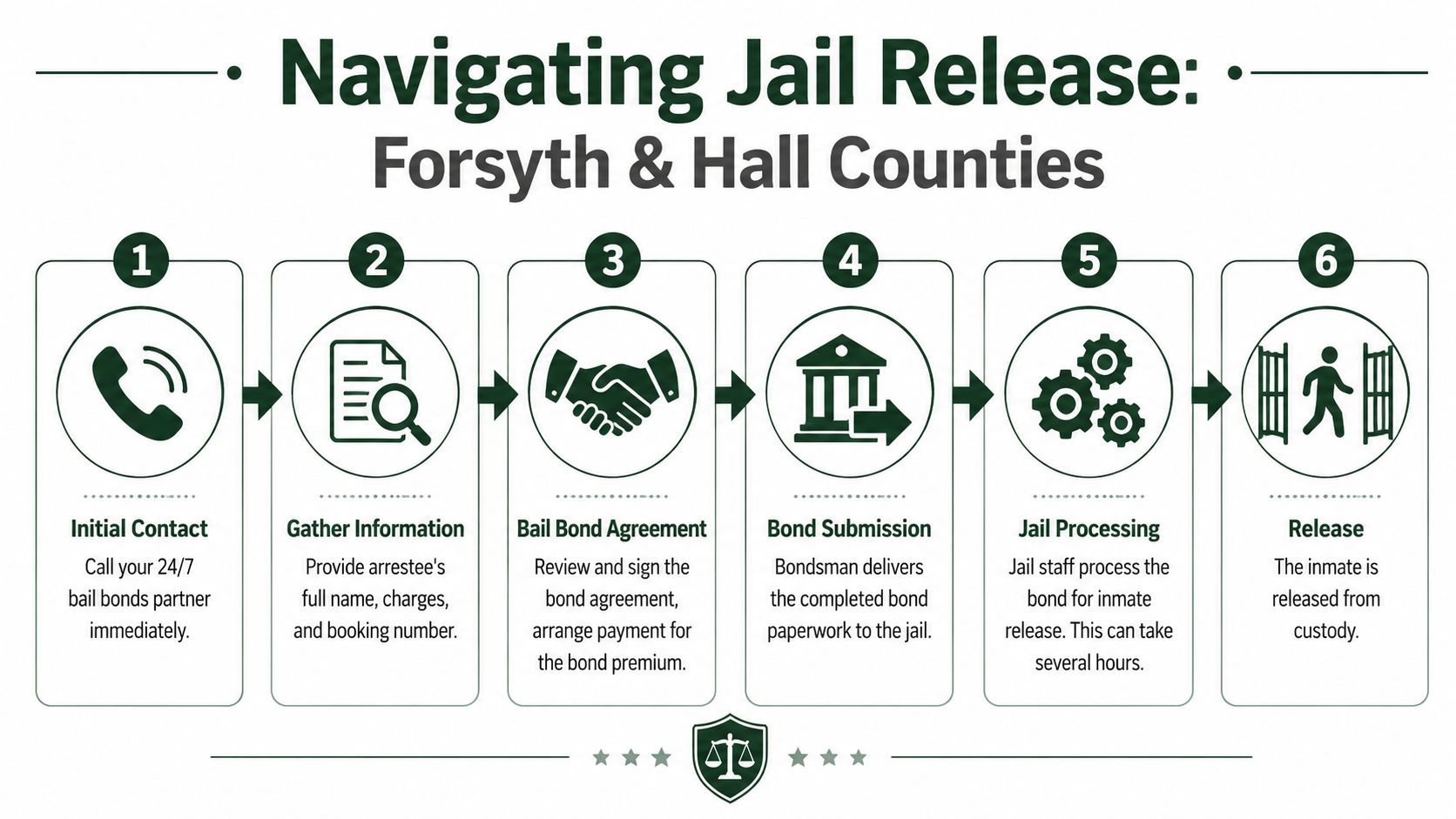
Here's how it usually plays out in Forsyth County and Hall County:
Initial contact
A family member calls with the defendant's name, jail, charge, and bond status.Screening and document review
The bondsman checks the bond details, asks about the co-signer, and determines whether collateral is needed.Agreement and signatures
The indemnitor signs the bond paperwork and provides supporting documents.Bond submission to the jail
The completed bond is taken or transmitted for processing, depending on local procedure and timing.Jail processing
Jail staff verify the bond, clear internal holds, and complete release paperwork.Defendant release
The person is discharged from custody once the jail completes its internal process.
What release timing actually looks like
In Forsyth County, the booking-to-release timeline can average between 4 to 12 hours after a bond is posted. That's why families sometimes feel like nothing is happening even after the paperwork is done. The bond may be accepted, but the inmate still has to move through jail processing.
A local bondsman can often cut delay because they understand the detention center's shift changes, paperwork habits, and when submission bottlenecks happen. Out-of-area services may still get the bond written, but they're more likely to lose time on avoidable issues.
Some of the longest waits happen after the family thinks everything is finished.
Forsyth County and Hall County differences that matter
Both counties follow the same broad path, but the feel on the ground can differ. In Forsyth County, timing around booking flow and staff handoff can affect how quickly an inmate release moves. In Hall County, the same bond can move smoothly or slowly depending on when the paperwork hits and whether any extra review is needed.
That's why “fast jail release” isn't just about speed at the front end. It's about reducing friction in the middle.
| Release stage | What slows it down | What helps |
|---|---|---|
| Intake confirmation | Wrong name, wrong jail | Exact booking details |
| Bond approval | Weak co-signer file | Complete documents |
| Jail submission | Late or incomplete paperwork | Clean signatures and local handling |
| Final release | Internal jail processing | Patience and accurate follow-up |
What families should do while waiting
Use the waiting time well.
- Keep your phone on: The bondsman may need one final signature or clarification.
- Don't flood the jail with calls: Repeated calls rarely speed release and sometimes create confusion.
- Prepare for pickup: Have clothes, medication instructions, or a ride plan ready if needed.
- Ask about Hall County specifics: If the person is in Gainesville, local release details can differ. Review this Hall County inmate release information if you need county-specific help.
If you're in Cumming, Gainesville, Alpharetta, Suwanee, or Dawsonville and searching “24 hour bail bonds near me,” this is what you're really paying for. Not just a signature on a bond, but a cleaner path through the local jail process.
Bail Bonds for Warrants DUIs and Other Common Charges
Not every arrest starts the same way, but many of the urgent calls in North Georgia fall into a few patterns. DUI arrests, probation-related arrests, and warrant situations are common. Each one changes the bond conversation a little.
DUI arrests
With a DUI, the family usually wants to know two things. When can they get out, and what do we need right now? The answer depends on when bond is available, whether there are any holds, and who can co-sign. These cases also tend to move better when the co-signer is organized and reachable.
Warrant situations
If someone learns they have an active warrant, the smartest move is often to handle it in a controlled way with a local bondsman and defense counsel if needed. A planned surrender is usually cleaner than waiting for an unexpected arrest during work, a traffic stop, or a weekend.
No-collateral requests in higher-risk cases
Families also ask whether a warrant case or DUI can be done with no collateral. Sometimes yes. Often no.
Recent Georgia trend reporting says only 12% of applicants qualified for certain no-collateral bonds under newer risk-scoring approaches that weigh employment stability and prior failures to appear, according to this no-collateral bail bond trend article. The practical takeaway is simple. If the case has risk factors, don't assume a signature-only arrangement is available.
For DUI bail, warrant assistance, or other criminal bail bonds, the winning move is preparation. Have the co-signer ready, have the documents ready, and be honest about the facts.
One Call Your 24 Hour Bail Bonds Partner in North Georgia
When someone's in jail, the family doesn't need a lecture. They need a calm answer, a clear list, and someone who'll pick up the phone right now.
That's what matters in Forsyth County and Hall County. Local experience helps with bail bond requirements, but availability matters just as much. Arrests happen after midnight, on weekends, on holidays, and right when most offices are closed. A real 24 hour bail bonds service has to be built for that reality.

What people need most in the moment
The best bail help in Cumming, Dawsonville, Alpharetta, Suwanee, and Gainesville usually comes down to a few basics:
- A fast answer at any hour
- Clear instructions on what information to gather
- Honest guidance about premium, collateral, and co-signer strength
- Familiarity with Forsyth County and Hall County jail release routines
- A discreet process that doesn't create more stress than the arrest already has
The right bondsman should make the night simpler, not louder.
Families searching for bail bonds near me, emergency bail bonds, how to post bail, or fast jail release aren't looking for theory. They're trying to solve a problem before morning. If that's where you are, keep it straightforward. Confirm the jail, gather the documents, line up the co-signer, and make one call to a local professional who handles these counties every day.
If you need immediate help in Forsyth County, Hall County, Cumming, Gainesville, Dawsonville, Alpharetta, or Suwanee, contact One Call Bail Bonds at 770-888-8447. They're available 24/7 to help with emergency bail bonds, DUI bail, warrant assistance, and fast inmate release, with direct local knowledge of the Forsyth County Detention Center and Hall County Jail.